What Are Artificial Reefs?
What Are Artificial Reefs? https://pharosproject.eu/wp-content/uploads/2026/07/Artificial-reefs-1024x576.jpg 1024 576 PHAROS Project https://pharosproject.eu/wp-content/uploads/2026/07/Artificial-reefs-1024x576.jpgArtificial reefs are human-made structures deliberately placed on the seafloor or submerged in open water specifically to enhance and support marine habitats. Through careful design and material selection, these structures mimic the characteristics of natural reefs, offering shelter, food sources, and breeding grounds for fish, crustaceans, molluscs, and plants that would otherwise have nowhere to establish themselves. Far from being a niche curiosity, artificial reefs have become one of the most widely deployed tools in marine habitat restoration, biodiversity enhancement, and fisheries management worldwide.
From Sunken Ships to Purpose-Built Habitat
Materials used to build artificial reefs range enormously in sophistication. Some are simple repurposed objects, decommissioned ships, sunken vehicles, or concrete rubble, placed underwater specifically to give marine life something solid to colonise. Others are purpose-engineered from the ground up, like the modular “Reef Ball” structures poured in perforated concrete domes specifically designed to maximise surface area and water flow for coral and sponge attachment. A few figures give a sense of how established and how effective this technique has become:
- Coral reefs, whether natural or artificial, support approximately 25% of all known marine species despite covering less than 1% of the ocean floor
- The Museo Atlántico in Lanzarote features over 300 life-size pH-neutral concrete sculptures installed at depths of 12 to 14 metres in 2016, transforming what was once a flat, featureless sandy seabed into what researchers describe as a vertical city for marine life
- The Atlantis Park artificial reef near Gran Canaria, created in 2017, contains more than 350 structures made from pH-neutral concrete and fibreglass
- A separate 1991-era artificial reef off Montaña Arena beach uses multiple concrete modules submerged roughly 23 metres deep to simulate natural habitat conditions
- Scientific meta-analysis confirms artificial reefs can be effective tools for enhancing fish communities, though researchers stress they are not a one-size-fits-all solution and their success depends heavily on design and local conditions
One Analogy: A Housing Development for Bare Land
Imagine a stretch of empty, barren land with no buildings, no roads, and nothing to attract anyone to settle there. Simply announcing that people are welcome to move in wouldn’t accomplish much, because there’s nothing to move into. Now imagine builders arriving and constructing a housing development on that same empty plot, complete with actual homes, water lines, and shared spaces. People start arriving almost immediately, not because the land itself changed, but because it finally offers structure to build a life around. An artificial reef does exactly this for a barren seafloor: it doesn’t create biodiversity out of nothing, but it provides the physical scaffolding that fish, corals, and invertebrates need before they can even begin moving in.
Beyond Habitat: Multiple Ecological Functions
Artificial reefs work through several overlapping mechanisms rather than a single simple trick. They provide physical shelter from predators and rough currents, offer hard surfaces for sessile species like sponges and corals to settle permanently, and create the layered complexity that supports demersal organisms such as crustaceans and molluscs, which in turn attract larger pelagic predators looking for prey. Reef structures can also stabilise sediments and reduce coastal erosion by breaking wave energy before it reaches shore, adding a coastal-protection function on top of their habitat role. Some reef systems even contribute to carbon sequestration, as the marine forest growth they support helps trap and store atmospheric CO2 while improving nutrient distribution through better water circulation.
PHAROS and the Next Generation of Reef Design
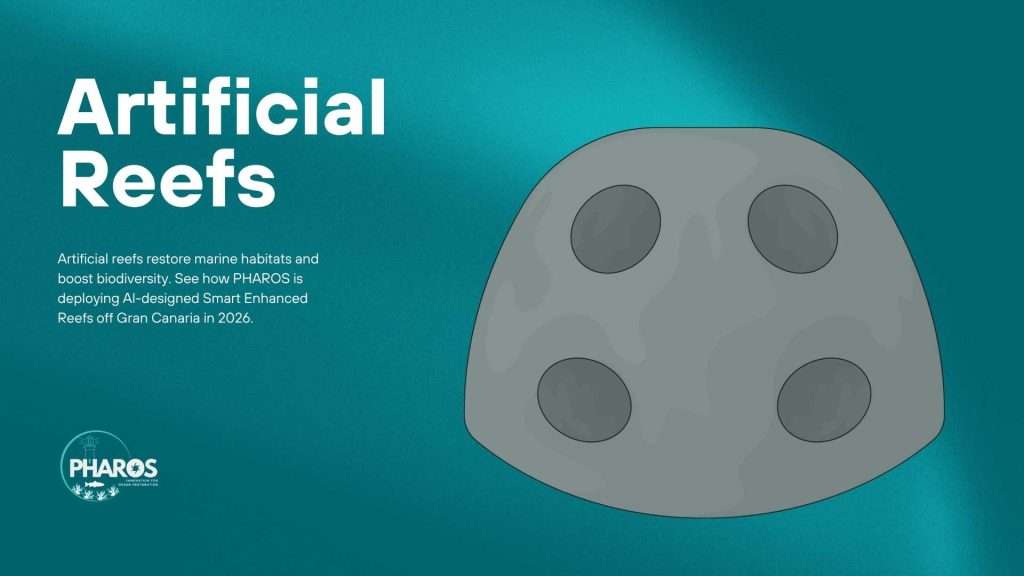
PHAROS is pushing artificial reef technology significantly beyond concrete blocks dropped onto the seafloor, deploying what it calls Smart Enhanced Reefs, or SER, designed by project partner Underwater Gardens International using AI-driven parametric design software. These structures are composed of calcium carbonate, biomaterials, and cement, and use algorithms specifically to optimise water flow and light distribution rather than relying on a generic, one-size-fits-all shape. At the Gran Canaria demo, Spanish permitting regulations actually forced an unexpected innovation: authorities recommended merging the original separate reef and IMTA permits into one, which pushed the reef deployment from a planned 15 metres down to roughly 49 metres depth and prompted the team to redesign the entire layout from scratch.
That redesign process produced three genuinely distinct reef types, each targeting a different ecological niche. Ten Type A reefs are built for benthic seafloor-dwelling species, twenty-four Type B “clamping” semi-submerged floating reefs are designed to attract pelagic fish, and sixteen Type C “cavity reefs” are integrated directly into mooring blocks to shelter small demersal and encrusting organisms. Fabrication is currently underway, with delivery to Gran Canaria expected by the end of 2026 ahead of full deployment alongside the IMTA system by March 2027. One reef set will deliberately sit upstream of the fish farm as a scientific control, while a second sits directly in the nutrient-rich outflow, letting researchers directly compare colonisation rates and measure exactly how much benefit the aquaculture’s nutrient discharge provides to reef recovery.
Proof From the Water Already
PHAROS didn’t need to wait for its own reefs to test whether this approach works, since Gran Canaria and nearby Lanzarote already host some of the clearest artificial reef success stories in the region. During a January 2026 Marine BioBlitz, citizen scientists compared natural recovery patterns against accelerated restoration happening at established artificial reef sites, logging their observations directly onto the MINKA platform to help quantify exactly how effective the approach has been. The PHAROS team’s visit to the Museo Atlántico during that same event was described as a direct validation of their core thesis, that a carefully designed artificial landscape can actively catalyse reef recovery rather than simply hoping marine life shows up on its own.