Hearth Aegean Summit Day 2: Scaling Island Resilience – Intentions and Engineering Radical Futures in Santorini
Hearth Aegean Summit Day 2: Scaling Island Resilience – Intentions and Engineering Radical Futures in Santorinihttps://pharosproject.eu/wp-content/uploads/2026/10/WhatsApp-Image-2026-10-25-at-08.41.01-771x1024.jpeg7711024PHAROS ProjectPHAROS Projecthttps://pharosproject.eu/wp-content/uploads/2026/10/WhatsApp-Image-2026-10-25-at-08.41.01-771x1024.jpeg
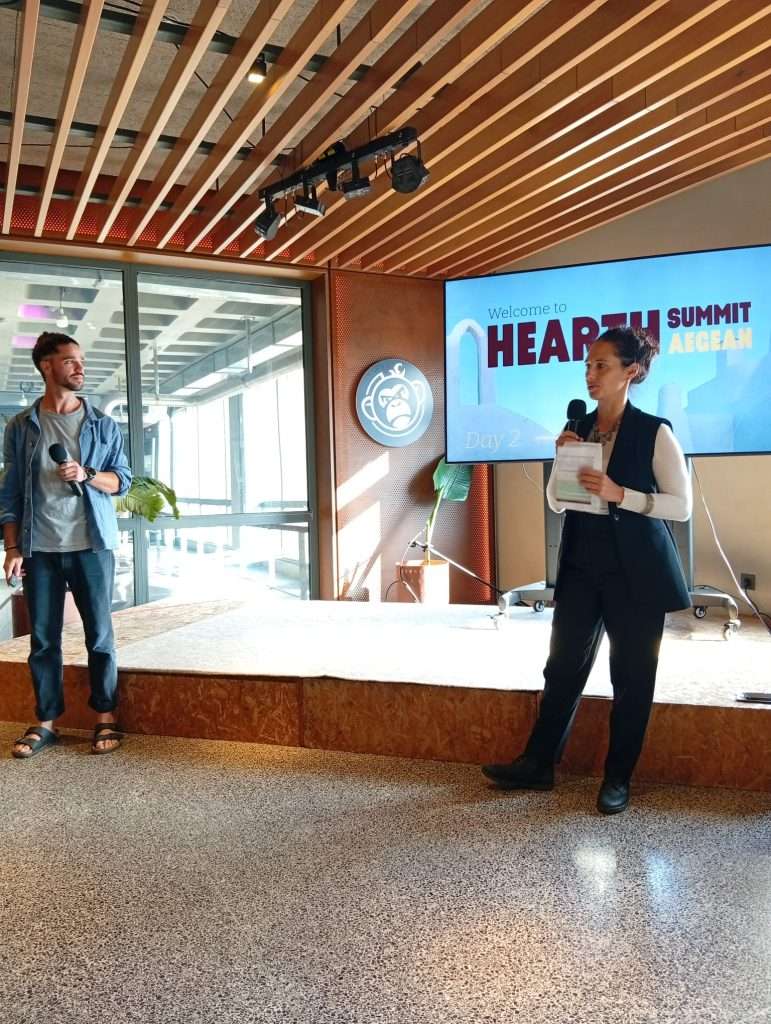
SANTORINI — Following an inspiring opening evening on the volcanic rim of Santorini, the Aegean Hearth Summit transitioned into its second day with a focus on practical implementation, ecological restoration, and community-driven design.
Gathering at the Ftelos Brewery, a bioclimatic facility built with rainwater harvesting systems and island resource management in mind, delegates, scientists, and local leaders joined forces to transform abstract sustainability concepts into grounded action.
Grounding and Introspection: The Metaphor of the Seed
The morning commenced with a physical and reflective grounding session facilitated by co-moderators Fabio Volkmann and Sheila Darmos of the European Alliance for Regenerative Agriculture. Participants engaged in silent journaling and peer-to-peer dialogues centred on a guiding question: What seed of inspiration has taken root since arriving on the island?
Opening the floor to public reflection, Ioannis Spilanis emphasised the critical distinction between viewing land as a financial asset versus a living community:
“What I got from yesterday is that we have to speak either for territories where people are going to live or spaces where investments are going to be done. There are two specific ways to see a place. So it is very important to see it as a territory for living, and not a space for investment.”
Further reflections highlighted the deeper cultural resonance of the summit’s core theme. Delegate Nafisa noted the historical significance of the hearth as a site of collective memory and future planning:
“In my native place, in winters we sit around a fire and talk so much about the day, about everyday life, but never realized that actually we do the sharing of our lives in that place. We are helpless with the future and the past, but I think we can learn from the past, keeping in mind that whatever we do in the present will definitely have an impact for the future.”
Architectural researcher John Litskas (Re-Made Athens and Ikaria) drew a connection between linguistic roots and spatial design:
“It is actually very nice the way everyone is saying ‘hearth’, because it brings out the ‘earth’ in the thing. If you bracket off the ‘h’ at the end, you have got ‘heart’. There were these ancient Greek temples to Hestia and Gaia, which were circular temples with a fire in the middle, connecting the home and the planet.”
Closing the introductory reflections, Dinty Siosi (Geosophy) highlighted the systemic nature of community responsibility:
“It is important to understand the system based on the connections and the relationships between activities, people, and nature. We have a very strong responsibility to our actions, and it is important to understand how we connect with other people in order to make this necessary change right now.”
Session 1: The Edible Island — Reclaiming Public Land for Urban Agriculture
Kicking off the Radical Futures pitches, Kalpana Arias, a London-based guerilla gardener, technologist, and lead campaigner for the Right to Grow campaign, presented a framework for transforming urban neighborhoods and island settlements into productive, edible landscapes.
Although based in London, Arias established an immediate parallel between urban centers and isolated islands, emphasizing that both environments represent bounded systems vulnerable to external ecological shocks. Opening her address with a foundational principle from theoretical physicist Ilya Prigogine, she noted:
“When a system is far from equilibrium, small islands of coherence in a sea of chaos have the capacity to shift the entire system to a higher order.”
Arias painted a stark picture of the overlapping polycrises facing modern communities, citing severe biodiversity destruction, ecological decline, and a widespread disconnect from nature. Pointing to the United Kingdom as one of the lowest-ranking nations in Europe for nature connectedness, she highlighted how urban areas are dangerously over-reliant on distant supply chains. To illustrate this fragility, she noted that a major metropolis like London currently imports 99 per cent of its food supply.
To counter this vulnerability, Arias introduced the Right to Grow initiative, an outgrowth of the Incredible Edible movement founded by Pam Warhurst in the UK. The campaign works to bridge grassroots action with formal policy reform, organising its work around three fundamental pillars:
Community: Galvanising neighbours to cultivate public land collaboratively, reclaiming unutilised spaces, and celebrating hyper-local food production. Drawing on a quote by Alexis Pauline Gumbs “The future is ancestral” Arias emphasised that seed saving and collective growing reconnect modern communities with ancestral wisdom.
Learning: Creating spaces for skill-sharing, environmental education, and practical agricultural training across generations.
Business & Economy: Developing localised, “sticky” economies that keep resources circulating within the neighbourhood, ensuring that local food growing supports community financial resilience.
From a legislative perspective, the Right to Grow seeks to overturn administrative hurdles by shifting local authorities from a rigid permission-based model to a rights-based framework. Under this proposed policy, local councils would be required to maintain accessible public registers of available land and provide uncomplicated, free leases to community groups.
Citing landmark research conducted by Lancaster University, Arias revealed that if all available public land in the UK were mobilised for community agriculture, it could produce 40 per cent of the nation’s fruit and vegetables.
To tackle the challenge of scaling these grassroots solutions across whole cities or islands, Arias pointed to technological integration. Through initiatives like Glitched, digital mapping and gamification are being deployed to make land use accessible, identify hidden growing spaces, and engage citizens directly in urban planning.
Closing her address, Arias quoted columnist David Brooks to reinforce the neighbourhood as the core unit of systemic ecological change:
“It could be the neighbourhood, and not the individual, that is the essential unit for social change. So if you are trying to improve lives, maybe we have to think about changing many elements of a single neighbourhood in a systematic way and at a steady pace.”
Session 2: Greening a Drought Landscape — Circular Engineering and Nature-Based Solutions
Following Arias, Dr Johannes Kisser, Technical Director at Alchemia-Nova and an expert in circular economy systems, delivered a detailed presentation on engineering nature-based solutions to combat drought, desertification, and water scarcity across dry island landscapes.
Dr Kisser shared that his passion for circular water infrastructure was first sparked on the nearby Cycladic island of Tinos:
“I got inspired on an island. Have you ever been to Tinos? There are these terrace structures that are abandoned for many years, decades, and they were brown. And they could be green! And I saw that thing there… the whole island could be green! So why not use water streams where they are? Why not use our wastewater? Why not use rainwater or dew? There are so many different types of non-conventional water sources that we can establish in these islands and make use of.”
Dr Kisser presented plants as the primary “engine” of ecological restoration, detailing how botanical systems can serve multifunctional roles: filtering heavy metals, stabilising degrading slopes, rebuilding degraded soils, and transforming polluted waste streams into vibrant, fragrant habitats.
At the core of his presentation was a closed-loop municipal and agricultural cycle designed specifically for island ecosystems:
Wastewater & Sludge Separation: Wastewater generated in settlements is directed into integrated settling and anaerobic biogas tanks. The organic sludge, toilet waste, and paper are converted into biomethane gas. Once purified, this bio-gas is compressed and used directly to fuel municipal vehicles, such as local waste collection trucks.
Constructed Wetlands & Fertigation: The liquid portion of the wastewater undergoes biological treatment through constructed wetlands, natural, planted filter beds. The resulting treated effluent (fertigation water) is rich in essential organic nutrients.
Agroforestry & Biomass Boost: The nutrient-rich water is piped into permaculture-inspired agroforestry systems, creating biodiversity hotspots and new agricultural yield streams. Dr. Kisser shared field trial results demonstrating that applying this treated wastewater yielded a threefold increase in biomass growth compared to standard agricultural irrigation. In one project spanning just over a hectare, more than 100 plant species were successfully established, creating vital habitats while generating local food and income.
Dr Kisser also detailed scalable non-conventional water technologies tailored for arid zones:
Micro-Scale Catchment & Condensation: Utilising passive dew condensation units, vapor harvest systems, and distributed rainwater catchment structures (such as those implemented in Mykonos) to store winter precipitation for summer agricultural use.
Bio-Inspired Desalination: Solar-driven desalination units that mimic natural evaporation processes to produce fresh water without heavy grid energy demands.
Architectural & Household Integration: Circular water mining built directly into residential buildings. By combining greywater filtration, green wall cooling systems, micro-biogas units, and Jean Pain-inspired compost heating systems (bio-milas), a standard three-person household can generate up to three hours of thermal cooking gas daily while recycling all household water.
Post-Disaster & Post-Conflict Restoration: Applying these plant-based stabilisation and regreening techniques to restore land following severe wildfires, as well as deploying nature-based recovery solutions in post-conflict zones such as Ukraine.
Concluding his presentation, Dr Kisser stressed that humanity already possesses the technological tools needed to reverse desertification, pointing instead to institutional inertia as the primary obstacle:
“The technical solutions are there. Maybe not all of us know them yet, but the biggest challenges I think are the social innovation part, and that is how we can make the social innovation possible.”
Session 3: Engineering Radical Futures: The Island That Forgot the Word Waste
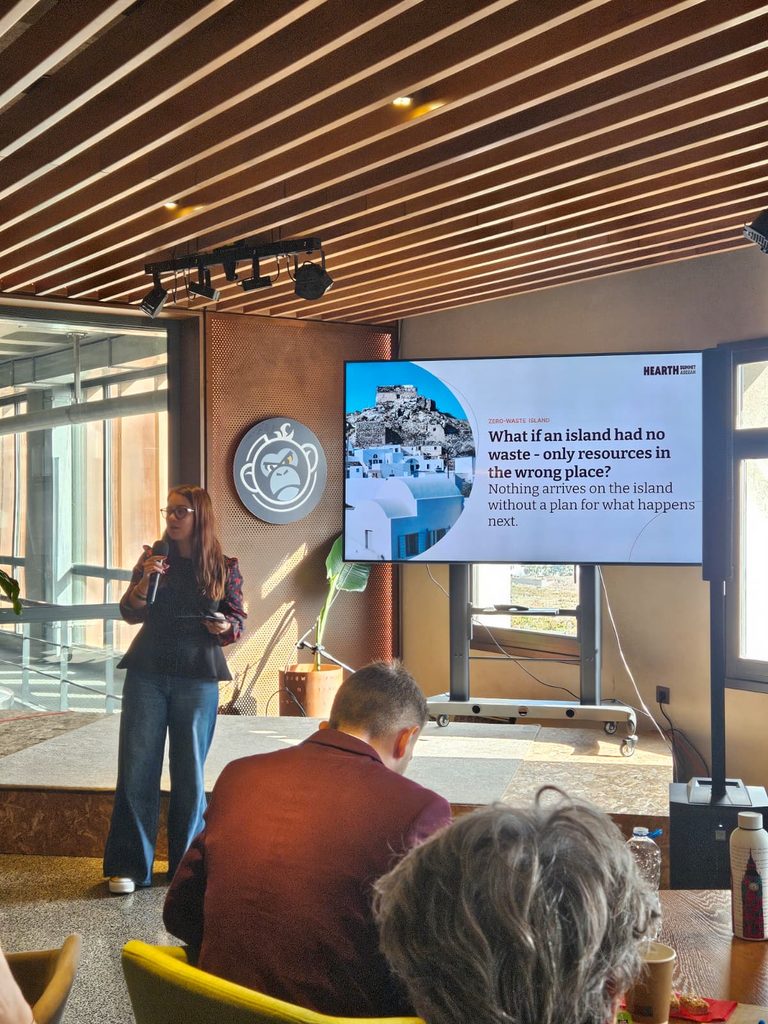
As part of the co-creation sessions exploring “Radical Futures”, among the five thematic tracks, session leader and sustainability and innovation advisor Dajana Jeglič introduced a vision of a zero-waste island, centred on the question: “What if an island had no waste, only resources in the wrong place?”
“When we talk about ‘zero waste’, we often think about recycling or waste management. But what if we looked at waste differently? What if something considered waste by one industry could become a valuable resource for another? A zero-waste island is not simply about managing waste more efficiently, but about preventing it, rethinking how resources are used, and finding new connections between sectors, technologies and people,” explained Jeglič.
Through an imaginative journey to Santorini in 2035, Jeglič illustrated how a zero-waste future could take shape in everyday island life. From tourism and hospitality to fisheries, water and energy systems, the presentation explored how existing and emerging innovations could be connected to create more circular and resource-efficient ways of living and doing business. Examples included packaging-free cosmetics, alternatives to single-use plastic bottles, and the reuse and valorisation of discarded materials.
Connecting Local Ecosystems and External Knowledge
Importantly, the vision was not about creating an isolated or entirely self-sufficient island. Instead, it highlighted the importance of connecting local industries, businesses and communities, while remaining open to external partnerships, knowledge exchange and innovative solutions from beyond the island. The goal was to identify opportunities for collaboration, where resources, expertise and technologies could be shared and used more effectively.
“Islands face unique geographical and financial challenges. Space is limited, resources are often imported, and every decision about what we consume and discard has consequences. But these constraints can also encourage us to rethink our habits and explore new ways of using resources, creating value and collaborating across sectors,”Jeglič highlighted.
Building on this vision, the session explored the geographical and financial realities of island ecosystems, where limited space and the costs of waste collection, disposal and transportation make resource efficiency particularly important. Participants considered how innovative solutions and circular approaches could be adapted to the local island context, and how changing the mindset from waste disposal to resource value could open new possibilities for sustainable development.
A Legacy for Future Generations
Jeglič concluded her presentation with a reflection on the future:
“Perhaps in 10 or 20 years, we will have reached a level of awareness where children find the phrase ‘throw it away’ strange, because they have grown up understanding that resources do not simply disappear, and that what we no longer need may still have value somewhere else.”
The vision ultimately challenged participants to rethink not only how islands manage waste, but how they connect people, industries, knowledge and resources to build a more circular future.
Session 4: A Feminine Future — Deconstructing Patriarchy and Reclaiming Public Space
In the fourth presentation of the Radical Futures pitches, journalist, screenwriter, and human rights activist Maria Louka addressed the necessity of reshaping societal structures through a feminist lens, focusing on the relationship between public spaces, safety, and systemic equality.
Louka opened her presentation by drawing attention to the mental and physical toll imposed on women by modern societal demands, offering a personal reflection on the intersection of professional and domestic responsibilities:
“I haven’t prepared a slide presentation today because I am arriving straight from another conference alongside numerous professional and parenting commitments; so first and foremost, I envision a future where women are simply less exhausted!”
Framing her presentation around the concept of reclaiming the public realm, Louka posed a foundational question: What would happen if women and feminine identities fully reclaimed the public space: our streets, squares, islands, cities, and public realm?
Louka explained that navigating public spaces under patriarchal systems imposes invisible, omnipresent barriers, metaphorical “barbed wire fences”, that generate constant states of fear, vigilance, exclusion, and self-restriction. Removing these structural barriers, she argued, would fundamentally transform everyday human experiences:
Unrestricted Freedom of Movement: Women could walk home alone at night without holding keys between their knuckles for protection, sending reassurance text messages to friends, or experiencing heightened anxiety in parks and public streets.
Bodily Autonomy & Inclusivity: All bodies, regardless of size, color, age, or physical appearance, could occupy public environments, beaches, and squares without being scrutinized, evaluated, or placed under societal judgment.
Professional & Social Liberation: Transgender women could openly work across all professional sectors, such as education, medicine, or engineering, without institutional discrimination. Similarly, migrant and refugee women would no longer be restricted to low-wage sanitation labor, but empowered to pursue creative, scientific, and self-actualizing careers.
Healthy Masculinities: Men would be liberated from toxic masculine norms, learning to embrace personal vulnerability, practice emotional care for themselves and others, express affection, and reject violence.
To transition from present realities to this envisioned future, Louka stressed the need to confront both extreme expressions of violence, such as sexual assault and femicide, and the subtle ways gender roles restrict individuals from early childhood. She emphasized that patriarchy and toxic masculinity are actively destructive to all members of society.
Louka outlined four essential steps for structural transformation:
Dismantling Structural Oppression: Recognizing that violence and inequality are not inevitable, and consciously rejecting patriarchal constraints.
Male Accountability & Self-Reflection: Requiring men to engage in active self-criticism, acknowledge inherited privileges, repair harm, and cultivate healthy relational models.
Collective & Inclusive Infrastructure: Shifting away from individual survival strategies toward community-based care systems, inclusive education models, and equitable child-rearing practices that honor the full spectrum of gender identity.
Immediate Action & Empowerment: Building on the momentum of contemporary feminist movements.
Reflecting on the impact of campaigns like #MeToo, Louka concluded that the most profound shift lies in collective empowerment and visibility:
“While legal reforms are vital, the most significant shift over these years has been empowerment and visibility. We now speak openly about issues we once hid out of fear or shame. Women and marginalized identities feel more empowered and are building supportive communities every day. In these solidaristic communities, and in the willingness of allies to act alongside them, lies the future we are building right now.”
Session 4: An Island of Artists — Art as the Core Operating System of Society
In the final presentation of the morning, Diana Droris, Manager of MATI Gallery in Santorini, introduced a vision where creative expression replaces traditional economic and administrative models as the primary organizing principle of island life.
Droris noted that her proposal builds directly upon the ecological, architectural, and social frameworks introduced by the preceding speakers. Integrating her background in social sciences with her work in fine arts, she posed two central questions: What if there were an island where all the locals were artists? What if art itself were the operating system of society?
In this proposed reality, the physical environment mirrors the natural beauty of Cycladic islands, but human activity and ecological systems exist in total harmony. Visual art, land installations, and architectural forms blend seamlessly into the volcanic landscape and sea.
Droris narrated a narrative scenario following a visitor exploring this art-driven island:
Acoustic & Visual Environments: The visitor awakens to an island-wide ambient soundscape blending natural ocean waves with musical instruments. Homes and public buildings display colorful banners featuring poetry, personal memories, visual art, and lyrics.
Expressive Public Life: Public markets serve as hubs for creative exchange, where community members gather to share food, news, and ideas. Individual self-expression is celebrated through diverse attire, hairstyles, and interpersonal communication.
Centers of Inspiration: Traditional standardized schools are replaced by decentralized, yurt-style structures called Centers of Inspiration scattered across the island. Children move freely between these spaces based on curiosity, cultivating empathy, openness, and freedom from judgment.
Integrated Creative Labor: Adults align their daily pursuits with passion rather than corporate careerism. Agricultural production and field labor are embraced as foundational phases of the artistic cycle, reconnecting human activity to ecological rhythms.
A central element of Droris’s presentation was the concept of “The Lost Words,” an interactive coastal art installation made of terracotta, driftwood, and seashells. Through a dialogue with a 14-year-old local boy, she explained the purpose of this space:
“These are the Lost Words. I come here when there is something I need to express, but couldn’t find the words for in the moment—when I feel misunderstood or judged. Here, you can give form to your discomfort and build something out of it. Our minds aren’t always bright and colorful, and everyone experiences dark moments. You can give your discomfort life through art, leaving it here for others to read, see, and hear. You heal yourself by helping others.”
Droris emphasized that art should not be treated as a commercial commodity, but as a universal language for living—a core mechanism through which communities learn, communicate, teach, and practice mutual care.
Concluding her pitch, Droris challenged the audience to recognize that the capacity for creative world-building already exists within every individual:
“In truth, we are all artists, we have simply forgotten it. This island reminds us of what we intuitively knew as children: that we possess an innate capacity to imagine, build, and connect. What would the world look like if we stopped asking people what they do for a living, and started asking them what they do for passion?”
Group Discussions
Session 1: The Edible Island — Localized Food Systems, Land Stewardship, and Economic Reform
In the group session focusing on localized food landscapes, participants collaborated with Kalpana Arias to translate the principles of urban guerilla gardening and the Right to Grow campaign into practical island strategies.
The discussion centered on shifting urban and island food production away from extractive global supply chains toward hyper-local, community-driven agricultural networks. A key insight from the working group was that achieving long-term food sovereignty requires restructuring community life to prioritize land stewardship alongside policy and economic reform.
Cultivating a Community Culture of Shared Values
A resilient edible island relies on establishing a culture rooted in non-extractive values, local bartering, and shared resource management. By encouraging community-driven trade networks, islands can reduce their dependency on imported goods while strengthening local social ties.
Lifelong Agricultural Education
To sustain food production across generations, practical agricultural training must be integrated into everyday learning. Educational frameworks should engage citizens from early childhood through to late adulthood, ensuring that traditional seed-saving techniques and ecological knowledge are preserved and continuously practiced.
Restructuring Work Schedules for Land Stewardship
A major obstacle to community-led agriculture is the lack of personal time under traditional employment structures. Participants proposed shifting workweek expectations and urban planning models to grant citizens dedicated time for community farming. One immediate proposal was replacing standard office lunch breaks with a recurring Land Stewardship Hour.
Legal Rights to Nature and Circular Economics
Island governance must establish access to land and nature as a fundamental legal right. By mapping accessible public land, securing long-term leases for community groups, and aligning university research directly with soil health, local governments can build circular economic models that support small-scale farmers, potentially backed by a localized Universal Basic Income for Farming.
Reflecting on the group’s vision, presenter Marie emphasized the necessity of embedding food production into the daily fabric of life:
“We had an amazing conversation about how to live in an edible city… We would have a work-life balance that allows us to grow along in our communities and take time for that, so instead of having the lunch break, we could have the land stewardship hour.”
Session 2: Greening a Drought Landscape — Decentralized Water Management, Bio-Filtered Luxury, and Ancestral Catchment
Building on the technical presentation by Dr. Johannes Kisser, the working group on water scarcity collaborated with Dr. Kisser and Renata to design decentralized circular water systems tailored for dry island environments.
The group focused on reversing desertification through smart water reuse, highlighting that island water crises can be mitigated by matching specific water qualities to appropriate tasks rather than relying on high-grade potable water for all needs.
Differentiated Water Quality and Decentralized Infrastructure
Islands must move away from centralized, energy-intensive water infrastructure toward micro-scale, decentralized recycling systems. By differentiating between high-quality drinking water and treated greywater, communities can safely reuse household effluent for garden irrigation, toilet flushing, and slope stabilization.
Bioregional Flow Finance and Policy Independence
To bypass bureaucratic delays and slow policy changes, the group proposed creating a portfolio of regional water initiatives supported by flow finance. This financial structure allows local communities and entrepreneurs to kickstart circular water projects immediately without waiting for municipal policy reforms.
Pairing Hospitality with Agricultural Farmland
To alleviate seasonal strain caused by tourism, island resorts and hotels should be paired directly with nearby agricultural land. Treated wastewater generated by commercial tourism can be piped straight to local farms for large-scale crop irrigation, turning a tourist burden into a vital agricultural asset that actively greens the landscape.
Redefining Luxury and Restoring Ancestral Cisterns
The group challenged the traditional luxury tourism model, proposing the conversion of chemical-heavy swimming pools into natural, bio-filtered pools that support local biodiversity. Furthermore, participants stressed the importance of reviving ancestral rainwater catchment techniques, restoring historical underground cisterns and providing residents with rainwater tanks to maximize self-sufficiency.
Summarizing the core takeaways from the session, the group presenter highlighted the fundamental shift needed in water management:
“Our vision is around decentralized water management and a lot of circular relationships on a systemic level… The insight is that you don’t need high-quality water for all purposes.”
Addressing the integration of tourism and local agriculture, a co-presenter added:
“We spoke about redefining luxury by converting conventional pools into natural pools… So instead of hospitality taking resources from the island, it would help contribute to the resources of the island.”
Session 3: The Zero Waste Island — Circular Materials, Resource Transparency, and Island Boundaries
In the group session focusing on circular economy frameworks, participants collaborated with environmental strategist Dajana Jeglic to outline practical mechanisms for eliminating waste across isolated island ecosystems.
The discussion centered on shifting the societal perception of discarded materials, moving away from linear disposal models toward a continuous repair and recovery mindset. A key insight from the working group was that islands serve as ideal living laboratories for circular systems due to their distinct geographic boundaries and clearly defined material inflows and outflows.
Systemic Stakeholder Coordination
Achieving a zero-waste reality requires aligning municipal policymakers, local business owners, residents, and multinational corporations under shared waste-reduction mandates. Rather than placing the burden solely on individual consumers, systemic accountability must be built into every level of local commerce and administration.
Resource Transparency and Digital Tracking
Communities need open-data platforms and digital tools to help municipalities and local businesses monitor material flows in real time. Exposing hidden waste streams across supply chains allows island authorities to identify waste hotspots and measure the true volume of materials brought onto the island.
Inflow Management and Extended Producer Responsibility
Island communities must establish strict entry-point controls on non-recyclable materials arriving via ports and airports. By introducing economic mechanisms that price environmental externalities directly into incoming goods, suppliers are financially incentivised to reduce unnecessary packaging before it ever reaches the island.
Hospitality and Cruise Line Collaboration
Forming win-win partnerships between island authorities, local hotels, and visiting cruise liners is vital for managing seasonal resource spikes. Participants proposed a formal environmental accreditation scheme (such as a Five-Star Sustainability Award) to recognize businesses that eliminate single-use items, alongside a voluntary Visitor Eco-Contract where tourists actively participate in local cleanup initiatives during their stay.
Regenerating Ancestral Practices
Modern zero-waste systems can draw heavy inspiration from traditional island heritage. By studying historical practices of material re-use, local repair networks, and natural packaging that predated modern plastic consumption, communities can revive time-tested methods of sustainable living.
Reflecting on the group’s conclusions, one representative highlighted the need to treat waste as an economic asset:
“The main insight was how we can see waste as a resource, and how we don’t waste, but we fix how we change this mentality across many actors, from policymakers and individuals to big corporations.”
Another participant stressed the distinct geographical advantage of working within closed island systems:
“Islands are quite specific in their inflows and outflows. By tackling entry points and controlling what comes onto the island, we can minimize the exit points as much as possible.”
Session 4: A Feminine Future — Intersectionality, Public Safety, and Institutional Transformation
Building on the morning pitch by Maria Louka, the working group on feminist futures explored how island communities can restructure public life around care, mutual support, and intersectional equality.
Participants focused on moving beyond theoretical discussions of gender equality to identify concrete social and structural shifts. The conversation emphasized that establishing genuine safety in public spaces requires dismantling hierarchical structures and replacing traditional cultures of dominance with systemic community care.
Designing Cities and Islands Around Care
Urban planning and local policy must be reimagined from the ground up to prioritize physical accessibility, personal safety, and social connection. Public squares, transit networks, streets, and coastal areas must be transformed into welcoming environments where women and marginalized groups can move freely at any time of day or night without fear or vigilance.
Reimagining Traditional Institutions
The group explored how established cultural and religious bodies can evolve into inclusive community spaces. Participants highlighted the radical potential for local churches to transition into open sanctuaries, serving as diverse, welcoming community centers that actively champion social inclusion and civic care.
Educational and Media Reform
Long-term cultural transformation requires shifting local media away from sensationalism, fearmongering, and rigid gender stereotypes. Instead, public media and educational frameworks should focus on teaching empathy, emotional intelligence, active solidarity, and healthy relational models for both children and adults.
Intersectional Inclusivity
Public policy must directly account for the lived experiences of all marginalized identities. A truly feminist future ensures that migrant women, trans individuals, working-class mothers, and elderly residents are active participants in local decision-making and benefit equally from community support systems.
Summarizing the core ethos developed at the table, a group speaker noted:
“We envisioned an island where care is in the middle. That means policy, and that means the way people treat each other and nature in a more intersectional way. We wanted a place that feels safe, where the perspective moves from domination to kindness.”
Addressing the role of public institutions in fostering social cohesion, the speaker added:
“We envisioned a time where the church could be an open house of diversity for the community. That was one discovery in a radical direction.”
Session 5: An Island of Artists — Cultural Heritage, Decentralized Learning, and Collective Governance
The session led by Diana Droris split across two working tables to examine how artistic creation can serve as the primary framework for governance, education, and civic life on an island.
The first working table examined the practical challenges facing smaller islands (such as Amorgos) where resident artists are few and cultural infrastructure is limited. Participants discussed ways to make artistic expression accessible to all residents rather than treating it as an elite commodity. The second working table focused on political governance, proposing an alternative civic body called the Council of Knowledge.
Democratizing Craft and Cultural Heritage
Communities must break down financial and social barriers to creative education so that artistic skills are accessible to everyone. By merging traditional Cycladic crafts with modern artistic methods, islanders can preserve their cultural heritage while expanding it into contemporary forms that engage younger generations.
Inter-Island Cultural Networks
To support isolated creative communities on smaller islands, participants proposed establishing regional networks and events. Concepts like The Art Circle of Cyclades would link neighboring islands through shared festivals, artist residencies, and collaborative workshops, allowing small communities to pool cultural resources.
Governing Through Living Councils
Traditional bureaucratic decision-making can be replaced by non-political governance bodies like the Council of Knowledge. Operating as a living ecosystem rather than a rigid institution, this council listens to the needs of the island through creative dialogue and formulates collective solutions through collaborative projects.
Dynamic Intergenerational Knowledge
Community knowledge should not be stored away in static archives, but treated as an evolving, living process. Through continuous artistic expression, each generation actively shapes local culture, ensuring that community wisdom remains adaptable and responsive to future challenges.
Describing the governance model developed by the group, participant Eduardo explained:
“This Council of Knowledge is a living ecosystem. It is not a traditional institution as we know councils, and it is not related to politics, it is related to people. The council will listen to the island, to different sensitivities and artistic points of view, using art as the language.”
Highlighting how accessible craft traditions and innovative governance structures depend on one another, co-presenter Angeliki concluded:
“One idea without the other cannot stand alone; they need each other to exist.”
Zero Waste: Beach Clean up and Plastic Lab
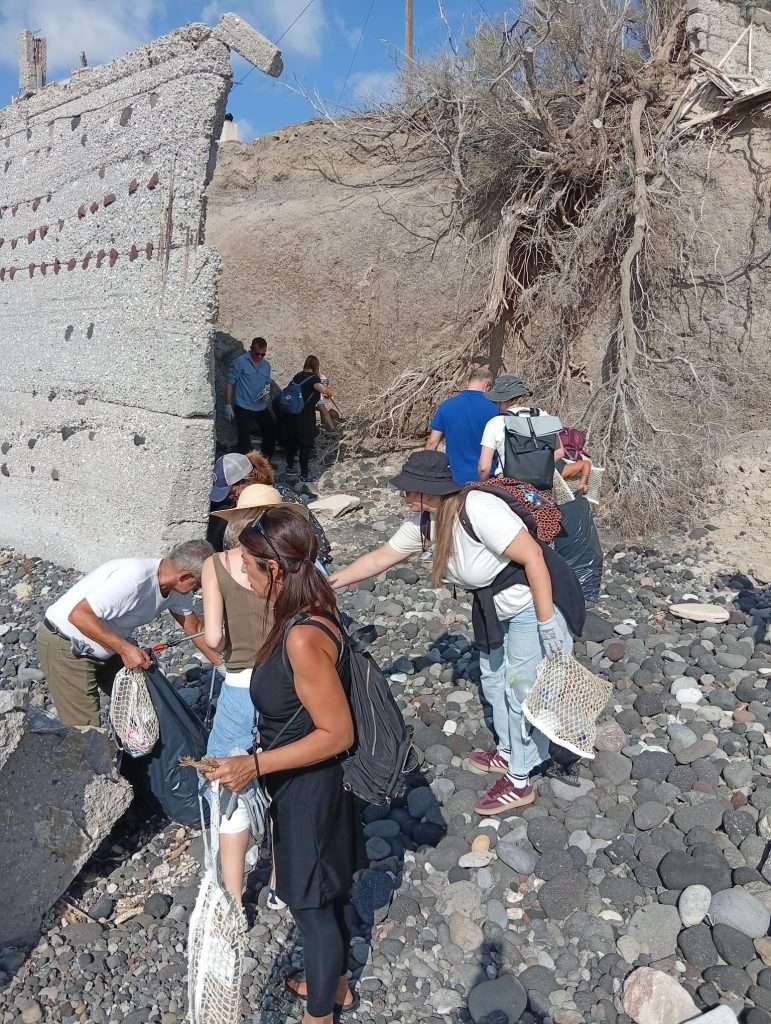
Under the bright Mediterranean sun on Vlychada beach, local community members, international researchers, and environmental activists gathered to put radical ideas of sustainability into direct action. Organised by Impact Hub Athens as part of the Hearth Aegean Summit in collaboration with the EU-funded PHAROS project and its sister initiative Isla Bonita, the afternoon track titled “Zero Waste Island: Circulating Materials in Nature” showcased how community-led cleanups and micro-scale plastic recycling can reshape vulnerable island ecosystems.
The event formed one of four parallel experiential pathways designed to move beyond theoretical debates about ecological crises and engage directly with land and resource stewardship across Santorini.
Tackling Over-Tourism on Vlychada Beach
The session opened with an active beach cleanup along the distinctive black volcanic sands of Vlychada. Facilitated by Dimitris, Facilitator at Impact Hub Athens, the initiative sought to embody the summit’s broader goals through collective physical effort.
“This is one of the four pathways of the island that we are realizing,” explained Dimitris, Facilitator at Impact Hub Athens. “We started with a radical future, and now we are moving with an action. We need to embody what we discussed and see what it takes to go into a zero waste future. So, it starts with individual actions, and it starts also with collective experiences.”
Leading the cleanup operation was Vasilis Sfakinopoulos, Founder of Save Your Hood, a nationwide grassroots volunteer movement established in 2020 that has grown to include over 57,000 volunteers across Greece. Pointing to the surrounding landscape, Sfakinopoulos drew attention to a stark reality: most of the waste accumulated on iconic Greek islands stems from land-based human consumption and over-tourism rather than marine debris washing ashore.
“Santorini is probably one of the most iconic islands of Greece,” stated Vasilis Sfakinopoulos, Founder of Save Your Hood. “That said, the problem that we are going to face today is not clean to this kind of rumor that this island has. The most important thing that you are going to notice today is that most of the trash that you are going to collect, that we are going to collect with our own hands, don’t come from the sea. You’ll see it for yourselves that it’s all an effect of the tourism that this island is accepting. So, over-tourism creates problems that create a real chain reaction.”
Sfakinopoulos revealed that through more than 7,500 cleanups, his organisation has recovered over 12.8 million litres of illegally dumped waste across Greece, a volume equivalent to three days of national illegal dumping.
“What we have accomplished is that we all have touched a little bit of the hearts of each other, we changed our own habits,”Vasilis Sfakinopoulos, Founder of Save Your Hood, reflected. “Cleanups and doing something for your neighborhood… you just act without thinking of what may come or may not come from our own actions. And of course, we influence thousands of other people in ways that we cannot really count.”
Demonstrating the Living Lab & Precious Plastic
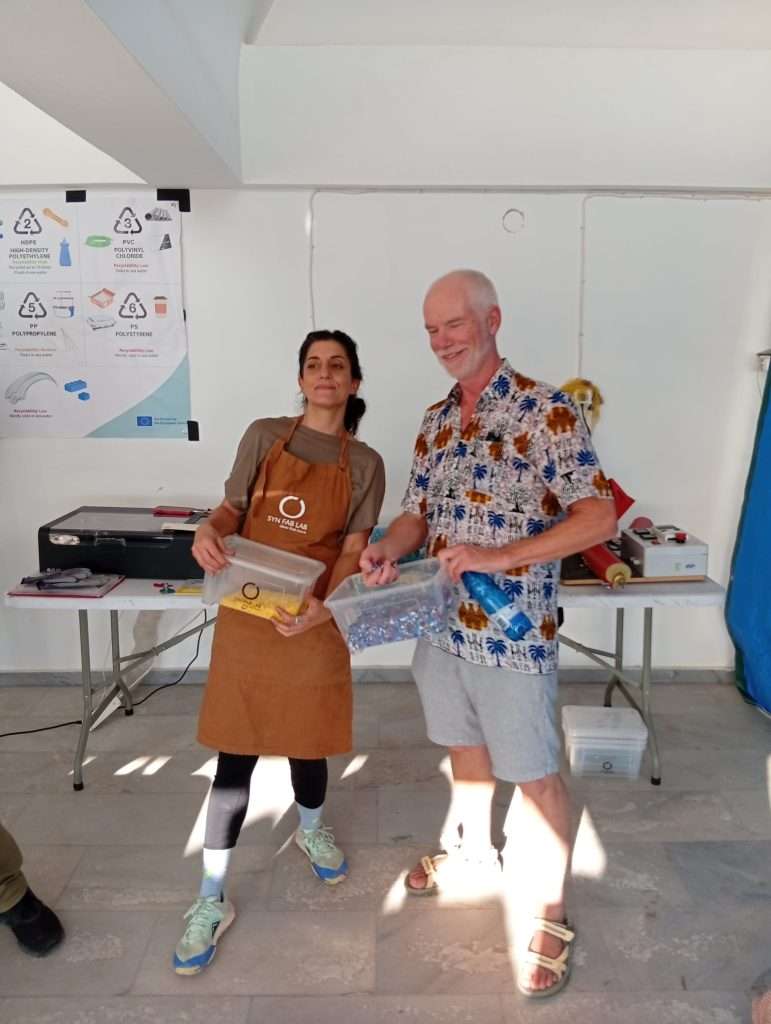
Following the cleanup and a shared Trapezomata community lunch, participants gathered at the Plastic Lab for an interactive demonstration on turning recovered waste into functional objects.
The mobile facility featured specialized open-source Precious Plastic machinery (including a mechanical shredder, an extrusion machine, and an injection moulder) transported to Santorini directly from Portugal.
Violetta Tsitsiliani from Impact Hub Athens introduced the setup as part of Santorini’s ongoing Living Lab, established in May through the EU-funded PHAROS framework and supported by its sister project Isla Bonita.
“We have set these plastic lab machines that flew all the way from Portugal,” said a representative from Impact Hub Athens. “This is actually part of what we call Living Lab here in Santorini. This is a Living Lab that became alive since May. It’s part of a bigger project that is called PHAROS… and now we wish to establish it and have like a stable place that we can put all the machines and have regular people coming here.”
Gordon Dalton, Project Coordinator at PLOCAN (Oceanic Platform of the Canary Islands), detailed the international scope of the European research initiatives supporting the local demonstration.
“PHAROS started two years ago, and has three demonstrations in Gran Canaria, Ireland, and Iceland,” explained Gordon Dalton, Project Coordinator at PLOCAN. “Impact Hub Athens and Santorini are replication sites in PHAROS. And through the success of that and the enthusiasm that they already had, we decided to put them as a demonstration in the next project, Espallida… Espallida started in September and has nine demonstrations: three in the Atlantic, three in the Baltic, and three in the Mediterranean. Santorini is one of the demonstrations that’s going to collect litter and make useful recycled plastic objects, while training locals as well.”
Upcycling Plastic and Transforming Mindsets
Guiding the technical demonstration was Olivia Kotsifa, Architect and Digital Fabrication Specialist at Impact Hub Athens. Kotsifa, who left a university professorship in architecture to focus on local environmental solutions, demonstrated how different polymers, such as High-Density Polyethylene (HDPE, Type 2) from cups and Polypropylene (PP, Type 5) or PET (Type 1) from water bottles, must be sorted carefully due to their distinct melting temperatures and potential toxicity when overheated.
“First of all, we are doing this because the idea is not to use plastic,” emphasized Olivia Kotsifa, Architect and Digital Fabrication Specialist at Impact Hub Athens. “The idea is not to give a solution to the plastic waste in order to keep on using it, right? So, the idea is to find other ways of doing it. In the meantime, with the plastic waste that we have… we can use plastic cups to make other objects, and we can use something like this to make either ropes or 3D-printed filament.”
Kotsifa walked participants through the mechanical recycling process:
Shredding: Plastic cups and containers are fed into an open-source shredder that cuts rigid plastic into small, sorted flakes.
Extrusion & Injection: The shredded flakes are heated to 230°C. The extrusion machine outputs a pliable, toothpaste-like plastic strand that can be shaped manually or wound into filament, while the injection moulder forces liquid plastic into custom moulds.
Laser-Cut Acrylic Moulding: To avoid the high costs of commercial metal moulds — which typically cost around €400 to €500 each — Kotsifa uses digital laser cutters to produce custom acrylic moulds from drawings made by local schoolchildren.
Closed-Loop Recycling: Excess plastic trimmed from moulded objects is re-shredded and melted up to three additional times, preventing any secondary waste.
“This way, we ask kids: what’s the story of the fish?”Olivia Kotsifa, Architect and Digital Fabrication Specialist at Impact Hub Athens, shared. “Where was it born? How much did it travel? Where did it go? So, you get a story of the fish as well as the whole idea of changing the mindset.”
To conclude the session, attendees were invited to operate the shredder, press custom souvenir stamps made from recycled plastic onto wooden postcards cut on-site, and take home practical examples of circular design. Through hands-on engagement, the combined efforts of Impact Hub Athens, Save Your Hood, and European research partners demonstrated how local island communities can transform environmental burdens into drivers of creative, sustainable education.
When you visit our website, it may store information through your browser from specific services, usually in the form of cookies. Our Privacy Policy can be read here.
Here you can change your Privacy preferences. It is worth noting that blocking some types of cookies may impact your experience on our website and the services we are able to offer.
Click to enable/disable Google Analytics tracking code.
Click to enable/disable Google Fonts.
Click to enable/disable Google Maps.
Click to enable/disable video embeds.
Our website uses cookies, mainly from 3rd party services. Define your Privacy Preferences and/or agree to our use of cookies.