Rallying Around the Hearth Aegean Summit in Santorini: Local Action and Global Regeneration
Rallying Around the Hearth Aegean Summit in Santorini: Local Action and Global Regeneration https://pharosproject.eu/wp-content/uploads/2026/10/WhatsApp-Image-2026-10-23-at-23.31.07-1-1024x768.jpeg 1024 768 PHAROS Project https://pharosproject.eu/wp-content/uploads/2026/10/WhatsApp-Image-2026-10-23-at-23.31.07-1-1024x768.jpegThe Aegean Hearth Summit officially opened its doors yesterday on the island of Santorini, bringing together international ecological thinkers, local agriculturalists, researchers, and policy makers. Staged against a backdrop of severe climate pressure and mass tourism, the summit seeks to explore how local communities can build resilience by reconnecting to the land and seas they inhabit.
The opening proceedings spanned a practical maritime workshop in the south of the island before moving to an immersive evening of plenary discussions, keynote reflections, and artistic performance at the Mati Art Observatory.
Pre-Summit Workshop: Fishers Stand as Ocean Guardians in Vlychada
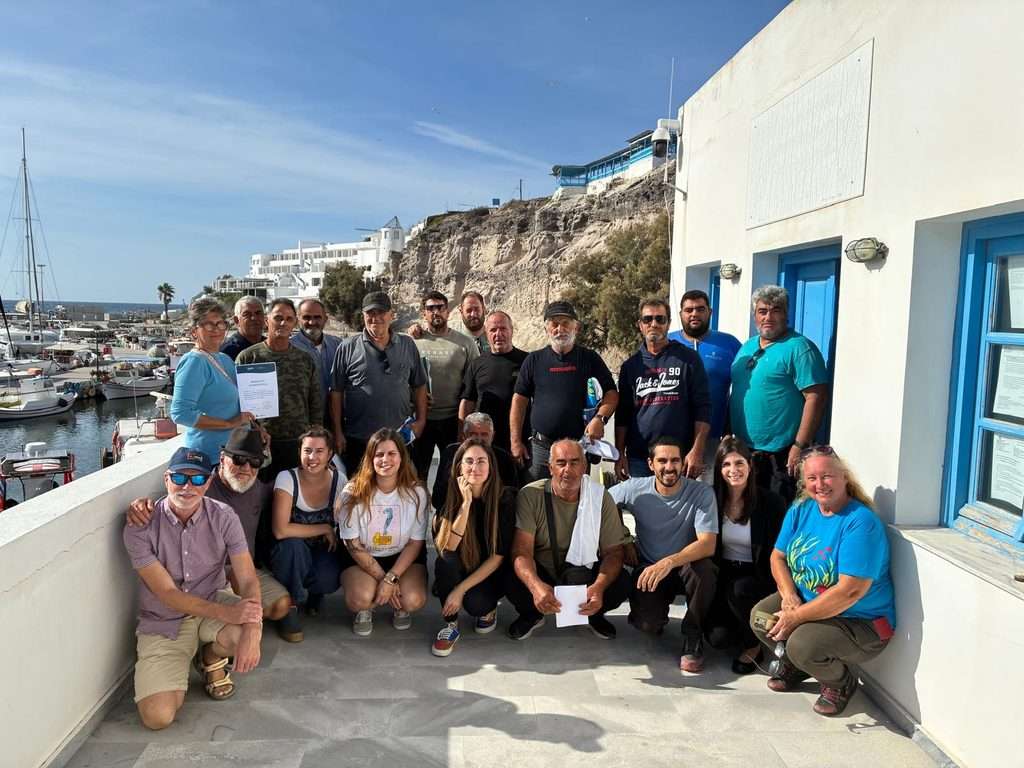
Ahead of the evening’s main gatherings, activity began at 11:00 CEST at the Vlychada Fishing Port. Between 12:00 and 16:00 local time, local Santorini fishers gathered for the Fisher Guardian Workshop, an event organised under the PHAROS Santorini Living Lab.
The participatory session was co-organised by CIIMAR (Coordinator of the Fisher Guardian Programme) and Impact Hub Athens (Coordinator of the Santorini Blue Loop Living Lab), with Dimitra Mavrommati facilitating. Fishers shared first-hand experiences and worked collaboratively to design practical steps for tackling marine litter, improving local waste management, and reducing incidental bycatch. By centering the practical knowledge of the local fishing fleet, the initiative aims to strengthen their active role as long-term stewards of the Aegean Sea.
For a detailed look at the discussions and outcomes from Vlychada, read the full PHAROS Fisher Guardian Workshop report.
Evening Plenary: Examining the Cost of Disconnection
At the Mati Art Observatory, attendees gathered for the summit’s official opening plenary, titled “Why Now, Why Here?”
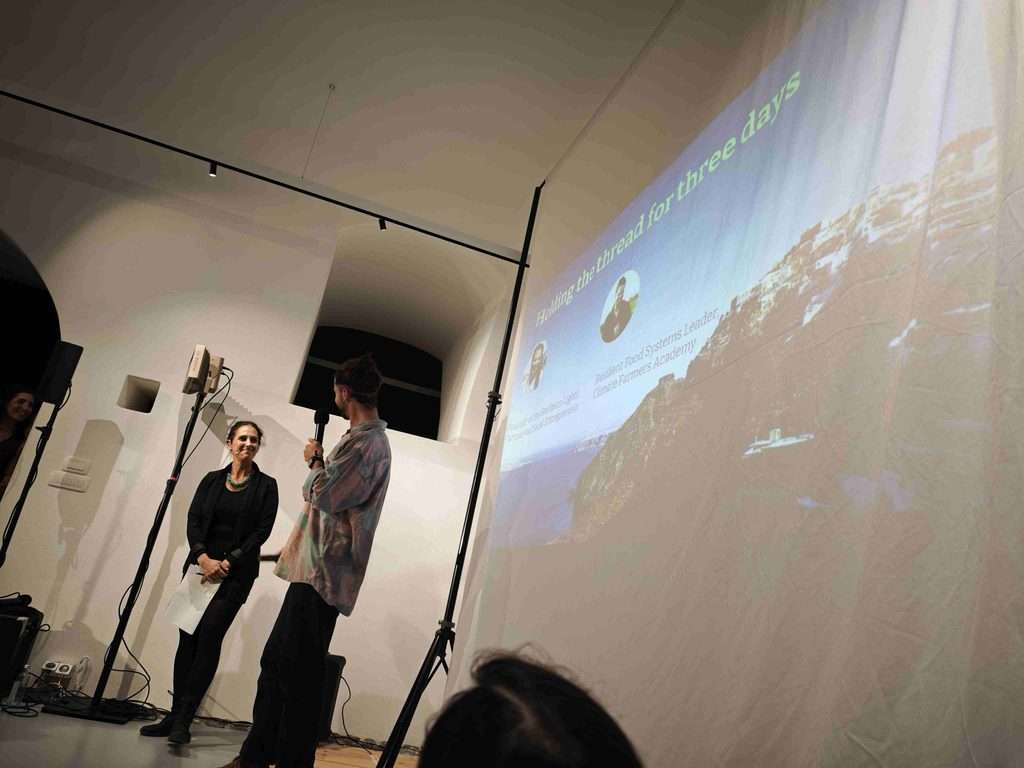
Co-moderators Sheila Darmos (a farmer from the Peloponnese, eco-project connector, and co-founder representing the European Alliance for Regenerative Agriculture) and Fabio Volkmann (a specialist in place-based regeneration and regenerative agriculture from the European Alliance for Regenerative Agriculture) introduced the guiding principles of the three-day gathering.
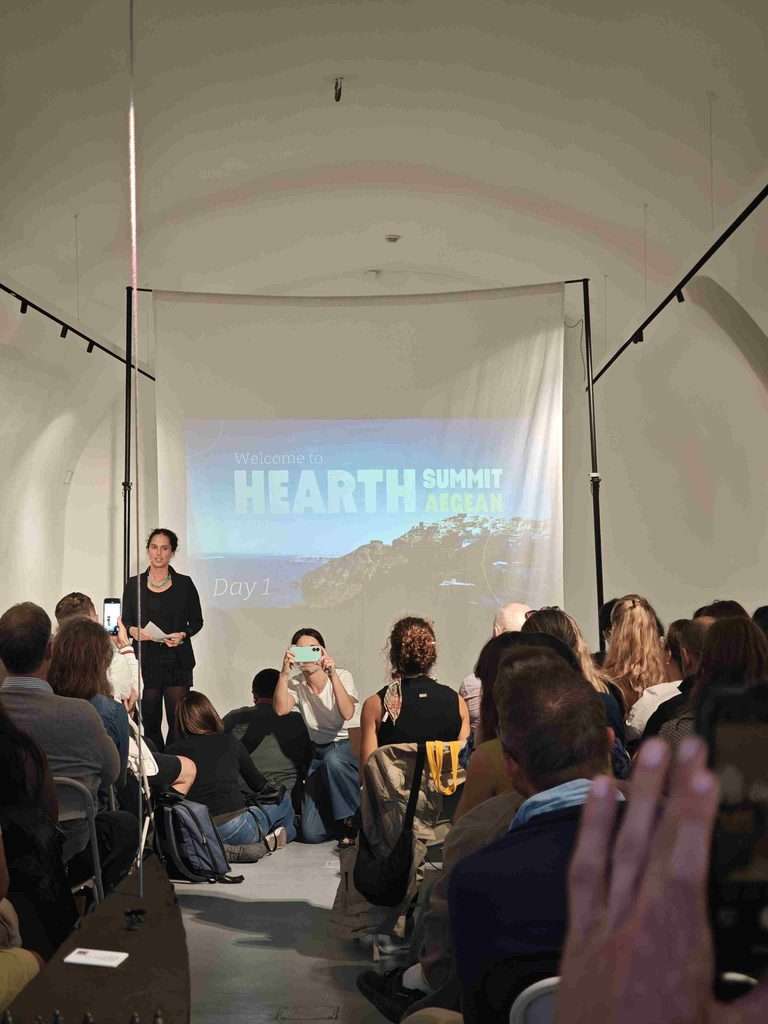
In her opening remarks, Sheila Darmos challenged the audience to reconsider their relationship with physical geography and shared communities:
“What does it mean to live well together in a place? There is already so much in this sentence. What does it mean to live well? We find answers to so many questions, but then we do not even know what it means for us personally to live together. Most of us live alone in an apartment. Maybe we have a community at work, but we are not connected to the people with whom we actually live in a shared physical space or in a bioregion.”
Focusing specifically on island environments, she highlighted how remote territories feel global ecological and economic pressures first. Depopulation, school closures, lack of year-round employment, and intense seasonal tourism create a pressure cooker environment where global crises collide. The summit, she noted, aims to spark localized, experimental solutions rather than generic, copy-pasted policies.
Following her remarks, Fabio Volkmann led a room mapping exercise to identify the diverse group present. The audience ranged from local Greek islanders and international guests to agricultural land managers, academic researchers, three policy makers, and a substantial contingent of artists and craftspeople. A short visual film showcasing traditional Santorini music, landscapes, and local voices followed, grounding the audience in the island’s unique atmosphere.
Reclaiming the Fireplace: Community Foundations in Volcanic Soil
Addressing the meaning behind the summit’s name, Sheila Darmos explained that the hearth historically served as the central fireplace around which families and communities gathered for warmth, safety, and storytelling. The Santorini event forms part of a wider global network of regional Hearth Summits connected to The Wellbeing Project.
Taking the stage to welcome participants, Sophie Lamprou (Co-Founder of Impact Hub Athens) reflected on fifteen years of community-building across mainland Greece and explained why the organisation chose Santorini for its Living Lab work three years ago:
“Santorini is where our spot for island resilience and innovation begins. As we have been working here for the last three years, we have experienced an identity, economy, and way of life that lies beyond the typical image or perspective that people have of Santorini. As we ignite this hearth in this volcanic landscape, with the power and strength that the volcano represents, we hope to contaminate the island with this positive force and cultivate positive stories into the common narrative.”
Keynote: Rooting Regeneration in Places as the Practice for System Transformation
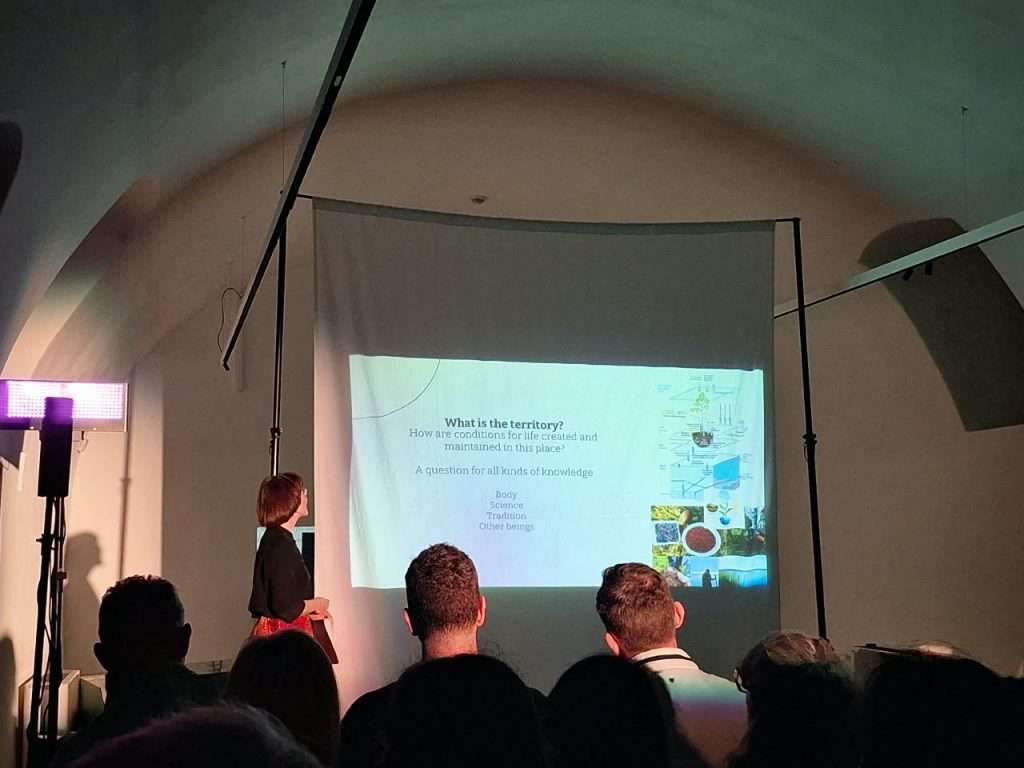
After a brief intermission, social scientist Dr. Anna Krzywoszynska delivered the keynote address, “Regeneration as the Practice for System Transformation.” Originally from Poland and now based in Northern Finland, Dr. Krzywoszynska studies environmental restoration and regeneration. She framed her presentation around her personal transition four years ago from mild, lush surroundings in the United Kingdom to the harsher, drier climate of Northern Finland.
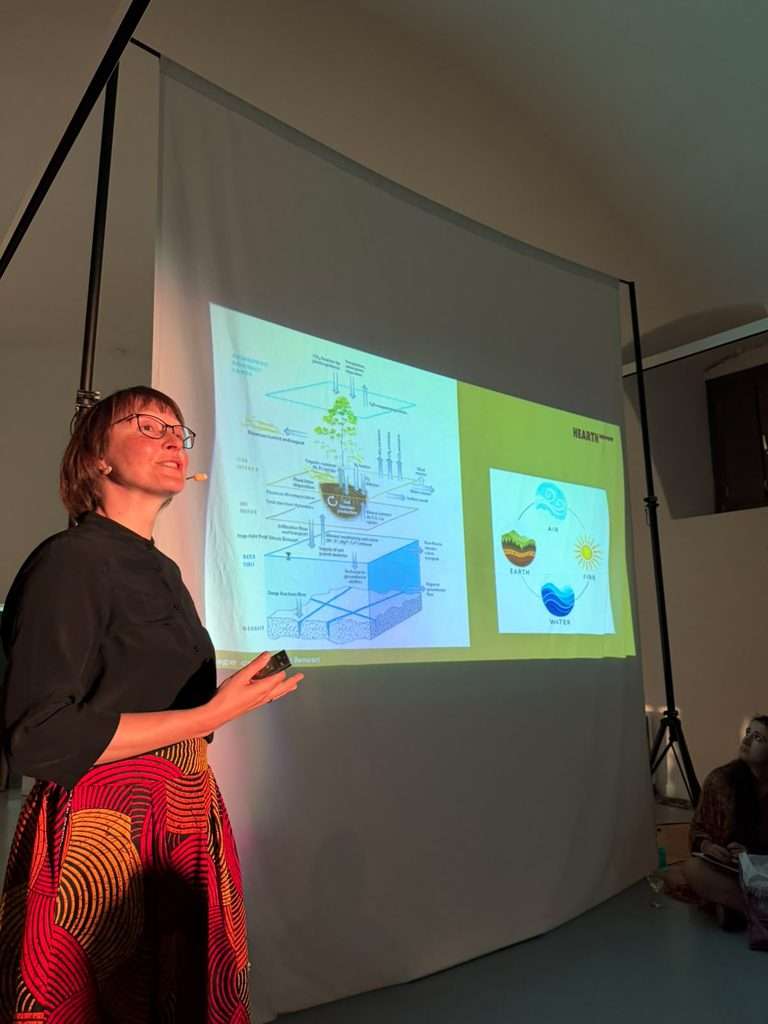
She described how adapting to a new environment forced her to learn the territory through her senses (foraging, swimming in cold waters, and tracking seasonal shifts) while gradually discovering the ecological wounds inflicted on the landscape. Drained mires, timber extraction, hydroelectric damming of salmon rivers, and mining infrastructure had all altered the local ecosystem, often driven by well-intentioned national economic goals.
During her address, Dr. Anna Krzywoszynska paused to invite participants to write down answers to three core reflective prompts in their summit notebooks:
- What is your territory like? What does it feel like on your skin across seasons? What does it smell, taste, and sound like?
- What is happening to your land? What shifts are occurring in your local waterways, soils, bird populations, and plant life, and what narratives are being used to justify these changes?
- Who is doing the work of healing? Who is working to restore water, soil, and human connections to the land, including those performing invisible day-to-day care labor?
Dr. Krzywoszynska criticized the modern tendency to treat land as a dumping ground for the undesirable side effects of industrial life, pointing to soil sealing under asphalt and concrete, monoculture agriculture, and reliance on long-distance chemical inputs. She warned against feeling paralyzed by abstract global environmental debates:
“When it comes to public debate, we experience a scale shift: from our experience of the places where we live, to the planet. This idea of a globe in danger can make us feel paralyzed and very small. But we can think of ourselves as ecological actors in a different way, right from the places where we already are. We can ask: How do we create a habitable future from where we are right now?”
She highlighted Critical Zone Science as an encouraging scientific framework that mirrors ancient traditional knowledge. By focusing on the thin, life-sustaining layer stretching from groundwater to the lower atmosphere, this field views soil, water, air, and solar energy as an interconnected engine of life. Rather than relying on top-down planetary fixes, she argued, genuine system transformation happens when individuals and collectives reorient their energy toward nurturing, place-based relationships.
From Rooting to Harvesting
To close the plenary block, Fabio Volkmann outlined the roadmap for the days ahead, comparing the summit’s progression to the life cycle of a seed:
- Day 1 (Rooting): Grounding participants in place, establishing shared intentions, and building initial connections.
- Day 2 (Imagining and Sprouting): Morning sessions on radical ecological futures, followed by field visits across Santorini in the afternoon to study local projects firsthand, ending with a collective evening gathering.
- Day 3 (Harvesting): Identifying practical takeaways, establishing long-term collaborations, and determining concrete actions to take home.
To set a collaborative tone, Fabio Volkmann introduced basic working agreements for the event: practicing active listening, choosing curiosity over absolute certainty, respecting personal energy limits, and looking out for one another. The plenary concluded with a two-stage interactive icebreaker where attendees wrote down their personal motivations for attending, paired up with strangers to share their stories, and then introduced their partners to nearby groups.
Following the opening plenary, the Mati Art Observatory cleared its seating area to host “Hikaru: The Fractured Mirror of the Anthropocene,” a poetic performance by artist Anastasia Parava.

Combining electroacoustic soundscapes with light, prisms, and mirrors, the performance invited attendees to reflect visually and audibly on what remains hidden in human interactions with the natural world, drawing the first evening of the summit to a close.