The Port and the Hearth: Fishers, plastic and the work of the Santorini Blue Loop Living Lab
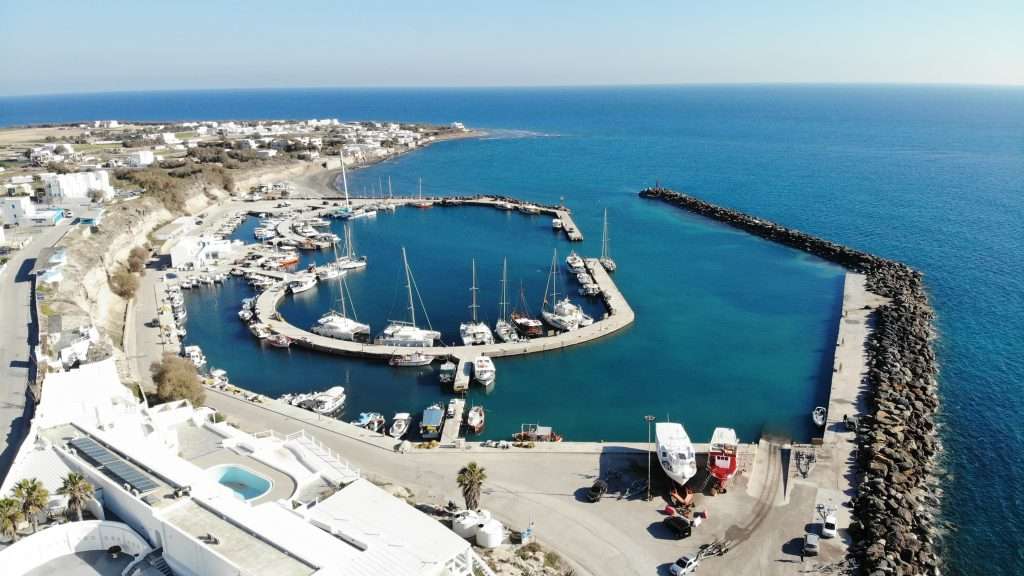
The Port and the Hearth: Fishers, plastic and the work of the Santorini Blue Loop Living Lab https://pharosproject.eu/wp-content/uploads/2026/10/Vlychada-Fishing-Port-1024x576.jpeg 1024 576 PHAROS Project https://pharosproject.eu/wp-content/uploads/2026/10/Vlychada-Fishing-Port-1024x576.jpegA three-day summit on wellbeing, landscape and regeneration came to Santorini. The most useful conversation happened before it opened, at a fishing port, when the people the project is meant to serve rewrote the script.
On the morning of 23 October, before the Hearth Summit Aegean opened its doors at the Mati Art Observatory, a group of fishers gave up a calm fishing day and sat down in a room at Vlychada Fishing Port. The weather was nice and the sea was workable, but they came anyway.
That detail matters more than any slogan about participation. The workshop was organised jointly by CIIMAR, which coordinates the Fisher Guardian Programme, and Impact Hub Athens, which coordinates the Santorini Blue Loop Living Lab, with Dimitra Mavrommati, Port Authority Fund of Fira, holding the room together. The stated aim was to put fishers at the centre of the conversation about marine litter, waste management and bycatch. Gordon Dalton, PLOCAN, said fishers must be at the centre of the conversation, and Lisa Sousa, CIIMAR, said their knowledge should shape the work. The fishers, to their credit, took the invitation literally.
What followed was one of the more honest exchanges I have seen at a sustainability gathering. It is worth reading the full account of the Fisher Guardian workshop in Vlychada because the detail is where the story lives.
The Fisher Guardian Programme was presented through three pillars: environmental awareness, acoustic transmitters to track lost gear in deep water, and recycling partnerships, including Gravity Wave in Spain, which turns recovered nets into new products. On paper it was a sensible package, though the fishers had other ideas.
Then an experienced local fisher explained, politely but firmly, that professional fishers do not abandon nets.
“A fisherman is in a very difficult position financially, he doesn’t have money to spare to leave nets down there. He will go fish it out.”
The nets found in their area, he added, belong to amateurs, not professionals. Recreational boaters drop nets illegally in summer and abandon them when they snag, while professionals burn fuel dragging the seabed to recover gear, sometimes at depths beyond 180 metres.
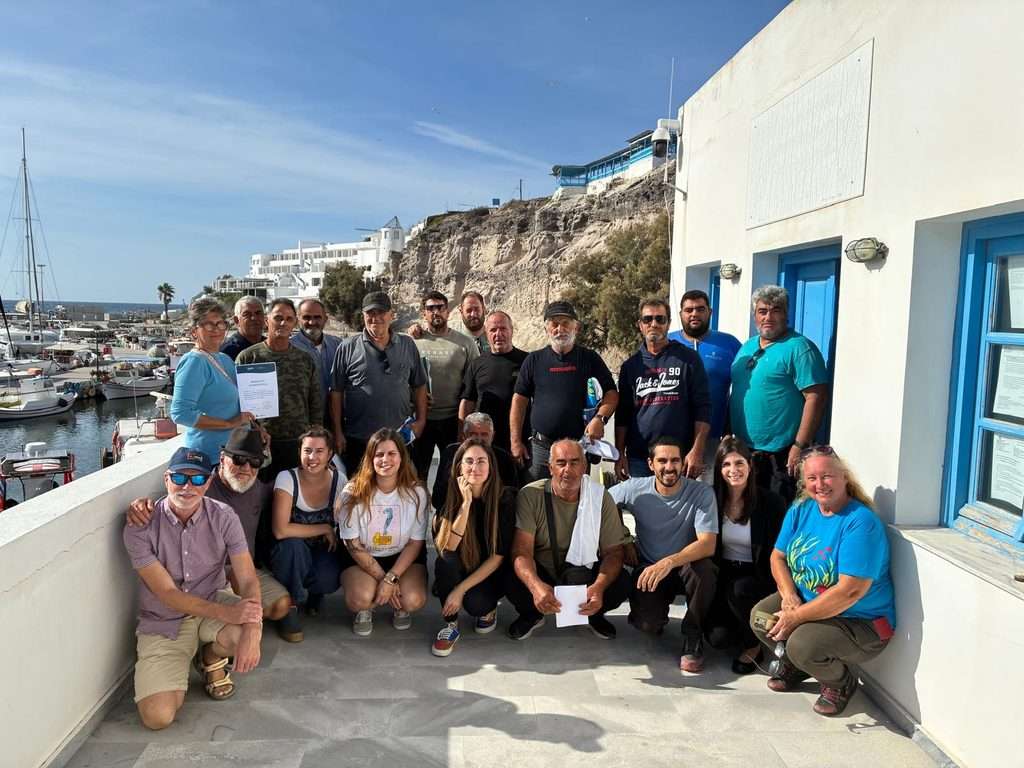
The room did not argue with him, which is the first thing to note, and the second is what happened when the acoustic tracking technology was presented. Fishers rejected mandatory transmitters outright.
“As professionals, we don’t go throwing nets out to lose them. We know where we go and we don’t need these things. They made plastic tags mandatory by law on every net, and now it’s a fine if you don’t have it. We do not agree to transmitters being installed because they will make it a law, transmitters aren’t cheap, and above all, we don’t need them.”
This is not a small thing, since one of the programme’s three pillars was rejected by the people it is meant to serve, on grounds of cost, redundancy and the fear of yet another regulation. A project that cannot hear that will not last long on this island, while a project that can hear it has something to work with.
What the fishers asked for instead
The fishers did not reject stewardship; they described what they already do, bringing collected waste back to shore rather than dumping it at sea and repurposing what they retrieve, anchors and tyres among it. Then they listed what would actually help.
- Refillable jerrycans on board instead of disposable plastic six-pack.
- Separate recycling bags inside boats, transferred directly to port bins.
- Bins at the docking points, not at a distance. As Violetta Tsitsiliani put it, “if they are far away, no one will take them there, and they’re already exhausted afterwards.”
- Municipal or port staff to help lift heavy debris, the chairs and sunbeds and umbrellas that wash up.
- Island-wide recycling for ropes, twine and styrofoam, with the licensing needed to process marine waste properly rather than send it to landfill.
- State funding to replace older vessels and seasonal maintenance subsidies during the April to May spawning window, which would reduce fishing pressure and fuel use at the same time.
- Pilot testing of biodegradable nets.
- Reusable insulated crates instead of single-use styrofoam fish boxes.
- A request that ministries consult active artisanal fishers before drafting marine legislation.
That last point was echoed by both Dimitra Mavrommati and Violetta Tsitsiliani, who agreed that top-down rules often fail without feedback from the deck. The fishers also spoke about seals and dolphins damaging longlines and eating catches and about the powerlessness of strict protection rules that expose them to penalties even for accidental harm while their losses go uncompensated. On fuel, they pointed to the gap between green transition language and the reality of high prices and poor quality diesel that damages engines. They asked for cleaner automotive-grade fuel and noted that commercial shipping burns far more than the entire local artisanal fleet.
This is what cocreation looks like when it is real: not agreement but negotiation over the problem itself.
The hearth, the land and its healing
That evening the summit opened at the Mati Art Observatory, and the tone changed. Sheila Darmos asked the question that framed the whole gathering: “What does it mean to live well together in a place?” She described islands as pressure cookers where global crises arrive first, from depopulation and school closures to the intensity of seasonal tourism. Sophie Lamprou, Impact Hub Athens, explained why Santorini was chosen for the Living Lab three years ago.
“Santorini is where our spot for island resilience and innovation begins. As we ignite this hearth in this volcanic landscape, with the power and strength that the volcano represents, we hope to contaminate the island with this positive force and cultivate positive stories into the common narrative.”
Dr Anna Krzywoszynska warned against the paralysis that abstract global environmental debates can produce.
“This idea of a globe in danger can make us feel paralysed and very small. But we can think of ourselves as ecological actors in a different way, right from the places where we already are.”
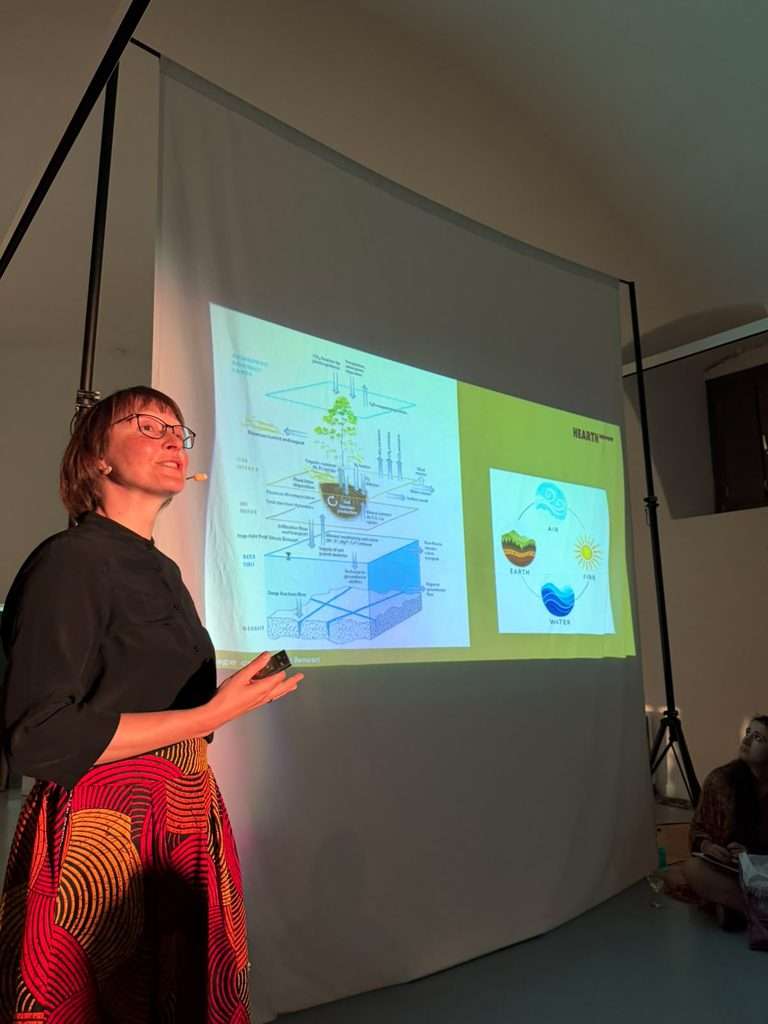
She offered three prompts: What is your territory like? What is happening to your land? Who is doing the work of healing?
These are good questions, though they are easier to ask in an observatory than to answer at a dock. The fishers were not asking for storytelling; they were asking for bins within reach, cleaner fuel, compensation for wildlife damage and a clear distinction between professional and amateur gear loss. The full account of the opening day and its framing is in the report on rallying around the Hearth Summit in Santorini, and it is worth reading alongside the port workshop because the two rooms were speaking different languages about the same island.
The pathway through the island
Saturday brought the Zero Waste Island Pathway, and here the summit moved from talk to handling. The morning session, Radical Futures: Imagining a Truly Zero Waste Island, ran at Ftelos Brewery from 10:30 to 12:00 and asked people to take unlikely futures seriously and to work backwards from them, using foresight as a tool for present-day decisions. It was an exercise in collective imagination and a useful one, though imagination is not the bottleneck at the port.
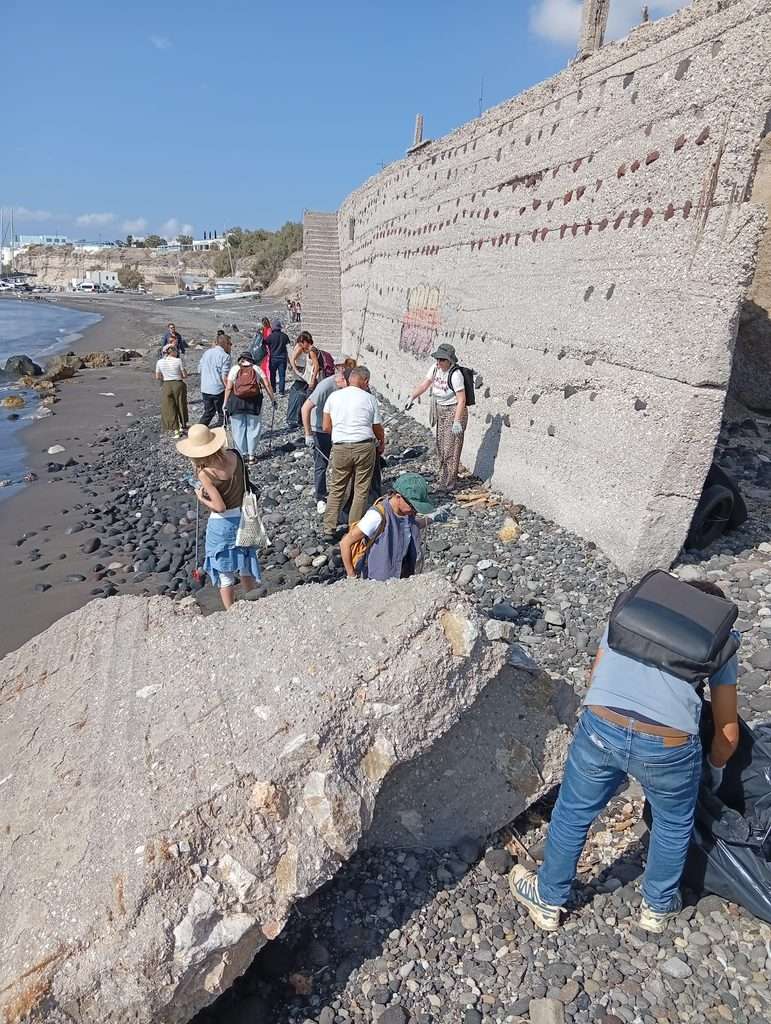
At lunchtime the group moved to Vlychada Beach for a cleanup from 12:30 to 13:30. It built on community engagement methods developed through REMEDIES and continued through ISLA BONITA, and it did what it said on the tin. People picked up plastic, and the beach was left cleaner, which made visible the link between ecological care and collective responsibility, and that is not nothing.
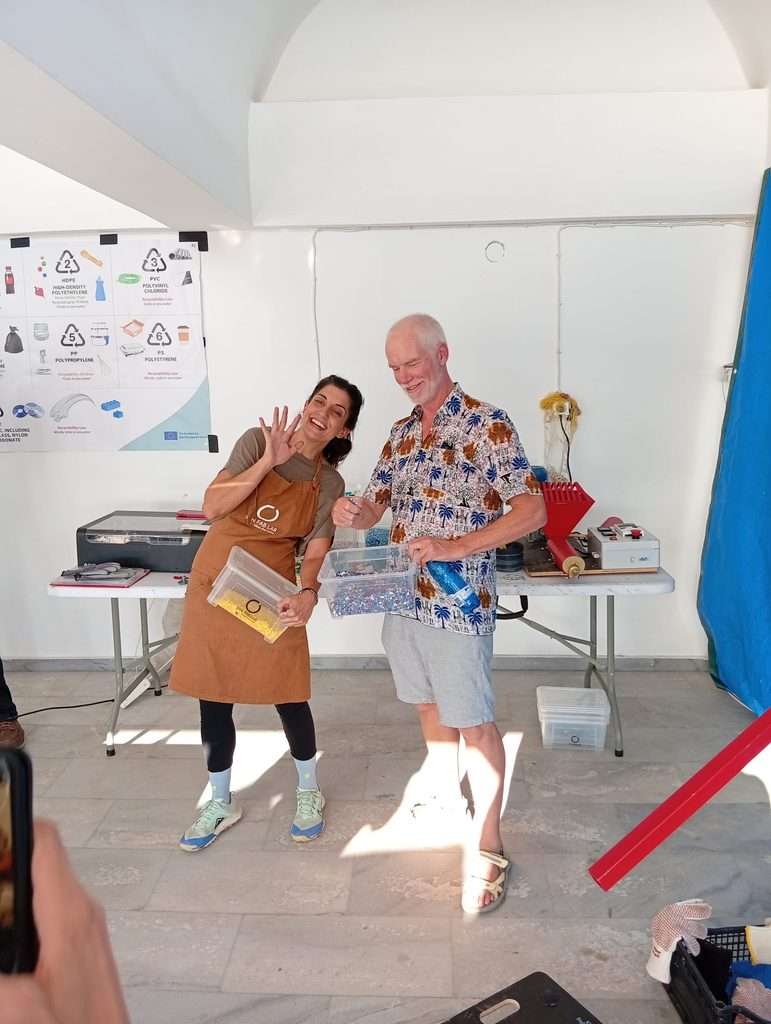
In the afternoon the Plastic Lab Workshop ran at Vlychada Port from 15:30 to 16:30. This was the most direct expression of the Living Lab’s circular economy work. Participants explored how discarded plastic can be collected, sorted, processed and turned into useful objects. They handled materials, talked about craft and local knowledge, and challenged their own relationship with disposable things.
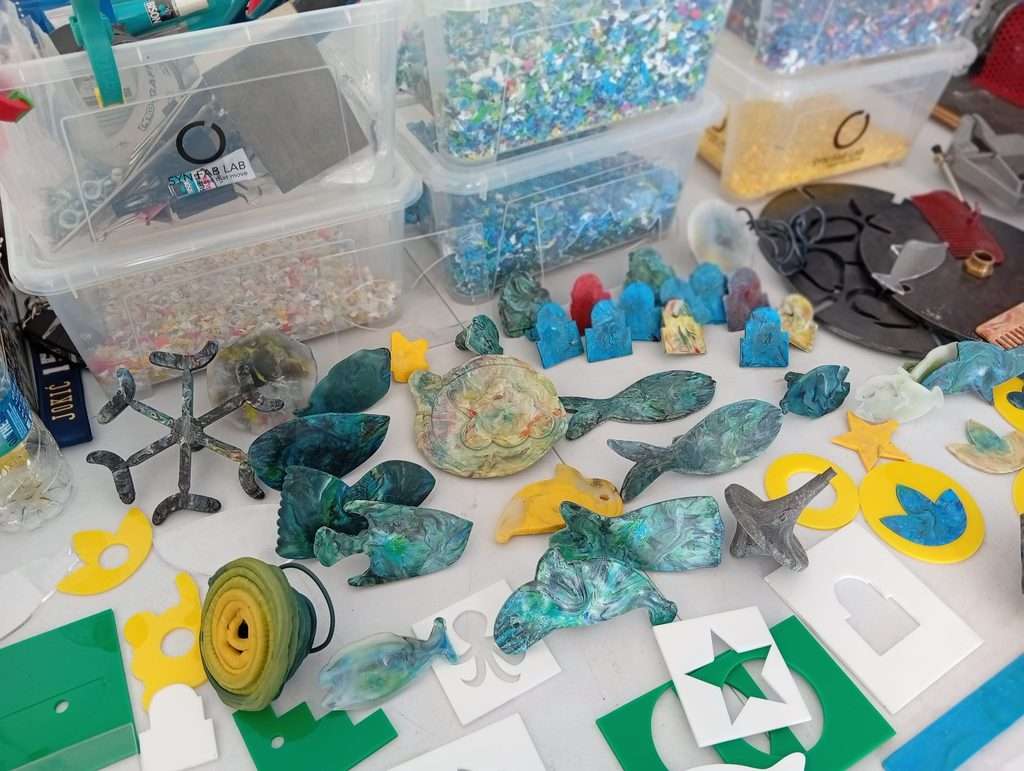
All of this matters, because the Plastic Lab shows that waste can become a resource, but it cannot, by itself, answer the fisher who said the nets in his water are dropped by amateurs and that the law is not enforced. A circular economy can turn a recovered net into a new product, but it cannot decide who is responsible for the net in the first place. That is a governance question, and it was sitting in the room at Vlychada two days earlier, waiting to be picked up.
The harvest and the open question
The final morning moved to the Tomato Industrial Museum “D. Nomikos” for From Seed to Harvest. The format was deliberately fast: twenty-five project pitches, each short and each followed by questions. Fabio Volkmann had framed the summit’s arc as rooting, sprouting and harvesting, and by Sunday the room was in harvest mode.
Coco Francavilla, Posidonia Soundscapes, spoke about protecting Posidonia seagrass meadows, the lungs of the Mediterranean, and about pushing for new Marine Protected Areas in the Aegean. That work connects directly to the Living Lab’s planned awareness sessions on Posidonia. Alexis, Ikaria Recycles, described solar-powered, privately run recycling hubs with electric cargo bikes, which speaks to the circular economy route. Antonis Orphanos, a Santorini winemaker, made the case for artisanal natural winemaking against an industrial market, which speaks to the sustainable viticulture route. Mary, University of the Aegean, talked about marine biodiversity change and integrating invasive alien species into the diet. Robin, Kea Island, described arid-adapted seed exchange and regional seed banks.
Then Gordon Dalton, PHAROS and ISLA BONITA coordinator, asked the question that the whole weekend had been circling.
“We have pilot demonstrations across 12 islands with corresponding living labs. My main question is: what are the roles of citizens and particularly local municipalities in these living labs?”
It was the right question, asked at the right time, which is to say at the end, when the enthusiasm of a gathering meets the reality of who will still be working on Monday. The Santorini Blue Loop is one of several replication Living Labs under PHAROS, alongside sites in Gran Canaria, Iceland, Ireland, the Danube Delta and Lanzarote. Each adapts a common framework to its own place. Gran Canaria had already run its own Fisher Guardian pilot, removing 220 kilograms of discarded nets in a single port collection. Santorini is not starting from zero, but it is starting from a different place, with a contested line between professional and amateur use of the sea, and with a tourist season that puts pressure on every service, including waste collection.
The full record of the final day and its pitches is in the report on how local island communities are blueprinting the future of the Aegean. It is a useful read, not least because it shows how much of the summit’s energy was terrestrial. Seeds, vines, dry stone, regenerative tourism. The sea was present, but it was not always the centre of gravity.
The dock after the hearth
The Santorini Blue Loop Living Lab is an ongoing process and not a one off event, and the summit was a gathering while the Living Lab is the work. The difference between the two is easiest to see at the port.
Will the bins be installed at the docking points? Will the acoustic tag proposal be redesigned, or dropped for Santorini, and what does that mean for the other Living Labs in the network? Will the Plastic Lab connect to the enforcement problem the fishers described, or will it remain a demonstration of what can be done with a recovered net once someone else has decided who lost it? Will the Day 3 pitches on Posidonia, recycling hubs, viticulture and seed banks be looped back into the Living Lab’s three routes, or will they sit in a report? Will the municipality take up Gordon Dalton’s question and define its role in practice, not just in principle?
These are not complaints but the agenda. The launch of the Santorini Blue Loop Living Lab set out three goals: reducing marine pollution, promoting the circular economy and developing sustainable practices on the island, and the summit added detail to all three while also adding a question that will outlast the weekend.
After the hearth cools, who is still at the dock?
Written by Sal Music, Head of Dissemination and Communication (ICoRSA, PHAROS project)