What Are EU Outermost Regions?
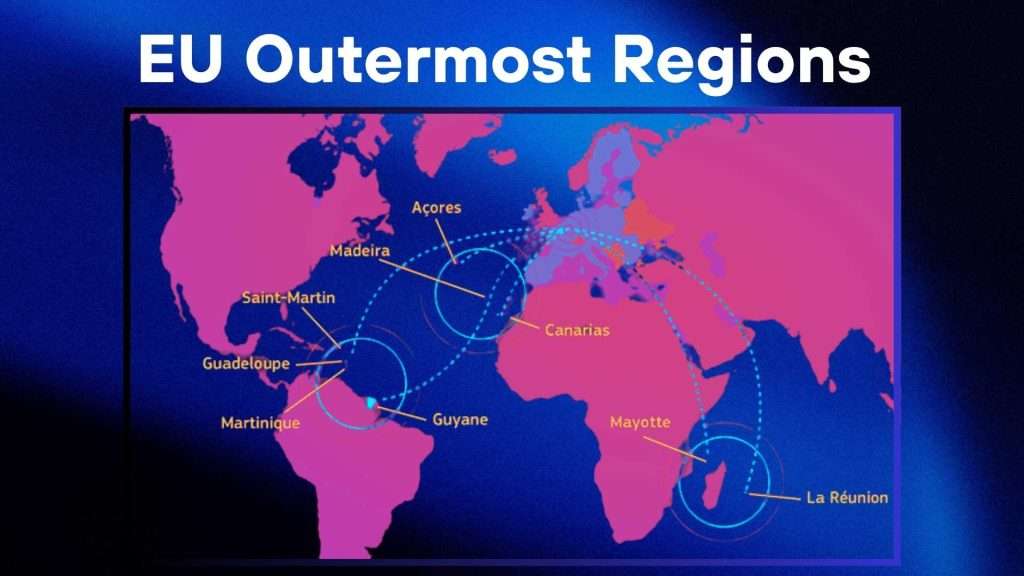
What Are EU Outermost Regions? https://pharosproject.eu/wp-content/uploads/2026/07/EU-Outermost-Regions-1024x576.jpg 1024 576 PHAROS Project https://pharosproject.eu/wp-content/uploads/2026/07/EU-Outermost-Regions-1024x576.jpgThe EU Outermost Regions, often abbreviated as ORs and referred to in PHAROS materials as AOM islands, are nine territories geographically far removed from mainland Europe that remain a full, legally integrated part of the European Union. They include French Guiana, Guadeloupe, Martinique, Mayotte, Réunion, and Saint-Martin, all belonging to France, alongside the Azores and Madeira under Portugal, and the Canary Islands under Spain. Despite sitting thousands of kilometres from Brussels, sometimes across an entire ocean, these regions carry every right and obligation of EU membership, including free movement, the euro where applicable, and full access to EU funding programmes.
A Legal Category Built for Extreme Distance
What makes the Outermost Regions a distinct policy category rather than just a geographic curiosity is Article 349 of the Treaty on the Functioning of the European Union. This article formally recognises that these territories face structural handicaps the rest of the EU simply doesn’t share: extreme remoteness, small size, difficult topography, vulnerability to climate hazards, and heavy economic dependence on a narrow range of local industries. Because of this, EU law permits specific adapted measures for these regions rather than forcing a one-size-fits-all policy across territories that range from Arctic-adjacent Atlantic islands to tropical rainforest in South America. A few figures illustrate just how distinct these regions are from the rest of the EU:
- The EU currently recognises nine Outermost Regions in total, a number that has grown from an original eight since Mayotte joined the category in 2014.
- These territories are scattered across the Atlantic, Indian, and Caribbean regions, with distances from mainland Europe often exceeding several thousand kilometres.
- Réunion and Caribbean territories alone account for a significant share of the 31% of ecosystem services research published on European overseas territories that focuses on Caribbean sites.
- The EU AOM islands sit within several of the world’s 25 recognised global biodiversity hotspots, which collectively represent 80% of Europe’s total biodiversity.
- Despite that biodiversity value, a systematic review of 1,030 relevant publications found many Outermost Regions remain “blank spots” in ecosystem service mapping and assessment.
One Analogy: Distant Branches of the Same Family Tree
Think of the Outermost Regions like distant relatives who technically hold full membership in the same family, complete with the same legal name, inheritance rights, and family obligations, but who live so far from the rest of the family that their day-to-day circumstances look nothing alike. A cousin living across an ocean still shares your surname and your legal standing in the family, yet the climate, opportunities, and daily challenges they face are shaped by an entirely different environment. The EU treats its Outermost Regions the same way: full family membership on paper, but policy has to adapt to circumstances, isolation, tropical or subtropical climate, tiny economies, that simply don’t exist for regions clustered around continental Europe.
Unique Assets, Not Just Unique Problems
The EU doesn’t frame Outermost Regions purely around hardship. These territories represent a genuine European territorial presence in strategically important parts of the world, and their unusual geography and geology make them valuable natural laboratories for research and innovation in fields like biodiversity, marine ecosystems, pharmacology, renewable energy, and space science. That framing matters directly for ocean policy, since many Outermost Regions sit inside globally significant marine biodiversity hotspots that mainland European coastlines simply don’t offer. Their isolation, often viewed as a weakness, actually gives these islands tightly knit stakeholder communities and strong land-sea interaction, qualities that make them genuinely well suited to piloting new marine restoration approaches before wider rollout.
Why PHAROS Prioritises These Islands
PHAROS has built its entire demonstration and replication strategy around this dual reality of biodiversity value and structural vulnerability. The project’s flagship Gran Canaria demonstrations sit directly in an Atlantic Outermost Region, and PHAROS deliberately designed its work to include the majority of EU AOM islands across its replication roadmaps, treating this network of remote Atlantic territories as central to the project rather than peripheral. This strategic focus shows up across nearly every strand of PHAROS’s work:
- The enhanced Blue4All MPA Solutions Hub is being extended specifically to reach AOM islands like the Azores, Madeira, and the Canary Islands, giving remote MPA managers the same adaptive management tools available on the mainland.
- PHAROS’s Blue Schools strategy explicitly targets underrepresented areas, since the wider European Blue Schools network shows a strong geographic bias toward the Mediterranean, leaving AOM islands and the Arctic underserved.
- Objective 3 of the PHAROS work plan commits to extending the Blue4All MPA Blueprint platform and network across large areas of the Atlantic, EU AOM islands, and Arctic basin.
- Objective 5 dedicates resources to co-creating replication roadmaps specifically for Associated Regions, ensuring restoration models proven in Gran Canaria can transfer to other outermost islands facing similar pressures.
Post-Project Continuity Through PLOCAN
PHAROS has also planned deliberately for what happens after its own funding ends. The project’s coordinator, PLOCAN, is based in the Canary Islands precisely because it brings deep experience as an island-based Research Performing Organisation, and it will continue operating as a lighthouse hub for the Atlantic, EU AOM islands, and Arctic basin long after PHAROS concludes. That continuity plan reflects a broader truth about the Outermost Regions: because they face structural handicaps that don’t disappear once a single EU-funded project wraps up, lasting impact depends on building institutions rooted in the regions themselves, not just delivering time-limited pilot results and moving on.