How Citizens in Ukraine Help Scientific Research
How Citizens in Ukraine Help Scientific Research https://pharosproject.eu/wp-content/uploads/2026/09/image-1024x768.png 1024 768 PHAROS Project https://pharosproject.eu/wp-content/uploads/2026/09/image-1024x768.pngRead the original article in Ukrainian
21 September 2026
Last September, Ukraine launched a new data-collection initiative on living nature: the Living Laboratory Danube Delta. It currently operates exclusively as a citizen science platform, but its creators have far more ambitious plans. How can your smartphone become useful to biologists? Why are data on both unusual and completely ordinary species equally important for science? And why can there never be too much data provided by citizens?
Dr Pavlo Goldin, Doctor of Biological Sciences, professor, researcher of modern and fossil cetaceans, participant and populariser of the Living Laboratory Danube Delta, and leading research fellow at the Department of Evolutionary Morphology of the I.I. Schmalhausen Institute of Zoology of the National Academy of Sciences of Ukraine, explained all this in an interview with the press service of the NAS of Ukraine.
What is citizen science?
Citizen science is a set of scientific methods that now have worldwide reach. Their principle is based on the idea that some data or information, that is, materials that can be used as primary data for scientific research, can be collected by a wide circle of citizens. In this way, citizens act as assistants to the researcher or even as independent researchers, and together they can all benefit from the results of such research.
This can be very important and very useful, for example, for rural or hard-to-reach areas where researchers do not arrive in a timely manner, or simply for large areas that a scientific institute cannot physically cover. It is especially important for field biological sciences, such as zoology, botany, mycology and others.
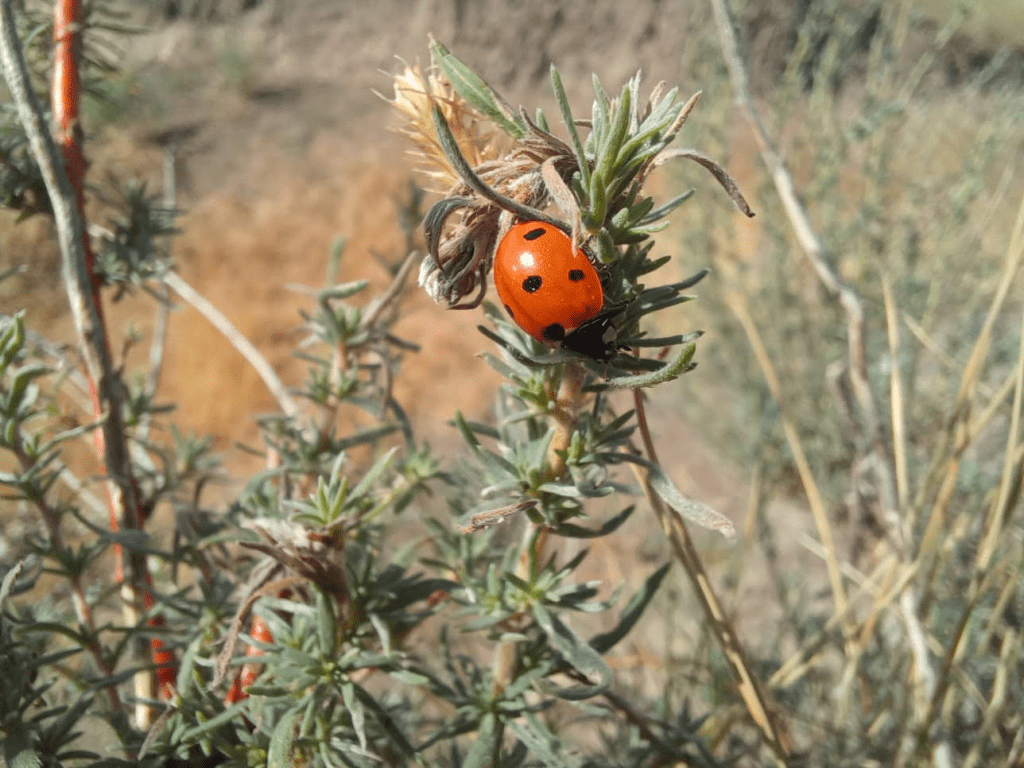
Suppose a tourist goes on a mountain hike or a kayaking trip and sees an interesting animal or plant they did not know before. They photograph it and send it to the relevant digital platform for data collection. It then turns out that this is a new invasive species for the country or even for the continent, one that harms agriculture or can carry some serious infectious disease, and so on. So there can be a problem at national or continental level that no one knows about, because its signs are still localised in a hard-to-reach area where no scientific expeditions go.
That is why citizen science has acquired special significance in field biology. Instead of scientific institutes, universities or three hundred research stations, we have tens or even hundreds of thousands of correspondents in each country. In fact, thanks to the efforts of citizen science, the number of research stations increases by orders of magnitude, and scientists can receive information in a timely manner that would take years to find using only specialists.
It is also very important that citizen activists all act at the same time. That is, on a given date you can announce an action and bring citizens together to photograph species of a certain group that are accessible to everyone, for example birds. And this will already be a screening study, sometimes even of a worldwide, planetary nature: millions of people simultaneously photograph birds in their localities and ornithologists learn where common species are located, because it is usually the common species that end up in the lens of participants in citizen science actions and programmes.
In other words, you should not expect that a citizen science activist will necessarily obtain information that a researcher cannot obtain. But monitoring common species is also extremely important, because even species that we consider ordinary, such as sparrows or goldfinches, have their own population dynamics. Animals and plants that everyone could see in their yard, in the field or in the garden 50, 20 or 10 years ago can later become vulnerable, threatened and even end up on the verge of extinction.
Operating solely with data from their own locality, a researcher may not notice this trend or may simply consider it a local phenomenon. And then it turns out that this phenomenon is global and a species that was quite recently common is now threatened throughout its entire range.
Why do dolphines need your photo?
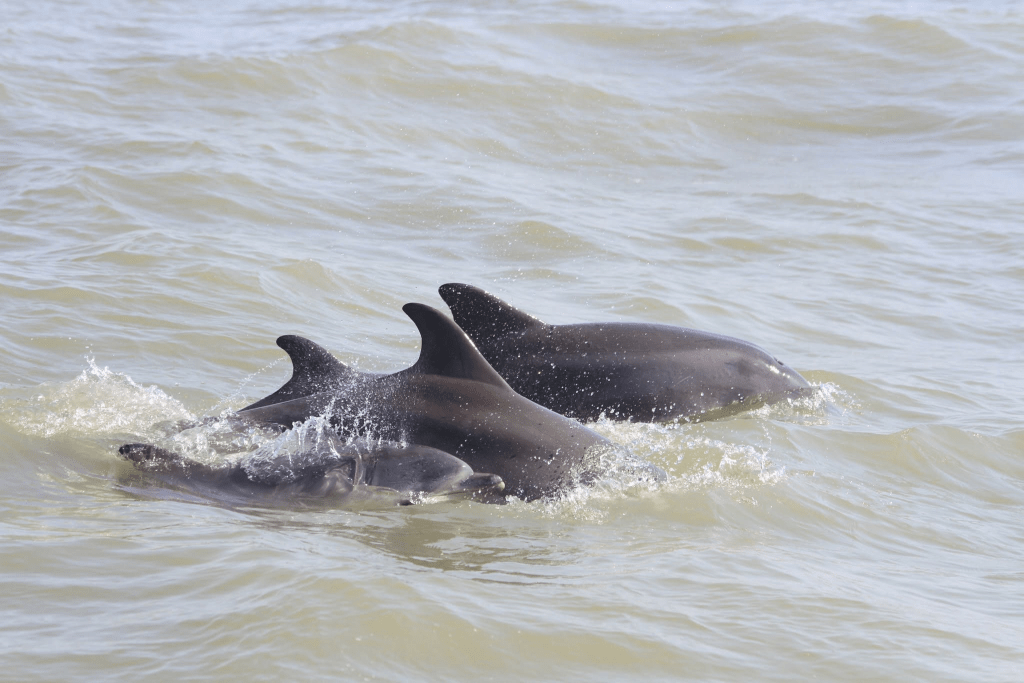
I myself study dolphins. For us, the efforts of citizen activists are very important. Because if an activist takes high-quality photographs of dolphins where the dorsal fin is visible, these images can be used for photo-identification. And you can find out that it is this particular dolphin, not any other, that ended up in the camera lens in a certain locality on a certain date. For example, today it was noticed near Odesa, and six months later near Istanbul.
In this way, you can find out the trajectories of movement of individual animals, and using these trajectories you can calculate the size of the group to which the dolphin belongs. And this is already a step towards understanding both the interrelationships between individual dolphin groups and their total numbers in the entire sea.
In essence, citizen science is a kind of scientific volunteering. But how do you encourage and motivate people to do it? Are there any incentives?
Actually, there are. For example, a researcher can receive a grant and use those funds to give prizes to the best activists. We in Ukraine are not currently using this. During martial law, we cannot expose people to danger. Because when a person develops a competitive spirit, they risk getting into a dangerous place for the sake of a prize. So we are not currently holding such actions or giving away gifts. But I hope we will be able to do this soon. At least in some safe locations.
What would you call the main limitations of citizen science, primarily in Ukraine? Apart from the fact that you cannot collect data in mined areas or in places where missiles, drones or their fragments have fallen.
Every citizen must comply with reasonable restrictions related to martial law and not go where it may be dangerous, whether it is a forest, a river or a garden. And this applies not only to scientific matters, but also to everyday issues. Unfortunately, this is part of our life, and after the current war there will still be locations with hidden ammunition for decades.
In addition, it should be understood that any citizen science platform or project associated with it is still a social network where age restrictions must apply. Of course, this is not something for small children. But for teenagers it is quite normal.
It seems to me that a significant incentive for amateur field observations is respect for the intellectual property rights of activists. Probably, anyone would be pleased if their contribution was officially recorded and acknowledged somewhere?
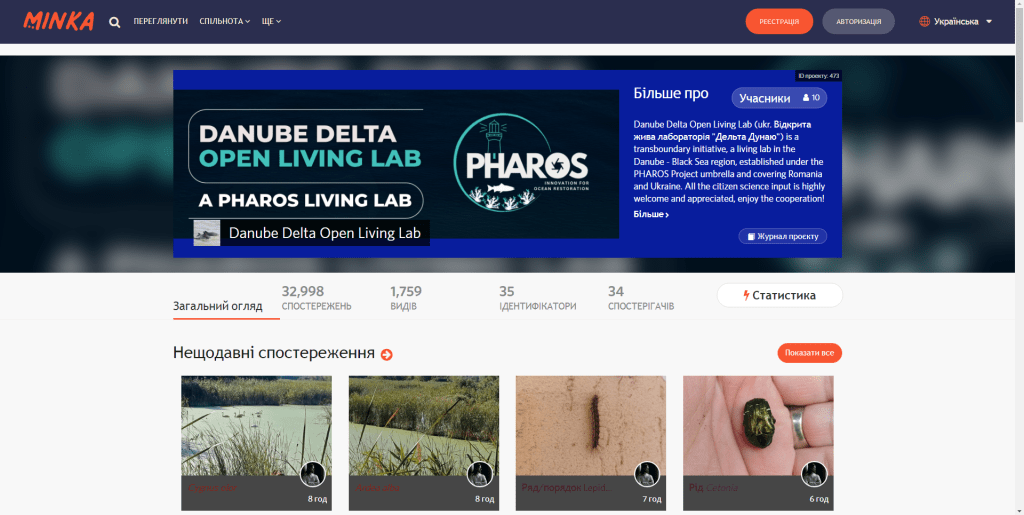
This is mandatory. And here I would like to say a few good words about the platform we are currently using within the new project. It is called MINKA SDG and is dedicated to achieving the UN Sustainable Development Goals. This platform is specially designed to comply with European Union legislation, including on copyright. Each user, when uploading their photographs or audio recordings there, can specify the type of licence for the use of this data, clearly defining the scope of their copyright. And the platform is built in such a way that other users will comply with these rights. That is, the author’s contribution will be fully preserved and very carefully documented.
How was Living Laboratory Danube Delta and PHAROS created?
The Living Laboratory Danube Delta was created and operates under the auspices of the PHAROS project under the Horizon Europe programme. It is one of four so-called lighthouse projects that are being implemented for each water basin around Europe. It covers the Atlantic Ocean and the Arctic seas, and its main area of application extends from the Canary Islands to Iceland. But the project implementers also invited colleagues from other basins to cooperate, including from the Black Sea, including Ukrainian and then Romanian institutions, so that we would reproduce the best practices and methodologies they use to study the Atlantic Ocean, and so that we would later launch a similar project for the Black Sea.
At the same time, another project is being implemented in the Danube basin, which belongs to the Black Sea region, with which we also maintain contacts. Obviously, several more lighthouse projects will appear in the future. The coordinator of the PHAROS project is the scientific and innovation platform PLOCAN, located in the Canary Islands. The initiator of the participation of Ukrainian institutions in it was the National University Lviv Polytechnic, which invited, among others, colleagues from the National Academy of Sciences of Ukraine. And our Institute responded, joined the application and later became a participant in the project.
A living laboratory is a concept that involves the simultaneous involvement of scientists, citizen activists, representatives of local communities, non-governmental organisations, business and others, so that each sector shares experience with others. The platform is needed so that we talk to each other, combine efforts to preserve biodiversity and restore habitats, propose and develop nature conservation solutions and new nature conservation technologies.
If we are talking, for example, about the Black Sea, then for us it is important to reduce its pollution, organise the collection and recycling of marine litter, propose sustainable development of aquaculture that will not pollute the sea, but on the contrary will clean it. From this point of view, for example, the cultivation of the Black Sea mussel is very promising, the population of which in our country has significantly decreased over the last century under the influence of invasive species such as the rapana. There is currently an excess of organic matter in the Black Sea. And the mussel can absorb it, because it is a natural filter feeder. So if we combine the efforts of civil society, business and scientists, as I said, then perhaps some projects will grow out of this that will make our environment better and society wealthier. This is the general ideology for which living laboratories are created.
Our Living Laboratory Danube Delta is an open living laboratory, that is, other interested participants can join it. It began its activities precisely with the introduction of citizen science methods to collect data on alien species that are moving into the Black Sea and into the Danube Delta, and then into other rivers of the Black Sea basin, such as the Danube, Dniester, Dnipro and others, and also to assess the interactions of these alien species with local species, to find out whether they compete with each other, suppress each other, feed on each other and thus create a new trophic network in the ecosystem, and also how marine and river species interact, particularly in the lower reaches of rivers.
Of course, we do not limit ourselves to collecting data only on aquatic species. Therefore, we ask our activists to provide data on terrestrial species. Because it is clear that no less important information comes from land than from aquatic ecosystems. And as of now, about 33,000 observations have been accumulated on the MINKA SDG platform, where, as I already said, we upload this data, within the Living Laboratory Danube Delta initiative. Of these, 10,000 observations have been verified and almost 2,000 species have been identified.”
Who is contributing?
There are currently 34 contributors and 35 evaluator-experts working on the platform, that is, people who perform identifications. In total, over 60 people. These are very different people, including individual activists. Taking this opportunity, I invite you personally and everyone who reads this interview to join and become participants. And biologists to become evaluators.
Is the Living Laboratory developing as you expected?
Well, as of now, this project is developing better than we expected. And on the MINKA platform, our national dataset is the largest outside the Iberian Peninsula, that is, Spain and Portugal. From this point of view, the initiative is developing well. But it is still desirable to evaluate it over a longer period than a year. Therefore, it is premature to say anything. Now we are at the stage of attracting participants and everyone who is interested in this, we ask them to join.
Why MINKA and not a global platform?
We use the MINKA platform because its terms of use, as I already said, comply with European Union legislation, including the protection of users’ copyright.
Obviously, in the context of European integration, this is important for Ukraine.
Yes, this is important in the context of European integration. And also in the context of understanding the public good. This platform was founded not by a private owner, but by a Spanish academic scientific institution, the Institute of Marine Research of the Higher Council for Scientific Research. That is, the platform was developed specifically to belong to the community of European peoples. And this is its fundamental difference from, perhaps, better-known and larger platforms, global and regional ones, that belong to private owners.
Among scientists there is an understanding that each country should have its own service for collecting scientific data and that the presence of national, local and local citizen science platforms in addition to global platforms and global repositories is an advantage. Therefore, of course, it is good that there are several global initiatives, but alongside them it will be extremely appropriate to have local initiatives as well.
For example, several nationwide platforms operate in Ukraine, including UkrBIN, the Ukrainian Biodiversity Information Network, which is managed by a consortium of organisations and independent researchers, and the Biodiversity of Ukraine Data Centre at the State Museum of Natural History of the NAS of Ukraine in Lviv. In the future, we would like to interact fruitfully with all national platforms so that the Living Laboratory could add data not only to the European platform, but also to national platforms, and so that all these platforms could integrate with each other, and data from them could enter global repositories and be in demand at all levels. We plan that an agreement will be signed between the UkrBIN and MINKA platforms this year.
Who are already partners of the Living Laboratory in Ukraine, besides the I.I. Schmalhausen Institute of Zoology of the NAS of Ukraine? And is this list open to joining new stakeholders?
It is open. Stakeholders can join officially or unofficially, whichever is more convenient for them, and use all the advantages of the living laboratory. Currently, official stakeholders of this initiative include, in particular, the Institute of Marine Biology of the NAS of Ukraine, the Institute of Hydrobiology of the NAS of Ukraine, the Ukrainian Scientific Centre for Marine Ecology, Taras Shevchenko National University of Kyiv, Vasyl Stus Donetsk National University, natural reserve fund objects, for example, the Danube Biosphere Reserve of the NAS of Ukraine, Kuyalnytskyi National Nature Park, and a number of public organisations and schools, Ukrainian and Romanian. We invite everyone to join.
Is Moldova involved? Although it does not have direct access to the Black Sea, it is considered a Danube country.
We very much hope that Moldovan organisations will also join in the future.
Is the Living Laboratory Danube Delta open to charitable initiatives? Can sponsors help it, or does it exist solely at the expense of the European Union and with the support of local communities?
Completely open. The concept itself envisages that the living laboratory will develop as a structure that supports itself. So over time it will be able to provide consultations to various organisations and everyone who needs them, and also, of course, accept and distribute contributions. Because if you take something, you have to give something back. And the living laboratory is founded precisely on the fact that it can both take and give.
How will the Living Laboratory develop further? Are there any plans for the near future and, possibly, for the longer term?
At this stage, the Living Laboratory will develop primarily as a citizen science project. And as soon as entrepreneurs join, it will also become a platform for entrepreneurial initiatives, nature conservation solutions and frugal technologies.
What do you see as the future and prospects of citizen science in Ukraine? Because, in my opinion, citizen science is roughly an analogue of participatory democracy, when people get involved not only in some socio-political processes, but also in scientific research, realising their freedom and initiative.
You have formulated it very well. That is approximately how it was conceived in the ideal.
- Dr Pavlo Goldin with Snezhana Mazurenko