What Is an Oligotrophic Desert?
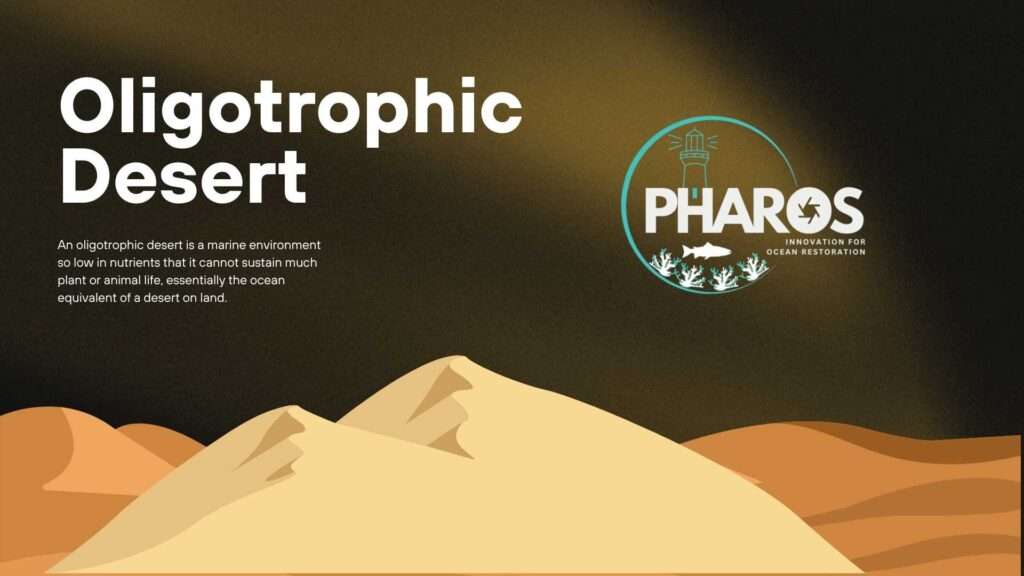
What Is an Oligotrophic Desert? https://pharosproject.eu/wp-content/uploads/2026/07/Oligotrophic-Desert-1024x576.jpg 1024 576 PHAROS Project https://pharosproject.eu/wp-content/uploads/2026/07/Oligotrophic-Desert-1024x576.jpgAn oligotrophic desert is a marine environment so low in nutrients that it cannot sustain much plant or animal life, essentially the ocean equivalent of a desert on land. The term comes from “oligotrophic,” meaning nutrient-poor, and scientists apply it to stretches of water where phytoplankton growth, the base of the entire marine food chain, has collapsed to near nothing. When a site is described as “approaching oligotrophic desert status,” it means decades of pressure have pushed that water toward becoming a biological wasteland.
Why Nutrients Matter So Much
Phytoplankton are microscopic organisms that use sunlight and dissolved nutrients like nitrogen and phosphorus to grow, exactly like plants on land use soil nutrients. Nearly everything in the ocean food web depends on this process, since phytoplankton feed the small fish that feed larger fish that eventually feed us. Satellite instruments actually track this by measuring chlorophyll-a concentration in surface water, and scientists use a specific threshold, around 0.15 milligrams per cubic metre in the Atlantic, to formally define where an oligotrophic zone begins. Below that line, the water simply does not have enough fuel to support a thriving ecosystem.
One Analogy: A Field After the Topsoil Is Gone
Picture a farm field where the topsoil has eroded away completely, leaving only bare, compacted subsoil behind. Seeds can still land there, but almost nothing grows because the nutrients that plants need have washed out. An oligotrophic marine desert works the same way: the water itself hasn’t disappeared, but the biological “soil” that fuels growth, the dissolved nutrients that feed phytoplankton, has been stripped away by currents, overfishing, or human interference, leaving a stretch of ocean that looks like water but functions like a wasteland.
Natural “Deserts” Versus Human-Made Ones
Some oligotrophic zones are entirely natural. The centres of subtropical ocean gyres, like the South Pacific Gyre, are naturally nutrient-poor because rotating currents trap surface water away from the nutrient-rich upwelling that occurs elsewhere, creating what researchers call the largest ocean desert on Earth. These natural deserts have existed for millions of years and support specially adapted microbial life that survives on almost nothing. But the deserts forming near coastlines today are a different story entirely, often the direct result of decades of overfishing, pollution, and climate stress compounding on top of naturally low productivity.
The Canary Islands Case of Oligotrophic Desert
The waters off Gran Canaria illustrate this human-driven version clearly. The Canary Current region is naturally oligotrophic to begin with, since it sits within a subtropical gyre system with limited nutrient upwelling, but decades of anthropogenic pressure have pushed specific coastal sites there to the edge of true desert status. Dr Pablo Reche García, PHAROS project manager, has described this stretch of Atlantic bluntly as an “underwater wasteland” shaped by overfishing, pollution, and climate change acting together over time. What makes this site scientifically useful, ironically, is precisely how degraded it has become, because it offers a clear baseline against which any recovery can be measured.
Reversing the Damage of Oligotrophic Desert Through Restoration
This is exactly the logic behind PHAROS choosing this location for its flagship Integrated Multi-Trophic Aquaculture demonstration. Rather than treating a nutrient desert as a lost cause, PHAROS is testing whether introducing macroalgae, fish, abalone, and sea cucumber together in a coordinated system can artificially recirculate nutrients that the ecosystem has been missing. Macroalgae in particular play a critical role here, absorbing dissolved nutrients from surrounding water and converting them into biomass, effectively rebuilding the base of the food chain that phytoplankton alone can no longer sustain locally. Reef restoration structures added to the same site are designed to increase organic particle retention and improve light distribution, giving marine organisms more chances to re-establish themselves in water that has offered them almost nothing for years.
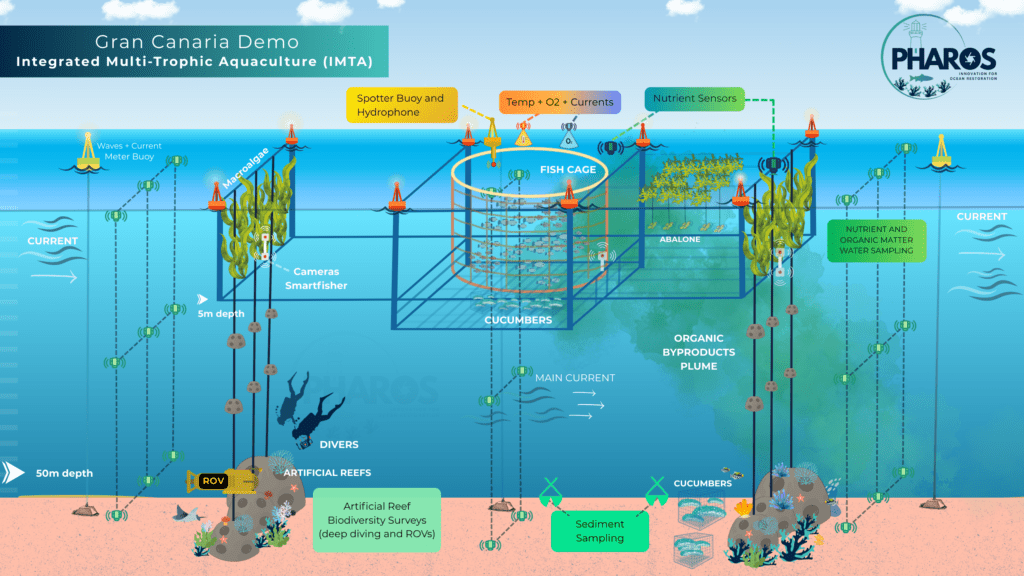
The Gran Canaria demo is being watched closely because success there would prove something significant: that an oligotrophic desert is not necessarily permanent, and that carefully engineered nature-based interventions can coax a degraded marine environment back toward biological productivity. That would matter well beyond the Canary Islands, since similar coastal nutrient deserts are appearing near heavily fished and polluted coastlines across the Atlantic and Mediterranean.