What Are Ecological Corridors?
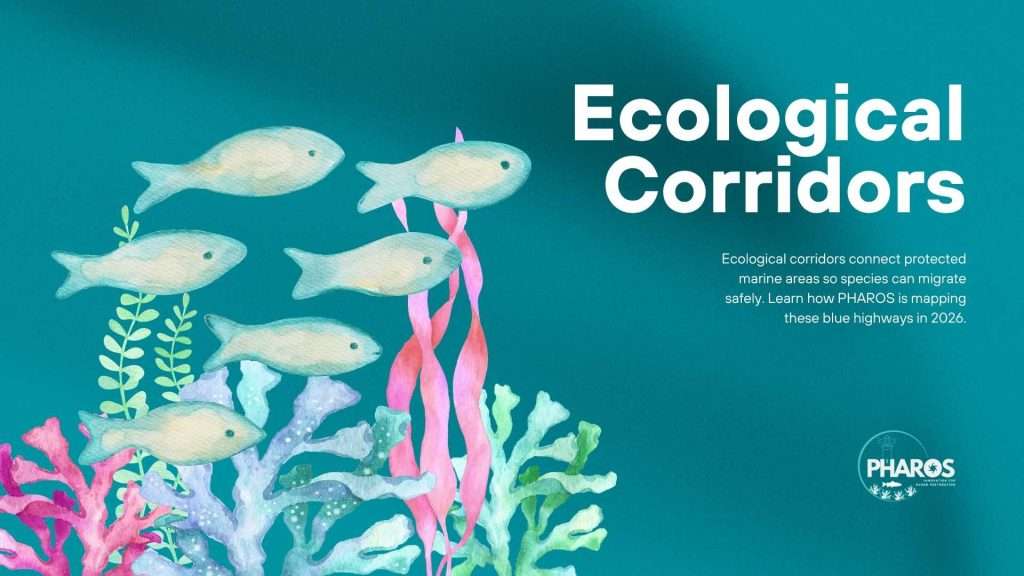
What Are Ecological Corridors? https://pharosproject.eu/wp-content/uploads/2026/07/Ecological-Corridors-1024x576.jpg 1024 576 PHAROS Project https://pharosproject.eu/wp-content/uploads/2026/07/Ecological-Corridors-1024x576.jpgEcological corridors are connected pathways of habitat that link separate protected areas together, allowing species to migrate, feed, and breed across a wider range instead of being trapped in isolated pockets of protection. In the ocean specifically, these are often called “blue corridors,” and they function as marine migratory highways that can span thousands of kilometres with no regard for political borders. Without them, even a well-managed Marine Protected Area risks becoming an isolated island of safety surrounded by unprotected, degraded water that species simply cannot cross.
Why Isolated Protection Isn’t Enough
Most Marine Protected Areas, or MPAs, have historically been managed as standalone units, effectively treated like a fenced garden rather than part of a connected system. The problem with that approach is that marine species don’t respect boundary lines. Fish migrate across entire ocean basins, larvae drift wherever ocean currents carry them, and turtles can travel thousands of kilometres between feeding and nesting grounds during a single life cycle. A turtle hatched off Cabo Verde, for instance, might spend its adolescent years feeding near the Azores, and if the water between those two protected areas is riddled with longlines and plastic pollution, the protection each site offers individually barely matters. Some of the scale involved here is worth putting into numbers:
- The EU has committed to protecting 30% of its seas by 2030, with 10% under strict protection, yet MPA coverage across Europe had only reached 13.7% by 2023, leaving significant gaps between protected zones
- Blue4All, the EU project developing corridor tools for PHAROS, works across a network of 25 Marine Protected Areas spanning the Baltic Sea, Mediterranean Sea, and North-East Atlantic
- Whales and other wide-ranging Arctic species rely on blue corridors that stretch across thousands of kilometres, often following sea ice as a natural guide between feeding and mating grounds
- Ocean covers roughly 71% of the Earth’s surface, yet corridor connectivity research in marine environments still lags decades behind similar work done on land
One Analogy: Stepping Stones Across a River
Picture trying to cross a wide river using only a handful of scattered stepping stones. If those stones sit too far apart, you simply cannot make the crossing safely, no matter how solid each individual stone is. Marine Protected Areas function the same way for migrating species: each MPA is a stepping stone offering safety, but if the gap between one MPA and the next is too wide, or filled with hazards like fishing fleets and pollution, no fish, turtle, or whale can actually make the journey between them. Ecological corridors are what turn a scattered handful of disconnected stones into an actual, walkable path across the water.
Building Corridors With Data, Not Guesswork
Designing an effective ecological corridor requires more than simply drawing a line on a map between two protected zones, it demands genuine ecological modelling. PHAROS and its sister project Blue4All use what are called Lagrangian models, a scientific method for simulating exactly how larvae and other drifting organisms move with real ocean currents over time. This lets MPA managers identify which stretches of water are genuine priority corridors worth protecting, rather than assuming connectivity based on rough distance alone. The same tools allow managers to spatialise pressures across a given corridor route, mapping where marine heatwaves are hitting hardest, where fishing fleets tend to cluster, and where cruise ship traffic churns through waters that migrating species need to cross.
PHAROS and the Enhanced Blueprint Platform
PHAROS is extending this corridor science through the Blue4All MPA Solutions Hub, formerly known as the Blueprint Platform, giving MPA managers a dedicated Ecological Corridors Module built specifically for this purpose. The module offers two core capabilities that didn’t exist in earlier MPA management tools:
- Tools to visualise and analyse connectivity between separate MPAs, turning abstract migration patterns into something managers can actually see and plan around
- Scenario-based assessments for ecological corridor management, letting managers test how a proposed corridor route would perform under different climate and human-pressure conditions before committing resources to it
This corridor work is being carried out in direct partnership with the Blue Connect project, which focuses specifically on connectivity across Macaronesia, the group of Atlantic archipelagos that includes the Canary Islands, Azores, Madeira, and Cabo Verde. That regional focus matters because Macaronesia’s islands sit inside several global biodiversity hotspots, making the corridors between them genuinely high-stakes for species survival rather than a theoretical planning exercise.
Corridors as Living Infrastructure
What makes ecological corridors different from a simple protected zone is that they need continuous monitoring to stay functional, since ocean conditions shift constantly with climate change. PHAROS addresses this by feeding live Digital Twin Ocean data directly into corridor planning, letting managers respond to marine heatwaves or shifting migration patterns as they happen rather than reacting to outdated seasonal reports. Artificial reefs deployed at PHAROS demo sites are also being designed with this connectivity goal in mind, positioned specifically to complement existing MPAs and help stitch together corridor routes rather than functioning purely as standalone habitat. This reflects the deeper principle running through the whole Blue4All approach: an MPA’s ecological value isn’t fixed at the moment of its designation, it depends on how well that protected patch of ocean stays connected to everything else a species needs to survive across its entire lifecycle.