What Is a Marine Forest?
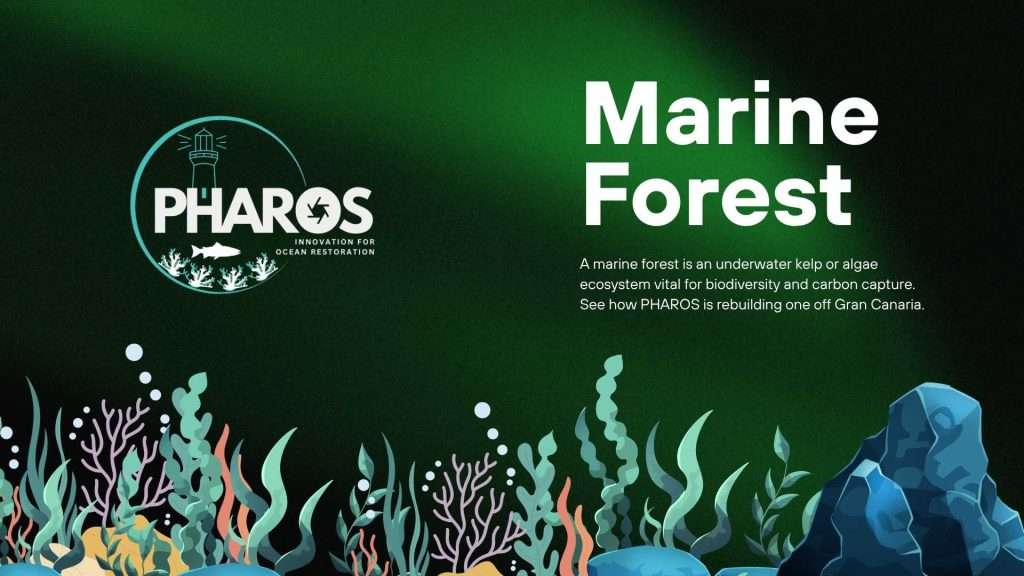
What Is a Marine Forest? https://pharosproject.eu/wp-content/uploads/2026/07/Marine-Forest-1024x576.jpg 1024 576 PHAROS Project https://pharosproject.eu/wp-content/uploads/2026/07/Marine-Forest-1024x576.jpgA marine forest is an underwater ecosystem where large algae, most commonly kelp or macroalgae, grow densely enough to form the same kind of layered, three-dimensional habitat that a forest creates on land. These forests provide food, shelter, and breeding grounds for thousands of fish, invertebrates, and marine mammals that would otherwise have nowhere to hide from predators or rough seas. Found along roughly 30% of the world’s coastlines, they rank among the most productive ecosystems in the ocean, yet remain largely invisible to most people simply because they sit below the waterline.
Structure Beneath the Surface of a Marine Forest
Kelp and macroalgae are not plants at all, they are large brown algae anchored to the seafloor by root-like structures called holdfasts, with flexible stems called stipes holding leaf-like blades up toward the sunlight. Many species carry gas-filled bladders that keep those blades floating near the surface where light is strongest for photosynthesis. This creates distinct vertical layers, a floating canopy at the top that shades everything below, a mid-water column where fish and invertebrates shelter among the fronds, and a rocky seafloor base, much like the canopy, understory, and forest floor of a woodland.
One Analogy: The Ocean’s Version of a Woodland
Think of a marine forest exactly like a forest you’d walk through on land. Tall kelp fronds function like tree canopies, blocking excess light and creating shade for smaller organisms below. Smaller marine species use the dense fronds as nurseries and hiding spots the same way birds and insects use shrubs and undergrowth, and just like a forest floor recycles fallen leaves into new soil nutrients, a marine forest’s base recycles organic matter back into the surrounding water. Remove the kelp, and you don’t just lose algae, you lose the entire structure that everything else in that ecosystem depends on.
Why These Forests Matter for Climate
Marine forests do more than house biodiversity, they actively fight climate change. Kelp forests and other macroalgae absorb dissolved carbon dioxide from the water column as they grow, helping buffer ocean acidification while locking carbon away in their tissue. This nutrient uptake also improves water quality directly, since macroalgae pull excess nitrogen and phosphorus out of the water before those compounds can trigger harmful algal blooms. Coastlines benefit too, as dense seaweed structures help stabilise shorelines and reduce erosion caused by waves and currents.
Building a Marine Forest From Scratch in Gran Canaria
PHAROS is putting this concept into practice off Gran Canaria, where decades of overfishing and pollution have pushed local waters toward oligotrophic desert status, meaning the natural nutrient base needed to support algae growth has nearly disappeared. Rather than waiting for nature to recover on its own, the project is actively deploying macroalgae forests attached to specially engineered artificial reefs positioned on the seafloor and suspended mid-water. This combined “reef plus macroalgae” arrangement is designed to give barren biotopes exactly what they’re missing: shelter and breeding grounds for marine life, plus a nutrient uptake system that reduces water pollution while simultaneously capturing CO2.
The demo takes deliberate advantage of a byproduct from a neighbouring PHAROS site, an Integrated Multi-Trophic Aquaculture system. Long ropes of fast-growing green macroalgae, Ulva lactuca, are strung downstream from a fish farm specifically to intercept the dissolved nutrients that fish waste releases into the water, turning what would otherwise be pollution into fuel for forest growth. Positioning the macroalgae ropes on both 2D mooring attachments and 3D reef structures on the seafloor maximises the surface area available for algae to colonise and for fish and crustaceans to find refuge among.
A Model Built for Comparison & Growth
PHAROS is running a parallel experiment in Bantry Bay, Ireland, that adds an important nuance to this restoration story. There, winged and sugar kelp are cultivated both near a commercial salmon farm and at a separate control site with no salmon nearby, and the first full season of data revealed a genuine trade-off: the control site grew more kelp biomass overall, but the site near the salmon farm hosted far greater biodiversity of tiny marine life. That finding matters because it shows marine forest restoration is not simply about maximising algae growth, it is about understanding which configuration delivers the ecosystem benefits a given site actually needs, whether that’s raw biomass, biodiversity, water filtration, or carbon capture.