Gardening the Atlantic: An experiment to farm fish and grow reefs side by side
Gardening the Atlantic: An experiment to farm fish and grow reefs side by side https://pharosproject.eu/wp-content/uploads/2026/10/Sucesion-Daroc-con-logo-final-1-1024x414.png 1024 414 PHAROS Project https://pharosproject.eu/wp-content/uploads/2026/10/Sucesion-Daroc-con-logo-final-1-1024x414.pngA pioneering EU-backed trial off Gran Canaria will test whether fish farming can be made kinder to the sea, with smart substrates (or Smart Enhanced Reefs) as a living safety net.
Fish farming has a waste problem. Uneaten feed and fish droppings drift out of the net cages and into the surrounding water. Off the Canary Islands, a research consortium is trying to turn that problem into an opportunity, and to build something close to a sea garden in the process.
The trial is part of PHAROS, an EU-funded project led by the Canary Islands Ocean Platform (PLOCAN), running from September 2024 to August 2029. The Gran Canaria demonstration will combine a fish farm with seaweed and shellfish that feed on its by-products, then surround the whole arrangement with specially designed artificial reefs.
Farming like an ecosystem
The approach has an unwieldy name, Integrated Multi-Trophic Aquaculture, or IMTA. The idea is simple. Species from different levels of the food chain, such as fish, seaweed and shellfish, are farmed close together to improve efficiency, reduce waste and clean the water. Seaweed absorbs dissolved nutrients, and shellfish or sea cucumbers can consume particles of waste.
Brussels likes the idea. The EU’s strategic guidelines for 2021 to 2030 promote IMTA among the farming methods most beneficial to the environment and climate. Early studies on the project’s own species mix suggest abalone and sea cucumbers perform best at a 70:30 biomass ratio, offering both economic and environmental benefits.
The reefs: three designs, three depths
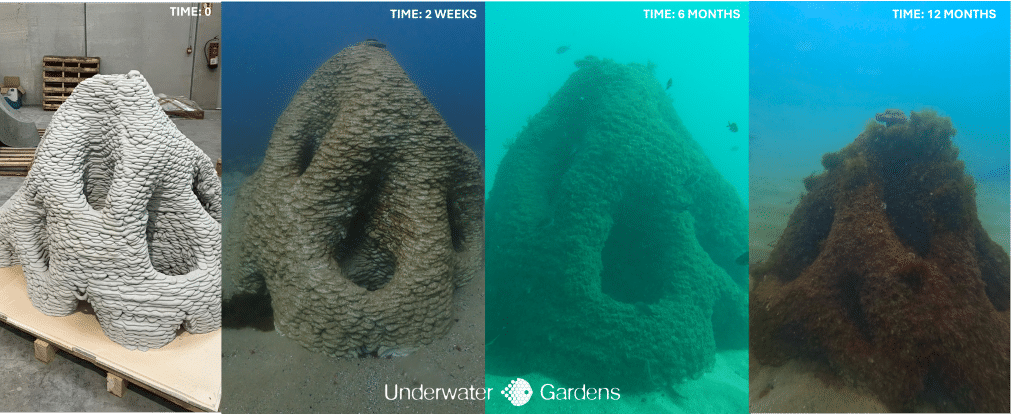
The smart substrates are the work of Underwater Gardens International (UGI), a Barcelona-based company founded in 2016 by Marc García-Durán Huet. Its Smart Enhanced Reefs (SER®) are made of concrete-based materials for resistance, but are covered with a crust of calcium carbonate nature, and the Gran Canaria set comes in three types, each aimed at a different slice of marine life.
- Type A (Daroc 2.0-rif®) is the heavyweight. Each unit is a rounded, perforated structure roughly 1.2 metres tall and weighing around 1.6 tonnes. Ten units will rest on the seabed at 45 to 50 metres, in two clusters of five, under the farm. They are designed for creatures that live on the seabed.
- Type B (Clamping-rif®) is a much lighter piece of roughly 100 kilograms, shaped like a curved loop that clamps around a cable. These will hang in the water column between about 5 and 15 metres, attracting free-swimming fish, fish larvae and zooplankton, the tiny drifting animals at the base of the food chain. The designers expect marine growth to raise each piece’s weight to around 150 kilograms and its volume to as much as 0.7 cubic metres within 12 to 24 months.
- Type C is a small textured panel, about 40 by 40 centimetres, fixed in groups to concrete blocks on the seabed. It is aimed at small bottom-dwelling fish and at organisms that attach themselves to surfaces.
What success looks like
The monitoring plan will track four things: how quickly marine life colonises these substrates, whether the structures hold up in the ocean, how complex the habitat becomes (more nooks and crannies generally mean more species), and the thin film of microbes that coats new surfaces and often prepares the ground for larger organisms. Divers from the University of Las Palmas de Gran Canaria’s science and technology foundation (ULPGC-FCPCT) will take samples regurlarly and analyse the data. Underwater cameras, some using AI to identify species, will be placed around the seaweed lines, and diving surveys aided by robotic vehicles will inspect the deeper new habitats.
The case for, and the questions
Supporters can point to local precedent. Concrete structures placed on the seabed at Pasito Blanco in 1991 by the University of Las Palmas have since become a rich habitat. The project’s backers also cite the nearby El Cabrón Marine Reserve, home to more than 400 species, as the benchmark to aim for.
Caution is still warranted. Marine scientists have long debated whether artificial reefs create new life or simply draw fish in from elsewhere, and whether they can match a natural habitat. One might argue that there are different phases in play. At first, new inhabitants come from existing nearby colonies, but once they settle, reproduction and grow go in the direction of a new habitat. The trial’s monitoring is designed to produce evidence on this, but first results will take time. IMTA itself also remains a work in progress in Europe. Under EU law, farmed animals cannot be fed on waste, which invalidates some designs that pair fish with shellfish and sea cucumbers that recycle fish waste.
Why it matters
Europe wants more home-grown seafood without damaging the coasts that supply it. If a farm can clean up after itself and leave a richer seabed behind, the case for expanding aquaculture becomes much stronger. If not, the trial will still show clearly where the limits lie, and that is the point of a demonstration project.
Contacts: PLOCAN (project coordinator); Marc García-Durán, CEO, UGI; Francisco Otero-Ferrer, ULPGC-FCPCT (diving, sampling, data analysis).