Who Are Citizen Litter Entrepreneurs?
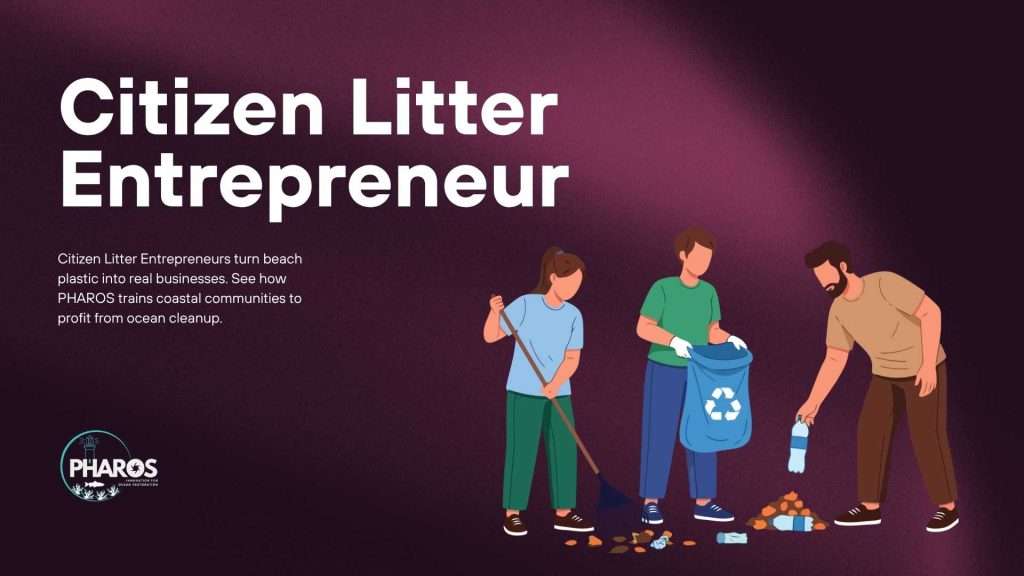
Who Are Citizen Litter Entrepreneurs? https://pharosproject.eu/wp-content/uploads/2026/07/Citizen-Litter-Entrepreneur-1024x576.jpg 1024 576 PHAROS Project https://pharosproject.eu/wp-content/uploads/2026/07/Citizen-Litter-Entrepreneur-1024x576.jpgCitizen Litter Entrepreneurs are ordinary people, from beachgoers to small local businesses, who are trained and supported to turn collected marine plastic waste into genuine commercial products and startups. Rather than treating beach cleanups as a purely voluntary, one-off activity, this programme gives participants a structured entrepreneurial pathway: guidance, tools, and mentoring to build a real zero-waste business around the litter they collect. It reframes plastic pollution from a problem someone else needs to solve into a resource ordinary citizens can build a livelihood from.
Where the Model Came From
The programme originates from REMEDIES, a Horizon Europe Mediterranean Sea Lighthouse project built around three core pillars: monitoring plastic litter, collecting and valorising it, and preventing new plastic from ever reaching the water. REMEDIES tested its approach across eight demonstration sites in eight Mediterranean countries before scaling up to 33 additional sites, with the explicit goal of eventually launching similar programmes across the entire Mediterranean basin. That pilot phase generated a strong track record before PHAROS adopted the model for the Atlantic and Arctic:
- 12 separate innovations tested and validated specifically for entrepreneurial plastic valorisation
- A dedicated Network of Experts established to support community-based litter solutions
- The “Plastic Fantastic” hackathon, which crowdsourced innovative marine litter solutions internationally
- A full entrepreneurial curriculum built specifically to cultivate sustainability-focused business skills
- Financial support of up to €100,000 per Associated Region to help replicate and scale validated solutions
One Analogy: Turning Weeds Into Resources
Citizen Litter Entrepreneurs works a bit like teaching a farmer to see an invasive weed not as a nuisance to burn, but as raw material for a marketable product, medicine, dye, or textile fibre. The weed itself doesn’t change, it’s still choking the field, but the farmer’s relationship to it flips entirely once someone shows them how to harvest and process it into something buyers actually want. Beach plastic works the same way in this programme: it’s still pollution sitting on the sand, but a citizen trained through this pathway learns to see it as free raw material for furniture, fashion, or building materials, turning a cleanup chore into an income stream.
PHAROS Brings the Model to the Atlantic and Arctic
PHAROS partnered with Impact Hub Athens to extend and roll out this Citizen Litter Entrepreneur programme across the Atlantic, EU outermost islands, and Arctic basin, targeting regions where unemployment and marine litter often coincide as compounding local problems, such as the Canary Islands. The programme runs through three linked components: inspiration, showcasing successful litter entrepreneurs and running “Meet the Oceanpreneur” webinars; ideation, running cross-European hackathons to generate new litter-reduction concepts; and capacity building, delivering months of coaching, mentoring, and pitching support to help ideas become real ventures. Concrete output targets attached to this work include:
- Mapping 20 case studies of successful citizen entrepreneur initiatives across selected regions
- Delivering 8 “Meet the Oceanpreneur” webinars showcasing best-practice examples
- Supporting 30 citizen ideas through cross-European hackathons involving 30 experts
- Providing 4 months of acceleration support, including investment-readiness training and circularity toolkits, to 15 citizen initiatives
- Hosting a pitching event where 6 to 10 project ideas present directly to impact investors and corporate stakeholders
From Webinar Series to Real Ventures
The flagship engagement tool driving this programme in 2026 is “Meet the Oceanpreneur,” an eight-part webinar series launched by Impact Hub Athens that runs from September 2025 through November 2026. Each session tackles a distinct theme, ranging from plastic pollution to sustainable tourism, co-curated with a partner Mission Ocean project whose representative moderates the discussion. A related in-person seminar held in January 2026, titled “From Waste to Value,” walked Canary Islands participants through real best practices for becoming ocean entrepreneurs, drawing on concrete regional examples of turning plastic waste into economic, social, and environmental value.
PHAROS has also plugged this programme directly into its wider Hackathon Boot Camp, which selected twenty teams from sixteen countries working on ocean-protection concepts ranging from AI-driven plastic traceability systems to plastic-to-furniture conversion businesses. Track A supports early-stage individuals and teams still refining their concept, while Track B backs already-established companies or non-profits under five years old looking to scale existing solutions. Projects shortlisted in this cohort include ventures converting beach plastic into handcrafted games, transforming low-value plastics into construction materials, and building AI-driven digital passports that trace marine debris back through its full recycling chain.
Why This Model Matters Beyond Cleanup Numbers
What separates Citizen Litter Entrepreneurs from a standard beach cleanup campaign is the explicit goal of building a self-sustaining circular economy around plastic waste rather than depending on repeated volunteer mobilisation. PHAROS frames this programme, alongside Fisher Guardians, as part of a broader strategy to fundamentally change how coastal communities perceive their own role in ocean protection, shifting from passive victims of pollution to active economic beneficiaries of cleaning it up. That shift matters most in exactly the regions PHAROS has prioritised, island communities facing high unemployment, where a viable litter-based business can address two problems, marine pollution and economic precarity, with a single entrepreneurial pathway.