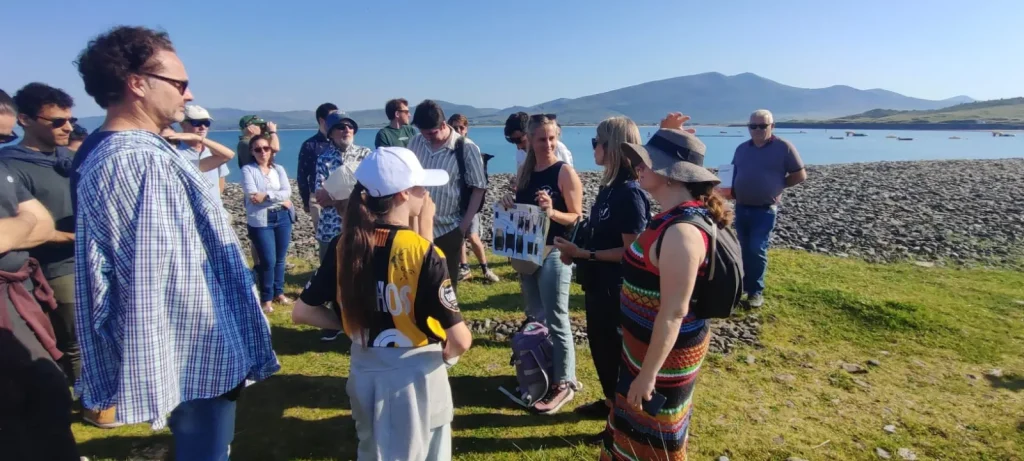
Launch of the Ireland Living Lab
Launch of the Ireland Living Lab https://pharosproject.eu/wp-content/uploads/2026/09/Living-Lab-Launch-MINKA-2026-05-26-at-19.37.00-1024x461.webp 1024 461 PHAROS Project https://pharosproject.eu/wp-content/uploads/2026/09/Living-Lab-Launch-MINKA-2026-05-26-at-19.37.00-1024x461.webpThe PHAROS Ireland Living Lab was officially launched on the Maharees Peninsula in County Kerry on Tuesday 26 May 2026, as the opening-day highlight of the PHAROS Ireland Mega Event. The launch brought research, policy and community stakeholders together on the shoreline of one of Ireland’s most ecologically significant and climatically exposed coastal zones, and placed a citizen science platform, MINKA, directly into the hands of the community that will use it.
MINKA Citizen Science Platform at the Maharees Peninsula
| Ireland Living Lab Lead | Munster Technological University (MTU Kerry), Circular Bioeconomy Research Group |
| Living Lab site | Maharees Peninsula, Castlegregory, County Kerry |
| Launch event | Tuesday 26 May 2026, 17:00 to 19:00 |
| Launch host partner | Maharees Conservation Association |
| Platform | MINKA citizen science platform |
The launch forms part of a wider three-day programme (26 to 28 May 2026) hosted by MTU Kerry in partnership with Bantry Marine Research Station, attended by over 200 stakeholders from research, education, citizen science networks, fisheries, policy, the National Parks and Wildlife Service, and international partners from the PHAROS consortium.
The Living Lab operates in direct partnership with the Maharees Conservation Association, which has delivered a decade of community-led coastal restoration work in the area. Through this partnership, PHAROS is embedded within an established, trusted and highly engaged community structure, rather than arriving as an external project. This positioning is central to the Living Lab’s design and to its longer-term viability.
Key launch outcomes include: the public introduction of the MINKA platform and its first community observations; demonstration of nature-based solutions already in operation on the dune system; direct engagement with secondary school students from Meánscoil Nua an Leith-Triúigh and their award-winning Ringed Plover project; and the commitment of the Maharees community to extend the platform’s use into coastal erosion monitoring, dune protection and marine plastics.
The report sets out the context, the launch activities, stakeholder participation, outcomes to date, and the planned 24 months of work leading to the second PHAROS Ireland Mega Event in 2028.
Context: The Maharees Peninsula
The Maharees is a five-kilometre natural tombolo on the Dingle Peninsula, a wind-shaped neck of sand connecting the mainland to a group of offshore islands and separating Brandon Bay from Tralee Bay. The dune system that forms the peninsula is both the community’s natural asset and its primary defence against the Atlantic.
The Maharees sits within a Special Area of Conservation that spans more than 25 kilometres of coastline. It holds the highest number of protected habitats of any area in Ireland (16) and the third highest number of protected species (28). It is home to the natterjack toad, Ireland’s only native toad, and provides critical breeding grounds for ground-nesting shorebirds including the ringed plover, currently on the amber list of conservation concern.
The dune system has retreated by more than 40 metres in recent decades. Climate change, intensifying storms, rising sea levels and local pressures (notably vehicle and foot traffic) are accelerating that loss. A 2019 survey recorded 23,040 vehicles on the Maharees road in a single week, with associated impacts on the marram grass that stabilises the dunes.
The combination of ecological importance, climate vulnerability and visible community action makes the Maharees an exemplary site for a PHAROS Living Lab. It allows the project to demonstrate nature-based solutions, co-created citizen science, and intergenerational engagement in a landscape where the stakes, the science and the community effort are all clearly legible.
The Launch Event
The Ireland Living Lab was launched on Maharees Beach on Tuesday 26 May 2026, between 17:00 and 19:00. The event formed the closing activity of Day One of the PHAROS Ireland Mega Event, following a Policy Round Table on Marine Protected Area management and the Waste to Worth circular economy showcase, both delivered earlier the same day at MTU Kerry’s An Cuan STEM Building in Tralee.
Participants travelled from the MTU campus to the Maharees coast by coach. On the beach, local residents, secondary school students, environmental advocates and researchers from MTU gathered on the shoreline for a working launch focused on hands-on citizen science rather than ceremony.
Programme elements on the day included:
- A guided walk of the dune system led by the Maharees Conservation Association, demonstrating nature-based restoration measures already in place, including marram grass planting, chestnut fencing and designated access routes.
- A live demonstration of the MINKA citizen science platform, with participants capturing their first geo-tagged observations of marine life, dune vegetation and coastal features along the shoreline.
- A presentation by students from Meánscoil Nua an Leith-Triúigh on their award-winning Ringed Plover protection project.
- Open discussion between PHAROS researchers, community members and visiting international delegates on priorities for the Living Lab’s forward programme.
The launch was followed in the evening by a ‘Pint of Science’ event at Spillanes Bar in the Maharees, which allowed researchers, community members and international delegates to continue the conversation in an informal setting.
The MINKA Citizen Science Platform
MINKA is an open-access citizen science platform through which users contribute geo-tagged photographic observations of marine and coastal species, habitats, pressures and features. Observations are added to a long-term environmental record that supports biodiversity monitoring, coastal erosion tracking and marine litter detection.
For the PHAROS Ireland Living Lab, MINKA provides the primary vehicle for sustained community engagement with the Maharees landscape. The platform serves several linked purposes:
• For scientists, it generates a continuous, high-resolution record of biodiversity, dune condition and marine pollution along the Maharees shoreline, suitable for integration into the PHAROS wider digital twin and MPA network activities.
• For the Maharees community, it provides a direct and visible stake in the science and in the data generated about their own coast.
• For schools and visitors, it offers a straightforward, mobile-first way to contribute observations and to see how local records fit within a wider European dataset.
The Maharees community has committed to extending the use of MINKA beyond the initial biodiversity use case. Priority applications identified at the launch include coastal erosion tracking, dune integrity monitoring and marine plastic observation, each of which aligns directly with the Maharees Conservation Association’s climate adaptation and nature-based restoration priorities.
Community Partnership: The Maharees Conservation Association
The Ireland Living Lab is anchored in a working partnership with the Maharees Conservation Association, founded in 2016 in response to a winter during which the only road onto the peninsula was impassable on 17 occasions due to storm-driven sand.
Over the subsequent decade, the association has delivered a sustained programme of community-led coastal restoration in partnership with Kerry County Council, University of Galway, Munster Technological University and state agencies. Interventions have included:
- Planting marram grass to stabilise degraded sections of the dune system.
- Installing 800 metres of chestnut fencing to designate beach access routes and prevent trampling, funded by Kerry County Council with partner contributions.
- Delivering climate adaptation planning, including a community survey that achieved an 82% response rate (an unusually high benchmark for coastal communities of this size).
- Developing regenerative tourism approaches, including a 2025 visitor leaflet on local food, biodiversity and responsible beach use.
- Aerial photography of previously degraded sections of the dune system (notably Magherabeg Cut) shows significant recovery following these interventions. The association has become one of Ireland’s most effective community-led coastal restoration initiatives, and the PHAROS Living Lab builds directly on that platform.
“We have been engaging in community custodianship of our Special Area of Conservation here for the last 10 years. You’re standing on the tombolo right now. It is protected at a European level for the amount of wildlife it supports.”
Martha Farrell, co-founder, Maharees Conservation Association
Martha Farrell has led the Maharees Conservation Association’s engagement with PHAROS from the outset, and is the named community lead for the Ireland Living Lab on the Maharees side. Her involvement, and the trust built with residents over the preceding decade, has been central to the Living Lab’s reception within the community.
Intergenerational Engagement and the Ringed Plover Project
A defining feature of the launch was the active role of secondary school students from Meánscoil Nua an Leith-Triúigh, Castlegregory, who presented their work on the protection of the ringed plover. The ringed plover is listed on Ireland’s amber conservation list and nests directly on shingle and sand beaches at the high water line, making it exceptionally vulnerable to human disturbance.
The students, working with teacher Karen Blennerhassett and in collaboration with the Maharees Conservation Association, PHAROS researchers and MTU, developed a multi-channel protection and awareness campaign. Their activities have included:
- Setting up dedicated TikTok and Instagram accounts to raise awareness among younger beach users.
- Producing an interactive workbook on responsible beach use.
- Delivering workshops in local primary schools.
- Collaborating with the Fossa Sustainability Fair and the Maharees Conservation Association on wider community outreach.
The project (branded ‘GoWild’) received national recognition at the ECO-UNESCO Young Environmentalist Awards 2026, winning both the Senior Biodiversity Award and the Overall Senior Award from a field of 340 projects submitted across 29 counties. The students presented their work directly to PHAROS international delegates at the Maharees launch, a visible example of intergenerational handover of coastal stewardship.
“The Maharees is an incredibly significant area for wildlife and insect life, but these little birds really have a stronghold on the peninsula here. It’s one of the most dense areas in the country for nesting ringed plover. By staying off of where you typically expect to see them, we won’t have any issues with trampling.”
Sarah Barry, ecological expert
The schools dimension of the Living Lab was further strengthened on Day Two of the Mega Event, when over 20 primary and secondary school teachers attended a dedicated EU Blue Schools workshop at MTU Kerry and were introduced to MINKA as a vehicle for engaging their own students in citizen science. The link between the Living Lab and the classroom is a deliberate design feature, creating a route for the platform to be adopted beyond the Maharees itself.
Stakeholder Engagement and Participation
The PHAROS Ireland Mega Event brought over 200 stakeholders to Kerry and West Cork across the three days. Stakeholder categories included:
- Research and higher education (MTU, University College Dublin, University of Galway, Bantry Marine Research Station, and international partners from the PHAROS consortium).
- Policy and public bodies (Department of Climate, Energy and Environment, National Parks and Wildlife Service, Kerry County Council).
- Citizen science networks and community organisations (Maharees Conservation Association, local volunteer networks in Fenit).
- Fisheries representatives (Tralee Bay Oyster Fisheries Society, local fishers from Tralee Bay).
- Education (primary and secondary school teachers and students from across Kerry).
- Industry and innovation partners (MTU Clean Technology Centre, BIM Clean Oceans Initiative, INSPIRED charity, WAZP).
The Maharees launch event itself drew a mixed audience, with the balance tilted toward community participants: Maharees residents and volunteers, secondary school students and teachers, and families alongside visiting researchers and international delegates. This profile is intentional. The Living Lab is designed to be led from the community, with research and policy stakeholders present as partners rather than principals.
“What’s stayed with me from this week is how completely the conversation moved from the page into the room. The MINKA Living Lab launch was a particular highlight, because it gives the Maharees community a real platform to keep doing the work long after the visiting delegates have gone home. That, for me, is what success looks like: research that leaves something behind in the community that hosted it.”
Eve Savage, Programme Manager, PHAROS Ireland, MTU
Outcomes and Alignment with PHAROS Objectives
The launch delivers against several of the PHAROS project’s stated objectives, particularly in the areas of citizen engagement, Living Lab establishment and Marine Protected Area network support.
Launch outcomes
- Formal establishment of the Ireland Living Lab, with Maharees Peninsula confirmed as the Irish demonstration site.
- MINKA citizen science platform live and in community use, with first observations captured during the launch.
- Formal partnership in operation between MTU Kerry and the Maharees Conservation Association.
- Over 20 primary and secondary school teachers trained on MINKA as a classroom citizen science tool, creating a direct pipeline between the Living Lab and schools across Kerry.
- Direct engagement between international PHAROS delegates and the local community, including school students presenting their award-winning work.
- Media coverage secured across local, trade and national channels, raising the visibility of the Living Lab beyond the Maharees itself.
Alignment with PHAROS objectives
- Objective 1 (Citizen and stakeholder engagement, co-creation and community-led biodiversity solutions): directly delivered through the MINKA launch and the community partnership model.
- Objective 3 (Extending MPA Blueprint Platform and network to the Atlantic and Arctic): supported through the deepened partnership with LIFE MPA Networks established during Day One of the Mega Event, feeding into Ireland’s MPA designation process.
- Objective 4 (Fisher and citizen Guardians and Cleaners of the sea programmes): advanced through the connected activities at Fenit and the Waste to Worth showcase, which together connect the Living Lab to the fisheries and circular economy dimensions of PHAROS.
- Objective 6 (Extending the Network of Blue Schools and ocean literacy): advanced through the Blue Schools workshop and student engagement at the launch.
Next Steps: 24 Months to the 2028 Mega Event
The launch marks the start of a 24-month delivery phase leading to the second PHAROS Ireland Mega Event, confirmed for 2028. Priority areas of work over this period include:
- Scaling MINKA activity in the Maharees community, with growth targets for registered users, observations recorded and schools actively contributing data in the Fenit Port and heritage park.
- Extending MINKA use into coastal erosion tracking, dune integrity monitoring and marine plastics, in line with community priorities.
- Formalising the Blue Schools pipeline, supporting the 20+ teachers trained at the Mega Event to deploy MINKA in their classrooms, and tracking student engagement and outputs to build a cluster of Blue Schools in the Southwest of Ireland.
- Deepening the LIFE MPA Networks partnership, with MTU Kerry acting as a supporting actor in the triad between European MPA best practice, Ireland’s MPA designation process, and citizen and stakeholder engagement.
- Integrating Living Lab data into the wider PHAROS digital twin and MPA network activities.
- Reporting progress through PHAROS consortium meetings, project deliverables and dissemination activity, culminating in the 2028 Mega Event.
“The PHAROS Ireland Mega Event has shown the calibre of work being delivered from this region, and how that work connects directly to European priorities. Hosting a consortium of 24 institutions from 12 countries here in Kerry and West Cork demonstrates the trust placed in MTU Kerry as a partner, and the ambition we now hold for the next 24 months of work leading into the 2028 PHAROS Ireland Mega Event.”
Dr Helena McMahon, Director, Circular Bioeconomy Research Group, MTU
The launch of the PHAROS Ireland Living Lab at the Maharees on 26 May 2026 was a successful opening to Ireland’s role in the PHAROS project. It established MINKA as an operational citizen science platform within the community, confirmed an active partnership with the Maharees Conservation Association, created a route into Kerry schools through the Blue Schools pipeline, and secured a visible local, national and European audience for the Living Lab’s work. More importantly, the launch delivered something the community can continue to use independently of the project calendar. The Living Lab is now in the hands of the people who live, work and learn on the Maharees coast.
Contact
Eve Savage Programme Manager, PHAROS Ireland · Circular Bioeconomy Research Group · Munster Technological University (MTU Kerry) · Eve.Savage@mtu.ie