What Is the Blue Economy?
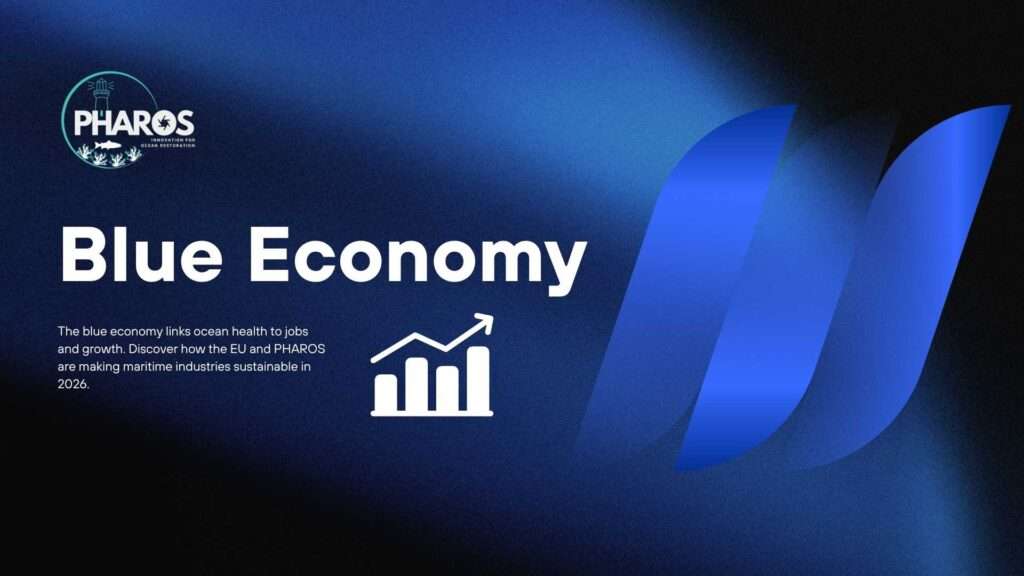
What Is the Blue Economy? https://pharosproject.eu/wp-content/uploads/2026/07/What-is-the-Blue-Economy-1024x576.jpg 1024 576 PHAROS Project https://pharosproject.eu/wp-content/uploads/2026/07/What-is-the-Blue-Economy-1024x576.jpgThe blue economy is the sum of all economic activity connected to oceans, seas, and coasts, spanning traditional sectors like fishing and shipping alongside newer fields like offshore wind and marine biotechnology, all measured against a single condition: that the ocean must stay healthy enough to keep generating that value. In 2023, this sector generated an estimated €263 billion in gross value added for the EU economy and supported nearly 5 million jobs, making up 1.7% of the EU’s total economic output. For a region surrounded by four seas and two oceans, that is not a niche industry, it is core European infrastructure.
Defining the Scope of Blue Economy
The European Commission splits the blue economy into two broad categories that together capture its full reach. Marine-based activities happen directly on or in the water, covering capture fisheries, aquaculture, offshore energy, desalination, shipping, and coastal tourism. Marine-related activities support those industries from land, including seafood processing, shipbuilding, port operations, marine biotechnology, and maritime insurance. Even parts of the public sector fall inside this definition, since coast guards, naval defence, and marine environmental protection are all essential to keeping ocean-based industries functioning.
One Analogy: An Economic Coral Reef
Think of the blue economy less like a single factory and more like a coral reef. A reef is not one organism, it is thousands of different species living in interconnected dependency, where the health of the coral itself determines whether fish, algae, and everything above them in the food chain can survive. The blue economy works the same way: shipping needs healthy ports, ports need clean water, aquaculture needs stable ecosystems, and tourism needs an ocean worth visiting. Damage the base layer, the ocean’s actual health, and every dependent industry built on top of it eventually collapses too.
Why “Sustainable” Is Not Optional for Blue Economy
The EU deliberately uses the term “sustainable blue economy” rather than just “blue economy,” and that distinction is the entire point of the current policy push. The bloc’s Mission to Restore Our Ocean and Waters has set three explicit targets for 2030: protect and restore marine ecosystems, eliminate pollution, and make the blue economy carbon-neutral and circular. As DG MARE’s Deputy Director-General Kęstutis Sadauskas has stressed, these three goals are treated as one interconnected mission rather than separate boxes to tick. An industry that strips the ocean of the very resources it depends on is not a sustainable business model, it is a countdown to its own end.
Momentum in 2026
This year has brought concrete signs that investors are catching up to the policy ambition. A European Commission report published in April 2026 found that dedicated “blue funds,” investment vehicles focused specifically on ocean-related sectors, are rising in number, with shipping, shipbuilding, and ports ranked as the top-performing areas for investor interest. The same report acknowledged that the blue economy remains structurally underfunded relative to its potential, largely because many investors still lack a clear picture of what the sector actually includes or how to get involved. Global projections reflect that untapped scale too, with the broader ocean economy expected to reach $3.2 trillion by 2030.
To close that funding gap, the EU has built a specific financial toolkit rather than relying on generic green funding. BlueInvest offers coaching, investor matchmaking, and pitch-readiness support tailored to ocean-tech startups, while the InvestEU Blue Economy Window provides guarantees and equity investment that have already unlocked hundreds of millions in private capital. Horizon Europe’s Mission Ocean calls added roughly €120 million in project grants in 2025 alone, specifically aimed at scaling pilots that have already proven themselves at smaller scale.
The PHAROS Approach to Blue Growth
PHAROS treats the blue economy as one of three pillars holding up its entire project design, alongside marine ecosystem restoration and ocean literacy. Rather than separating environmental restoration from economic activity, PHAROS demos are built to generate commercial value directly from the restoration work itself, IMTA systems producing high-value abalone and macroalgae, or reef restoration sites doubling as tourism and research assets. The project is also developing dedicated business plans and hosting investor brokerage events so that local entrepreneurs and SMEs in its demo regions, from the Canary Islands to Ireland, can turn these nature-based systems into functioning local businesses.
That skills dimension came into sharp focus at the Blue Economy Innovation & Skills Forum held at MTU’s North Campus in Tralee during PHAROS’s Ireland Mega Event in May 2026, where industry leaders, entrepreneurs, and students explored what talent Ireland’s ocean industries will need going forward. Pairing that kind of workforce development with hands-on Blue Schools programming reflects the same logic driving the rest of PHAROS: a blue economy only stays sustainable long-term if the next generation of workers understands the ocean well enough to protect it while working in it.