What Is Aquaculture Co-location?
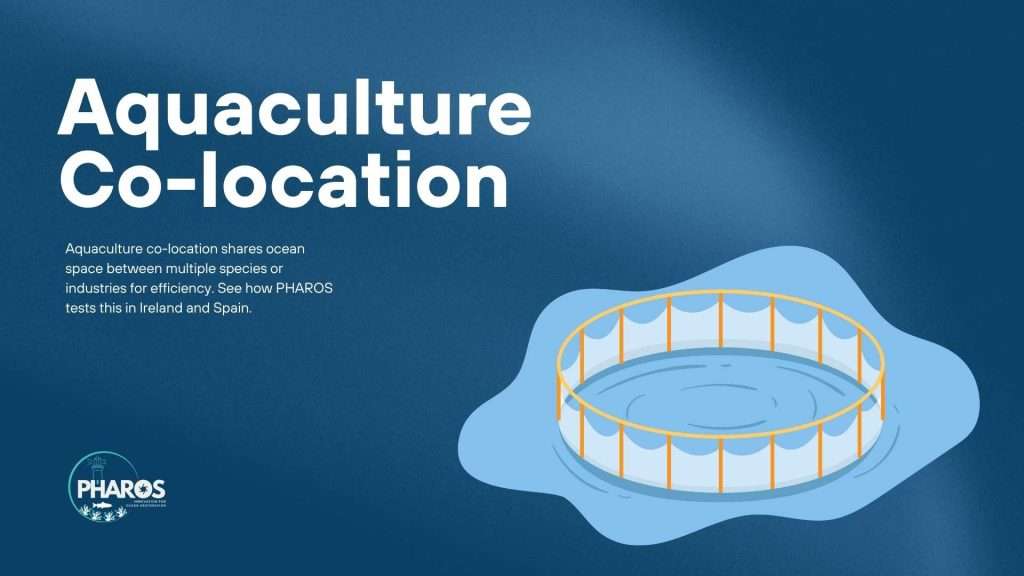
What Is Aquaculture Co-location? https://pharosproject.eu/wp-content/uploads/2026/07/What-is-Aquaculture-Co-location-1024x576.jpg 1024 576 PHAROS Project https://pharosproject.eu/wp-content/uploads/2026/07/What-is-Aquaculture-Co-location-1024x576.jpgAquaculture co-location is the practice of positioning multiple ocean activities, or multiple farmed species, in the same marine space at the same time, rather than spreading each activity out on its own separate patch of water. This might mean growing seaweed and shellfish inside an offshore wind farm, or farming fish, algae, and invertebrates together in a single interconnected system. The goal is straightforward: get more value and more environmental benefit out of the same stretch of ocean, instead of treating every square kilometre of sea as a resource for only one use.
Why Ocean Space Has Become Contested
The push toward co-location exists because marine space is no longer as open as it once seemed. The rapid expansion of offshore wind and wave energy has intensified competition for ocean space and put pressure on fishing grounds and other traditional maritime activities. In Germany’s North Sea Exclusive Economic Zone alone, roughly 30% of the area is already tied up in offshore wind development applications, leaving planners actively searching for ways multiple sectors can share that same footprint rather than fight over it. Co-location addresses this directly by asking a simple question: can two activities that need ocean space actually benefit from being neighbours, rather than competitors?
One Analogy: Companion Planting at Sea
Gardeners have long used companion planting, growing certain crops side by side because one plant’s waste or shade becomes another plant’s advantage, like beans fixing nitrogen in the soil that neighbouring corn then absorbs. Aquaculture co-location works on the same logic underwater. A fish farm produces nutrient-rich waste that would otherwise pollute the surrounding water, but if you plant seaweed nearby, that seaweed absorbs those very nutrients as fuel for its own growth. Neither species needed to be moved to a different plot of ocean, they simply needed to be placed where one’s output became the other’s input.
The Ecological Logic Behind It
The clearest form of aquaculture co-location is Integrated Multi-Trophic Aquaculture, or IMTA, which structures farming so that waste from one species becomes a valuable input for another, mimicking how nutrients cycle naturally through a real ecosystem. Fish waste feeds algae and filter feeders, filter feeders clean the water column, and the whole system produces more usable biomass than any single species farmed alone. Beyond IMTA specifically, marine co-location can also pair aquaculture with entirely different sectors, offshore wind turbines, wave energy devices, or artificial reefs, wherever the physical infrastructure of one industry can share space with the biological needs of another without serious conflict.
What the Research Actually Shows about Aquaculture
Co-location is not a guaranteed win simply because it sounds efficient on paper, and recent field data makes that clear. The European Commission’s own assessment of co-location found that its potential benefits depend heavily on species selection, site conditions, and how carefully the systems are engineered together, rather than assuming any two activities placed near each other will automatically thrive. PHAROS’s own Ireland demonstration in Bantry Bay tested this directly, growing kelp lines alongside a commercial salmon farm and comparing results against a control site with no fish farm nearby. The control site actually outperformed the co-located site on raw kelp growth, yielding around 17 kilograms per metre against roughly 12 kilograms at the salmon farm site, showing that nutrient-rich water does not automatically translate into more seaweed.
That same Bantry Bay trial revealed a more complex trade-off underneath the surface. While the salmon farm suppressed overall kelp growth compared to the control, it reshaped the surrounding epifaunal community toward much higher abundance of small marine organisms, even though those communities showed lower species diversity than the control site. This is exactly the kind of nuanced result that makes co-location research valuable: it is not a simple equation of stacking species together and expecting universal benefit, but a genuine negotiation between competing ecological variables that differs from one site to the next.
Gran Canaria’s Multi-Layered Aquaculture Co-location Model
PHAROS is running a more elaborate co-location experiment off Gran Canaria, where a single storm-proof structure combines a fish cage stocked with gilthead seabream, sea cucumber cages positioned beneath it, high-value abalone production, and macroalgae ropes stretching through the surrounding water column. Artificial Smart Enhanced Reefs are layered into the same footprint, adding a fourth restoration function to the mix, testing biodiversity recovery and pollution reduction alongside the aquaculture output itself. This demo is explicitly framed as testing the benefits of IMTA co-location, examining how each additional species and structure changes outcomes for the others sharing that same patch of ocean.
Why This Matters for Future Ocean Planning
As offshore wind and other energy infrastructure continue expanding across European waters, co-location is increasingly viewed as a practical necessity rather than an optional efficiency gain. Projects like OLAMUR are already piloting seaweed and mussel farming directly inside wind farm zones in the North Sea and Baltic Sea, aiming to prove that low-trophic aquaculture can share space with energy infrastructure at commercial scale. PHAROS’s own findings from Bantry Bay and Gran Canaria feed directly into this wider European effort, providing real evidence about which species combinations actually work together and which trade-offs planners need to weigh before assuming co-location is automatically the more efficient path.