Estonian fishermen get first‑hand look at Bantry Bay’s seaweed and lumpfish research
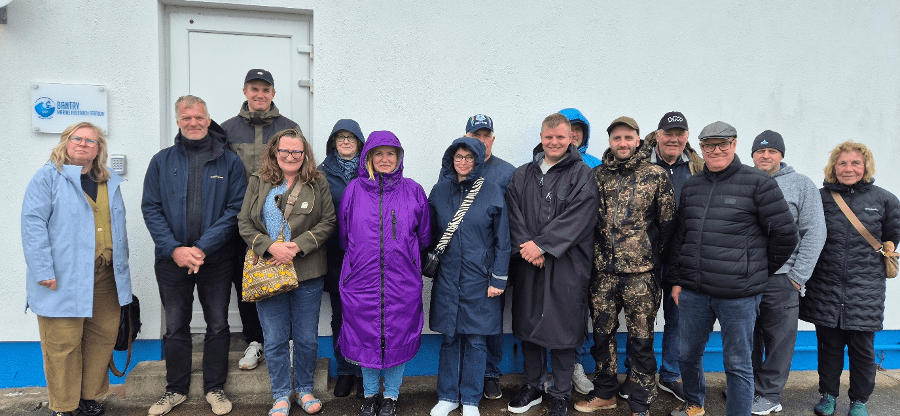
Estonian fishermen get first‑hand look at Bantry Bay’s seaweed and lumpfish research https://pharosproject.eu/wp-content/uploads/2026/06/image.png 900 416 PHAROS Project https://pharosproject.eu/wp-content/uploads/2026/06/image.pngLast Friday, a group of fifteen Estonian fishermen arrived at the Bantry Marine Research Station on the shores of Bantry Bay in County Cork. They were met by the station’s Research Director, Julie Maguire, who escorted them through the facilities and explained the work carried out at the site. The visit gave the fishermen a practical look at how research in Irish coastal waters is trying to solve some of the persistent environmental puzzles of modern aquaculture.
Maguire walked the group through the station’s core operations, paying particular attention to the seaweed farming trials and the lumpfish hatchery. The fishermen saw the sixty land‑based tanks, which range from 600 to 8,000 litres each, as well as the controlled‑environment systems and the temperature‑regulated laboratories where microalgae and macroalgae are studied. They also heard about the two licensed sea sites operated by the station, one covering 6 hectares with seventeen longlines and another spanning 16 hectares with seventy‑eight longlines, all of which are used for cultivation and research.
The tour of the lumpfish hatchery drew particular interest. BMRS was established as a company in 2005, and the hatchery in 2018 and developed Ireland’s first pilot‑scale marine recirculating aquaculture system specifically to improve lumpfish production. Lumpfish are used in salmon farming as cleaner fish, meaning they eat sea lice off the salmon and provide a non‑chemical alternative to conventional parasite treatments. The fishermen could see how the station monitors and refines that production process from egg to juvenile fish.
Maguire also explained the station’s broader research agenda, which centres on Integrated Multi‑Trophic Aquaculture, or IMTA. The basic idea is straightforward; seaweed longlines are placed close to salmon cages so that the nutrients released by the fish, ammonia, nitrates and phosphates, can be absorbed by the kelp. In theory that turns a waste product into a harvested crop and reduces the local environmental load. But the fishermen learned that the science is more complicated than the theory. Data from the first full growing season of 2024 to 2025 showed that seaweed at the control site in Toormore Bay, which sits farther from the salmon farm, actually outperformed the IMTA site, yielding 17 kilogrammes per metre compared with only 12 kilogrammes per metre at the co‑located site. Water samples revealed that ammonia and nitrite concentrations were often higher at the control location, which contradicted the original hypothesis. The IMTA site did support a larger total number of attached fauna, with 4,570 individuals against 1,422 at the control site, but the control site had higher species diversity. Further modelling pointed to light availability as the primary constraint on sugar kelp growth at the IMTA site, not nutrient supply. So the work at BMRS is not about simple absorption, but about careful ecological accounting.
All of this local activity is part of a much larger framework. BMRS leads the Irish demonstration site for the PHAROS project, which stands for Marine Biodiversity Restoration in the Atlantic and Arctic. That project is coordinated by the Canary Islands Oceanic Platform and brings together twenty‑four partner organisations from across Europe. It runs from September 2024 through to August 2029 and receives EU funding as a core component of the European Union’s Ocean Mission. The general purpose of PHAROS is to test and deliver nature‑based solutions that restore marine ecosystems and biodiversity while also addressing climate change and the pressures of human activity at sea. The ultimate goal, set for 2030, is to restore marine habitats, cut pollution and build a sustainable blue economy that can support coastal communities and fishing industries alike.
For the fifteen Estonian visitors, the day at Bantry Bay was a window into that wider ambition. They left with a clearer picture of how Irish researchers are approaching the balance between fish farming and environmental health, and how the results from a single bay in Cork are feeding into a European effort that stretches from the Atlantic to the Arctic.