Hearth Aegean Summit Day 3: How Local Island Communities are Blueprinting the Future of the Aegean
Hearth Aegean Summit Day 3: How Local Island Communities are Blueprinting the Future of the Aegeanhttps://pharosproject.eu/wp-content/uploads/2026/10/WhatsApp-Image-2026-10-25-at-17.44.00-1024x576.jpeg1024576PHAROS ProjectPHAROS Projecthttps://pharosproject.eu/wp-content/uploads/2026/10/WhatsApp-Image-2026-10-25-at-17.44.00-1024x576.jpeg
From intention to action, grassroots innovators, scientists, and policy experts gather at Santorini’s Tomato Industrial Museum to build a lasting framework for island resilience.
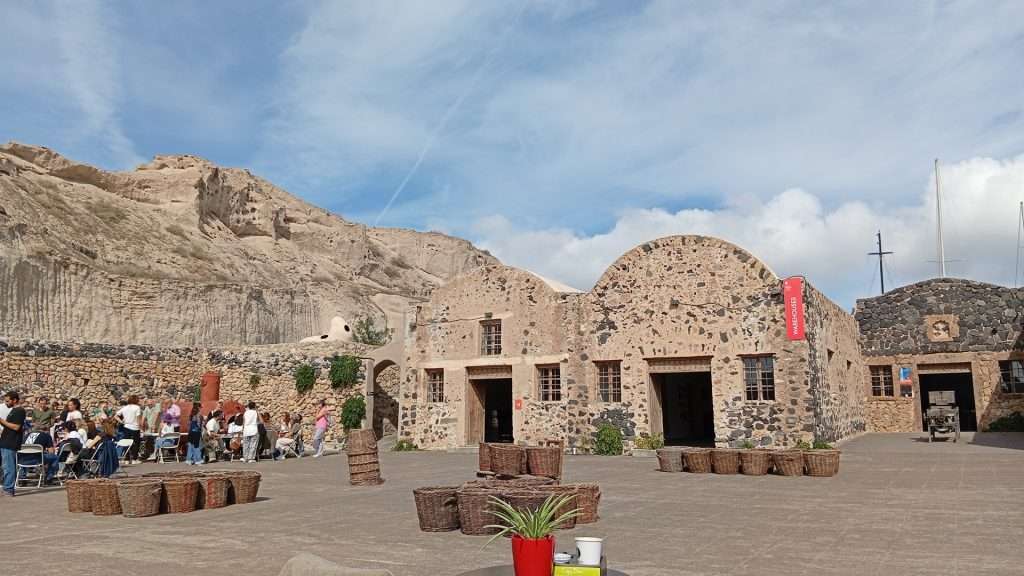
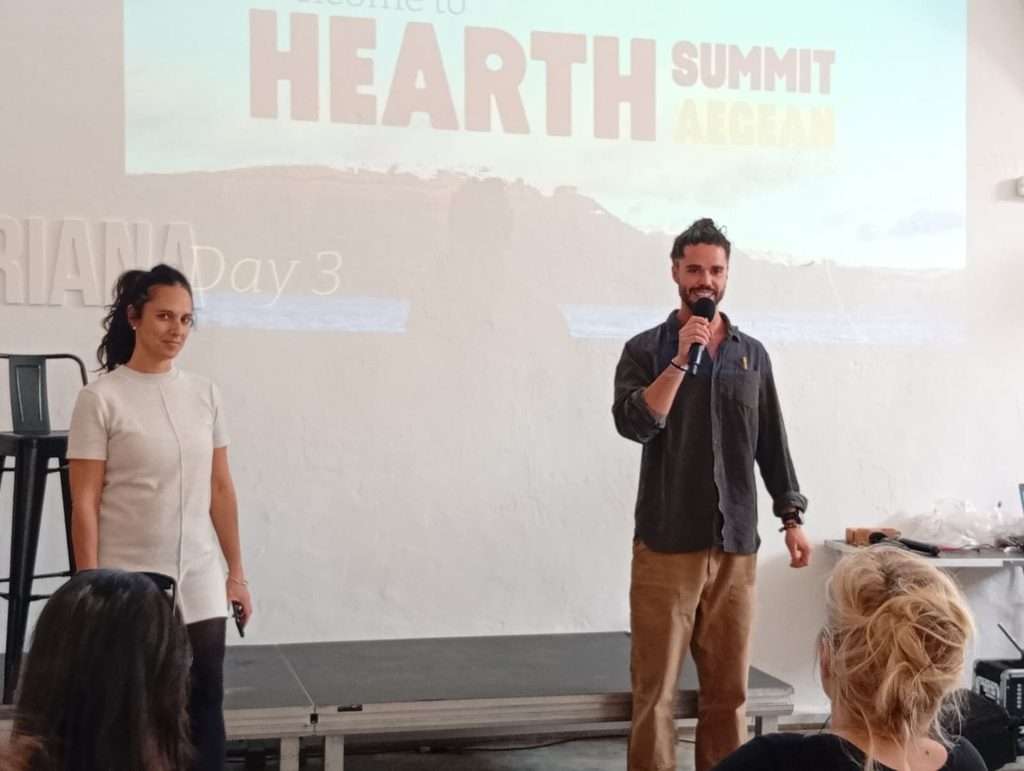
On the final morning of the Hearth Aegean Summit, gathered inside the historic industrial red-brick setting of the Tomato Industrial Museum “D. Nomikos”, participants assembled for Day 3 under the banner “From Seed to Harvest”. After days of setting intentions, exploring coastal pathways, and witnessing hands-on practical solutions to island waste, the summit turned its focus toward concrete action, collaboration, and systemic change across the Mediterranean.
A Moment for Reflection and Local Voice
The morning began with a call to quiet introspection led by the event facilitators, encouraging everyone to let the accumulated lessons, experiences, and seeds of ideas settle into their journals before stepping into collaborative project creation.
“On Friday, we set the seed, we got to know each other, and we defined why we are here, setting our intention. Then yesterday, we explored different pathways, had workshops, and an incredible dinner. Today we are here to really look at what are the next steps, how we want to move forward, how we can collaborate, and what we take back home,” explained Fabio, Lead Facilitator.
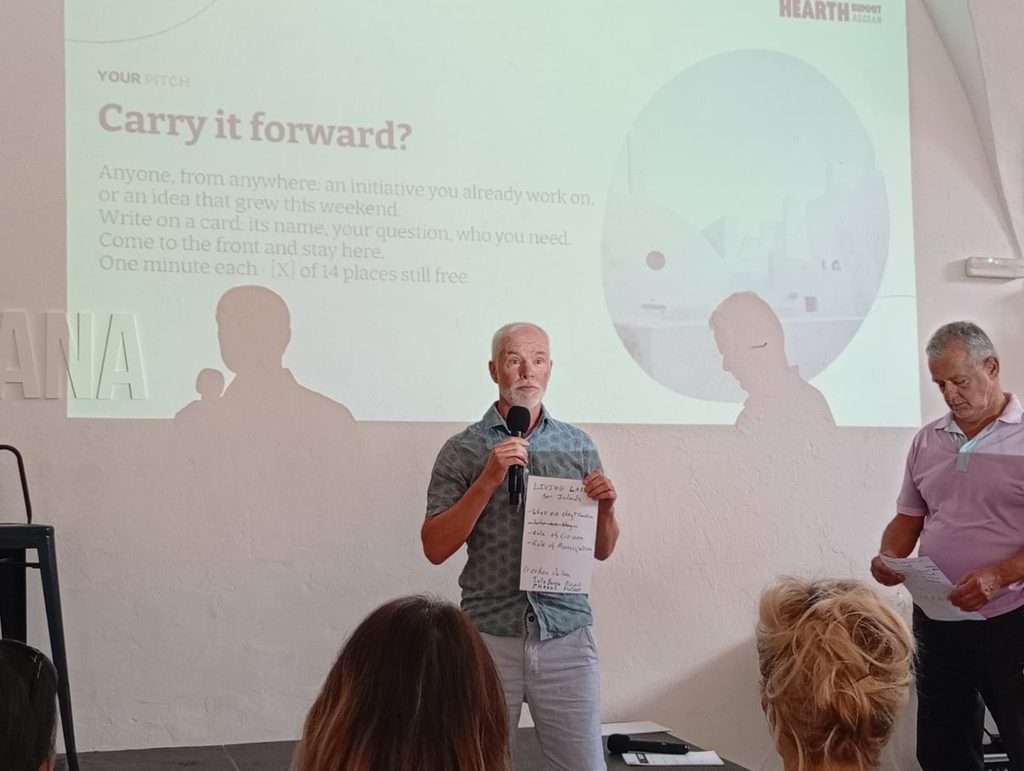
Fabio added that everyone is invited to suggest a topic, initiative or idea: write their idea or question on a piece of paper, then join others during the exercise to discuss it in smaller groups. With the chance to switch between rounds, there’s more time to go deeper.
A Marketplace of Ideas: The Project Pitches
The core of the morning centred on rapid project pitches, where initiative leaders presented their work and posed specific challenges to the participants.
1. Integrated Hospitality and Local Economy Co-Creation
“I want to share a process we developed in the Sustainable Island Mauritius project. We created a co-creation process to bring together hotels, tour operators, and local businesses who were not so interested in working together, as the main point for locals was to be integrated into the whole economy. We did a five-year process to make this happen, and I can share how we made it happen,” presented Nicola, Representative from the CSCP (Collaborating Centre on Sustainable Consumption and Production), Wuppertal.
2. Community-Driven Regenerative Tourism
“I am Yasemin, the founder of MULTICULTI Experiences. I would like to discuss and gather more ideas on how tourism can be a force for good instead of being extractive, how it can be more community-driven, educational, and regenerative, especially for the Greek islands,” shared YaseminOttaviani, founder of MULTICULTI Experiences.
3. Circular Construction and Bioeconomy Mapping
“I represent CluBE, the Cluster of Bioeconomy and Environment in Western Macedonia and HUBS4BUILD (Regional Circularity Hubs for a Bio-based and Resilient Built Environment), a Horizon Europe Innovation Action project launched in September 2026 to transition Europe’s highly linear construction sector into a circular, sustainable ecosystem. It is coordinated by the University of Thessaly (with scientific coordination by CluBE). We are looking to map practitioners and interested parties all over Greece who want to join this community and learn how to use circular materials,” presented Johannes, Scientific Coordinator at CluBE.
4. Island and Border Community Advocacy Networks
“I represent the Border Towns and Islands Network. We take care of the needs of border communities on European islands and land borders, from Lesbos to North France, and Malta to the Polish-Ukrainian border, across 24 members. We handle topics like migration, sustainable development, and water scarcity, facilitating a steady collaboration between local authorities and civil society organisations at the local and transnational levels,” introduced Carlo, Secretary General of the Network.
5. Revitalising Terraces and Dry-Stone Wall Crafts
“I represent Ambassada from the island of Tinos. We are an association working with the natural and human-made landscape of the island, including water, cultural activities, and heavily involving dry-stone walling. My question is: How can we create economic opportunities for people who want to learn how to work with stone and build?” asked Fillipos, representative of Ambassada Tinos.
6. Year-Round Permaculture Educational Hubs
“I am Katerina Papadimatiou from Om Eressos on Lesbos Island. My question is: How can a permaculture educational centre be sustainable all year round considering various factors that influence it?” submitted Katerina, founder of Om Eressos.
7. Year-Round Community Programming in Cultural Parks
“We represent Paros Park, an environmental and cultural park belonging to the Municipality of Paros. We organise a summer festival, educational activities for the local community throughout the year, and now we are looking for more collaborations and ideas to create new activities beyond the tourist season,” explained Themis and Katerina, representatives of Paros Park.
8. Arid-Adapted Seed Exchange and Regional Seed Banks
“I am Robin from Kea Island, part of the Analaos Hub ITI team. We just made a vegetable garden with no irrigation, so we are looking for traditional seeds of plants used in dryland conditions. My idea is to find seeds, exchange them, and make a seed bank with seeds adapted to these conditions,” called Robin, Representative of Analaos Hub / ITI Team.
9. Strategic Educational Models for Gastronomy and Agriculture
“I am Periklis from the non-profit company Anthos Tinou. Our main goal is to connect environmental protection, regenerative agriculture, and gastronomy in a sustainable economic model through education. We are looking for strategic partners to build this model,” stated Periklis, Representative of Anthos Tinou.
10. Repurposing Industrial Mining Heritage
“I am Manolis Terrovitis, an archaeologist and creator of the Santorini Archive Project. The question I want to ask concerns the reuse of industrial spaces, particularly the mines you see around us, how the landscape and buildings are used, and what is the next day for Santorini,” presented Manolis Terrovitis, Archaeologist.
11. The Role of Municipalities and Citizens in Island Living Labs
“I am Gordon Dalton, coordinator of the Horizon Europe PHAROS and Isla Bonita projects. We have pilot demonstrations across 12 islands with corresponding living labs. My main question is: What are the roles of citizens and particularly local municipalities in these living labs?” asked Gordon Dalton, Project Coordinator from PLOCAN.
12. Creating Shared Development Spaces Across the Archipelago
“I represent Voices of Archipelago. What we have seen is that there are many common problems across Greek islands. We are trying to create the islands’ common space in order to see how we can shape an alternative development path,” shared Ioannis, representative of the initiative.
13. Decentralising Decision-Making in Small Island Communities
“I represent the Cultural Association Keros from Koufonisi. I would like us to examine how we can strengthen community participation in shaping decisions on the activities we run, so that it is not just three or four people deciding for the whole year,” voiced Ianthi, Representative of the Association.
14. Scaling Grassroots Impact from Remote Villages
“I am Yannis from Lesbos, representing the West Municipality of Lesbos and the European project SUBLIME. I want us to discuss how a small organisation from a forgotten village can grow into something that makes a big impact,” invited Yannis.
15. Economically Viable Farming on Restored Terraces
“I represent Karpos Kserolithias from Tinos. We work in the art-agriculture field, and our vision is how to give life back to abandoned land on Tinos, supporting new and active farmers so that this becomes economically viable,” submitted Lykaon.
16. Socio-Ecological Planning and Political Organising
“I am John from Athens and Ikaria. What is missing and holding our projects back is a functioning political and planning system. I think islands offer an opportunity for organising a different kind of political structure in Greece, placing emphasis on socio-ecological planning,” argued John, Regional Activist.
17. Solar-Powered Recycling Hubs with Cargo Bikes
“I am pitching a model of smaller recycling centre hubs that are privately run, financially sustainable, and powered solely by solar energy. It combines baling and precious plastic machinery, while all recyclable pickups are done via electric cargo bikes. The pilot project is called Ikaria Recycles,” presented Alexis, Creator of Ikaria Recycles.
18. Nature-Based Solutions for Vulnerable Communities Near Industrial Sites
“I represent Synergeia. Our idea is how we activate environmental justice in extremely vulnerable communities and mobilise them around nature-based solutions, strengthening community action around landfills, power plants, and mines,” explained Sokratis.
19. Connecting “Islands of Coherence” Across Atlantic and Mediterranean Archipelagos
“I run Dialogue Lab in Portugal, and I am interested in the concept of ‘islands of coherence’. It explores how a system in chaos has punctual points that, once connected, can shift the whole system toward harmony. We are starting communication between the Azores, Madeira, and the Canary Islands,” shared Breno Russo.
20. Farmer-Hotel Synergies for Destination Management
“I represent the organisation Vatiki from Tinos. ‘Vatiki’ is essentially the rent farmers used to pay to cultivate land. We are running a destination management project, bringing together farmers and hotel owners to create synergy for sustainable tourism,” described the Representative from Vatiki.
21. Community Energy Independence on Small Islands
“I represent the Municipality of Chalki. In 2019, we created our energy community on our island, and our goal is to make the island more sustainable and improve the quality of life in our local community,” noted Yannis, Representative of the Municipality of Chalki.
22. Participatory Art Methods for Island Commons
“I am Olga, co-director of Koinono from Lesvos. We work with communities in Lesvos and the North Aegean. My question is how we can use participatory methodologies and art more to genuinely co-create with our community,” asked Olga.
23. Artisanal Natural Winemaking in an Industrial Wine Market
“I am Antonis Orphanos, the youngest winemaker on the island. The challenge is how to make natural wine on an island dominated by industrial wine production. I have brought some of my wines so we can taste them together outside,” invited Antonis Orphanos, Winemaker from Santorini.
24. Marine Biodiversity Changes and Local Coastal Plates
“I represent the University of the Aegean as a PhD student in marine ecology and scientific diver. My question concerns how changes in Mediterranean marine biodiversity affect coastal communities and how we can integrate invasive alien species into our diet,” presented Mary, Researcher at the University of the Aegean.
25. Posidonia Soundscapes and UNESCO Ocean Decade Advocacy
“I am Coco Francavilla, founder of musicforthesea.org. Our project, Posidonia Soundscapes, is endorsed by UNESCO under the UN Ocean Decade to protect Posidonia seagrass meadows, which are the lungs of the Mediterranean. We need to raise public awareness and push for the approval of new Marine Protected Areas in the Aegean,” highlighted Coco Francavilla, Composer and Founder.
Maritime Platforms and Open Policy Exchange
Beyond the rapid pitches, participants explored floating education models and flexible ways of matching skills. One example was the training ship Alkyi, a restoration and rebuild platform based in Andros. Its floating learning model focuses on seamanship, ocean research, sail cargo and cultural diplomacy, with an emphasis on ecocentric stewardship and personal development, and reaches coastal communities across the Eastern Mediterranean.
“We are going to talk about the sea and how we can use a floating learning platform as an island, as a community building point, and an educational platform. Our platform is the training ship Alkyi, currently under restoration. Our focus is education, seamanship, marine research, and environmental stewardship, using the sea as an extension of the limitations of the land,” presented Dimitrios, Representative of the Alkyi project.
To ensure every participant could contribute without necessarily hosting a formal table, facilitator Fabio outlined a flexible policy and skills exchange format.
“We are creating a matching platform for what you offer and what you need. Next to the projects, you can place notes such as ‘I work on European policy and would like support in policy-making’. You do not need to host a table for that, simply leave your notes so interested parties can reach out to you,” clarified Fabio Volkmann, Summit Facilitator.
Through these interconnected sessions, Day 3 of the Hearth Aegean Summit transformed theoretical environmental discussions into an operational network of regional projects, paving a clear path forward for circular, community-backed development across the Aegean.
Post-Tourism Aegean: Reimagining Santorini’s Economic and Cultural Blueprint
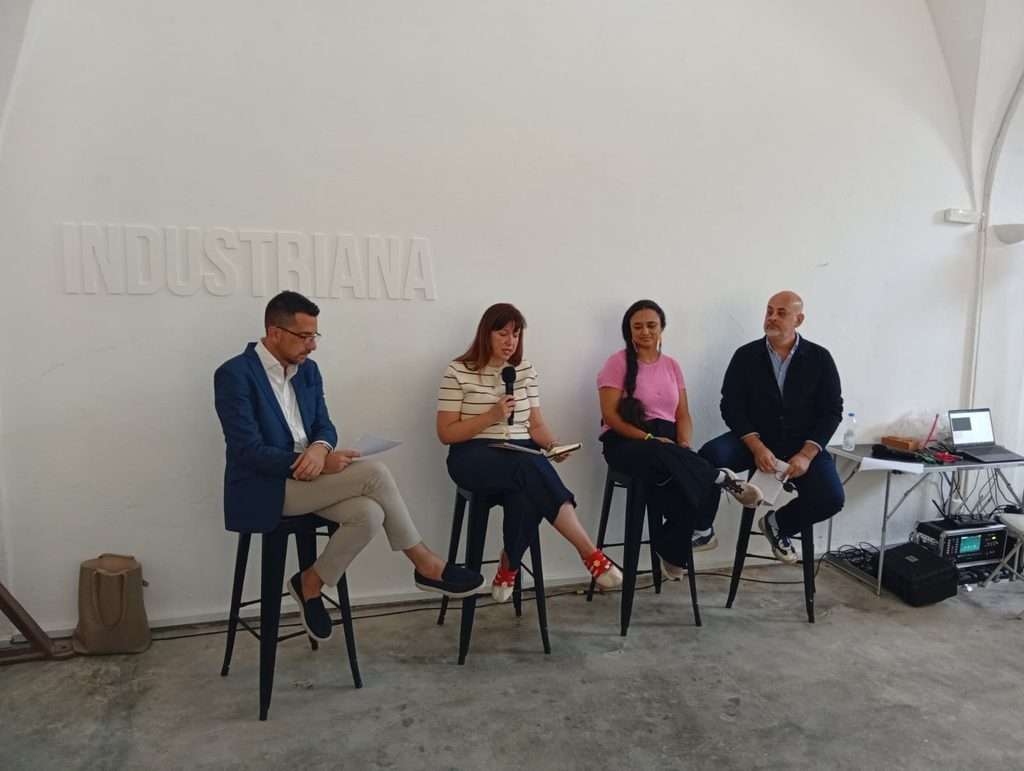
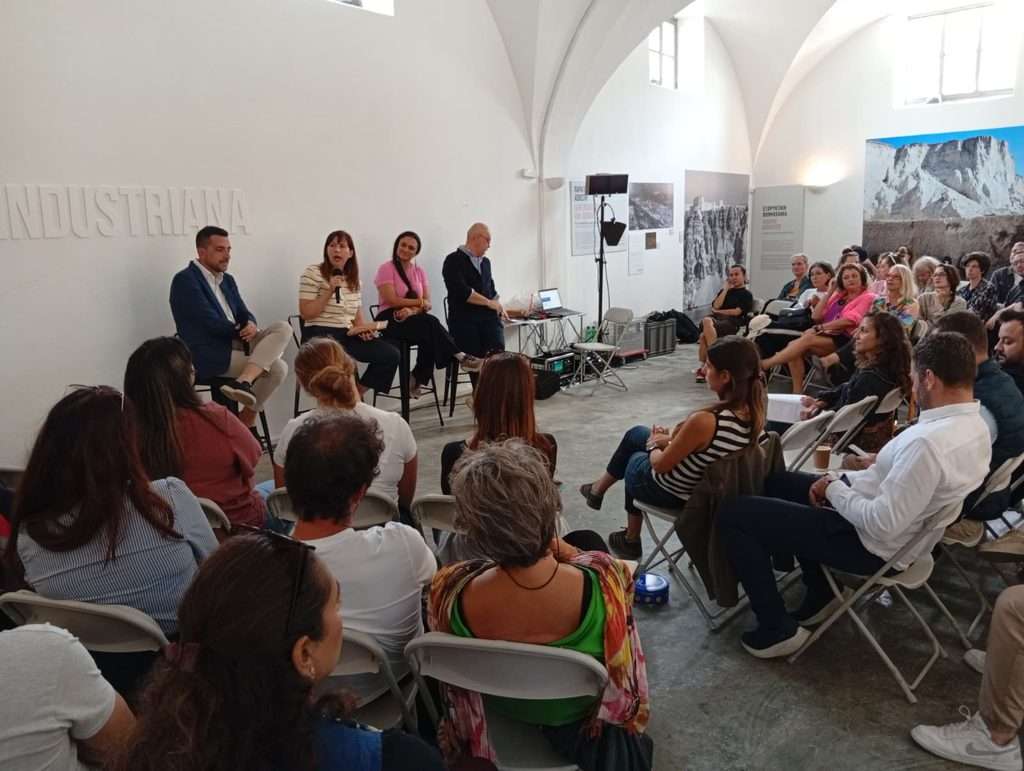
Sitting inside the cavernous, historic walls of the former D. Nomikos Tomato Factory in Vlychada, an architectural monument to Santorini’s 1950s industrial agricultural heritage, delegates, local officials, and international experts gathered for the summit’s midday panel session titled “Experts Riddle: Post Tourism Aegean, what else could we be?”
Moderated by Georgia Nomikou, President of the Thira Municipal City Council and Tourism Board, the panel brought together Dimitrios Alexakis, Chief Operating Officer of EMPIRIA Group, Idrissia Thestrup, Regenerative Tourism Expert and CEO of Lost Horizon, and Pascal Falcone, CEO of META Group and President of “We Are Ready”.
What began as an executive pitch for cross-sector collaboration evolved into an intense, raw debate between institutional representatives, tourism leaders, and local residents over the carrying capacity, social sustainability, and political gridlock gripping one of the world’s most recognizable travel destinations.
The Hospitality Sector’s Proposal: Think As One
Opening the panel, Georgia Nomikou posed a direct challenge to the speakers by asking how residents and businesses on an island consumed by tourism can build a life and a diversified economy beyond it.
Responding on behalf of the luxury hospitality sector, Dimitrios Alexakis presented a proposal centered on shifting tourism from an isolated economic pillar into a supportive mothership for the entire local ecosystem.
“Santorini is much more than a tourism destination,” Alexakis emphasized. “Its unique landscape, its agricultural heritage, the cultural identity and the local communities are valuable assets that can support a more diversified economy. Tourism should be the mothership destination, but at the same time, it should coexist with thriving local production, entrepreneurship, cultural activities, and environmental stewardship.”
Alexakis outlined a practical twelve-month pilot project designed to break traditional strategic planning deadlock. Rather than launching multi-year master plans, he proposed creating an immediate framework connecting hoteliers, local farmers, winemakers, artisans, municipal authorities, and academic research institutions.
Practical Resource Management
The proposal targets immediate operational challenges by focusing on water efficiency, climate resilience, and sustainable agricultural supply chains. By directly addressing the finite resources of the island, the initiative aims to make daily business operations far more environmentally viable.
Local Commercial Synergies
The scheme creates direct purchasing channels and marketing pipelines between hospitality venues and small-scale local producers. This structure allows local micro-enterprises to tap into the high demand generated by tourism, ensuring that economic benefits circulate through the resident community.
Measurable Community Metrics
Success will be measured through quality-of-life indicators for permanent island residents rather than traditional figures like total visitor arrivals or hotel bed capacity. Shifting these benchmarks ensures that human well-being takes priority over volume.
Environmental Funding Partnerships
The project partners directly with regional conservation platforms, such as the Cyclades Preservation Fund, to secure consistent funding and expert resources for local environmental protection initiatives.
Lessons in Regenerative Tourism: From Greenland to the Cyclades
Taking the floor, Idrissia Thestrup brought two decades of international experience in arctic and island destinations, including Greenland, Iceland, and the Faroe Islands, to critique the current state of Aegean tourism.
Thestrup highlighted a striking contradiction she observed during her time at the summit, noting that while formal sessions focused heavily on water, agriculture, and biodiversity, side conversations among attendees repeatedly returned to tourism as the root of all evil.
Extraction Versus Regeneration
Using a visual diagram displayed in the hall comparing a mine to a vineyard, Thestrup categorized Santorini’s contemporary tourism model as an extractive industry.
The extractive model operates on short five-to-ten-year financial horizons, treating cultural and natural landscapes as disposable consumables while leaving behind heavy environmental debt. In contrast, regenerative tourism is built through local democratic participation, treating the destination as a nurturing mother that must be preserved intact for future generations.
“Your biggest asset and your biggest threat is your attractiveness. You are becoming a backdrop for selfies,” Thestrup warned the room. “Currently, tourism in Santorini is an extractive industry. It is conceived, planned, and managed just the same way as mining. But you cannot give up on your home. You have to stop thinking about it as just a place open for everyone to come, do whatever they want, and leave you with the consequences.”
Grassroots Community Ownership
Addressing the challenges of over-tourism, Thestrup pointed to practical models from other northern destinations, such as Greenland’s tradition of organizing annual corporate and public volunteer trash cleanup days rather than waiting endlessly for municipal execution.
Strategic Visitor Dispersal
To manage heavy congestion at iconic sites, such as Iceland’s crowded Golden Circle, regional authorities built new access roads and created active storytelling initiatives in lesser-visited areas, successfully redirecting visitor flow and reducing environmental strain.
The Human and Historical Perspective: Volcanic Energy and The End of Travel
French author and CEO Pascal Falcone anchored his intervention in a deeply personal narrative, drawing parallels between human vulnerability during conflict in Ukraine and the fragile state of global environmental heritage sites.
Reflecting on the setting of the Nomikos Tomato Factory, Falcone noted that while the structure weathered brutal coastal winds, sea salt, and devastating earthquakes, it ultimately collapsed under the economic pressures of mass tourism.
Falcone called for a fundamental shift in how visitors engage with the Aegean, advocating for a transition from high-density, short-stay excursions to long-term, slow-travel immersion.
Reconnection with Geological Identity
Islanders and visitors must learn to coexist with the raw, active volcanic energy of the island, understanding its history rather than treating the landscape merely as a photo backdrop.
Active Cultural Integration
The destination should encourage travellers who want to participate directly in local life by restoring traditional dry-stone terrace walls, harvesting heritage crops, clearing mountain trails, and supporting local pottery, music, and philosophy workshops.
Seasonal Normalization
Island strategy must shift away from brief cruise ship stops toward extended visits focused on year-round cultural engagement and environmental stewardship.
DEBATE HIGHLIGHTS GRASSROOTS ACTION, MUNICIPAL PARTNERSHIP AND A UNITED VOICE TO GOVERNMENT
The open-floor debate revealed a shared commitment to improving Oia together. A local resident’s concerns about commercialisation, neglected infrastructure, parking shortages and delayed school repairs sparked a constructive exchange on how municipality and community can act more collectively. Drawing on Japan’s civic model of collective responsibility, the discussion pointed towards practical opportunities: stronger grassroots action on waste and public spaces, closer partnership between local businesses, associations and the municipality, and renewed efforts to unlock donations and investment for public facilities. The debate thus opened a positive route forward through shared responsibility, local initiative and sustained dialogue with central government.
“We have to go past the things that we consider ‘what will the municipality do for me?’, and we have to go into ‘what can I do for the community?'” Nomikou stated. “There are lots of things that we can do in collaboration, together, into making everybody’s life change.”
Reinforcing her point, Dimitrios Alexakis added: “We have two options: We either give up, or we fight. What I propose is that we fight! Each and every one of us, day by day with our family, with our friends, we try to make a change.”
As the panel concluded, lead facilitator Fabio summarized the overarching consensus of the debate before transitioning the summit into its afternoon phase.
Reclaiming Civic Democracy
Communities must use local assemblies and collective decision making to define carrying capacities and select the types of visitors they wish to welcome.
Realigning Success Metrics
Corporate and municipal success indicators must be realigned around resident well-being, stable public services, and birth rate retention rather than gross tourist arrivals.
Focusing on Incremental Progress
Islanders should focus on immediate, small scale neighborhood solutions rather than becoming paralyzed by national bureaucratic hurdles.
Rather than relying on vague declarations, project leads from across the Aegean presented short commitments regarding their immediate next steps, spanning local seed bank exchanges, dry-stone walling apprenticeships in Tinos, solar cargo bike recycling hubs in Ikaria, and living lab networks across the Cyclades.
“We came here to set seeds, but the true test of our work is what happens when we step off this island,” noted Fabio, Lead Facilitator, during the closing plenary. “We have laid out our offers, our needs, and our shared commitments. Now it is up to each of us to carry these partnerships back to our home communities and keep these hearth fires burning.”
The Breath of Pelagie: A Story of Four Hundred Islanders Living in Harmony on Linosa
During the lunch break, delegates were treated to a special documentary screening introduced by Fabio, representing Linosa, a small volcanic island in the Pelagie Archipelago of Sicily. The short film, titled The Breath of Pelagie, offers an intimate look into how a isolated community of roughly 400 islanders lives in harmony with their environment while actively protecting the island’s unique biodiversity. The project was created in partnership with the local environmental group Pelagos, whose conservation work can be followed on Instagram @associazionepelagos. For those who missed the afternoon screening, the full documentary is available to stream on YouTube via The Breath of Pelagie.
Music For the Sea Performance and Cultural Resonance
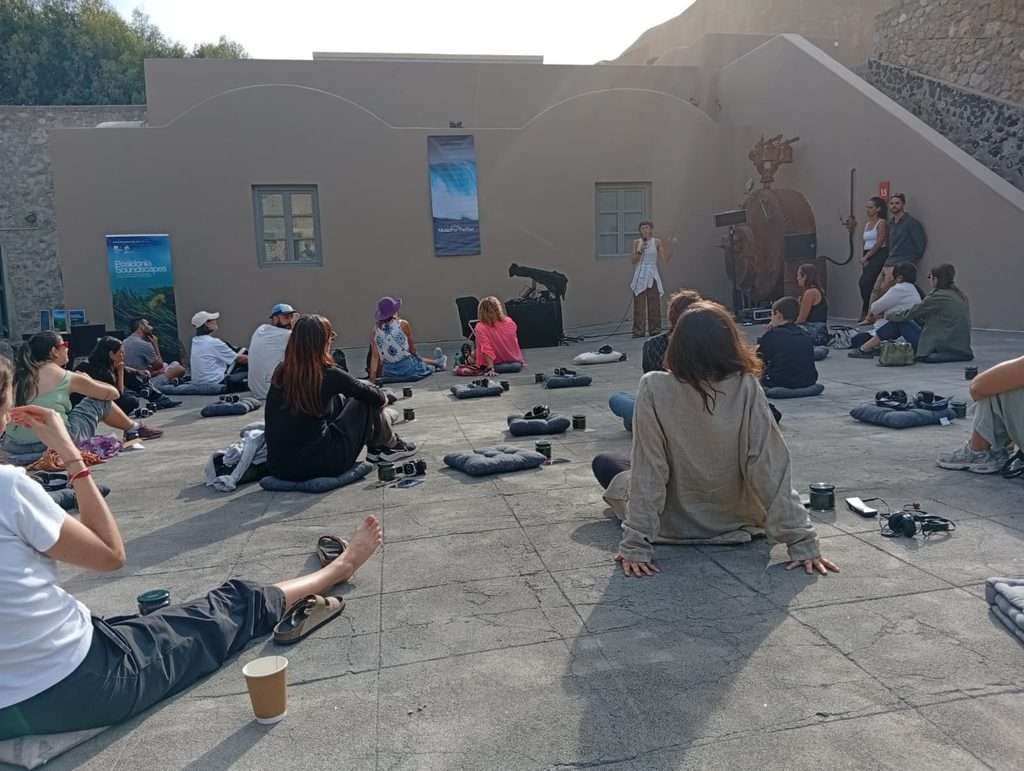
Following the formal closure of the indoor program, attendees moved outdoors into the distinctive industrial courtyard and surrounding volcanic beach landscape of Vlychada for the closing performance by Coco Francavilla, an Italian composer, sound artist, producer, and sound engineer based in Ibiza. Today, her artistic focus centers on ambient electronic compositions, underwater bioacoustics, and creative marine advocacy.
Francavilla is the founder of Music For The Sea, a transdisciplinary initiative that blends marine science, underwater acoustic research, and artistic performance to raise public awareness around ocean conservation. Through its Posidonia Soundscapes Project, which is endorsed by UNESCO under the United Nations Ocean Decade, the initiative records and preserves the bioacoustic environments of Posidonia oceanica, the ancient Mediterranean seagrass meadows often referred to as the lungs of the Mediterranean. Working alongside marine biologists onboard research vessels, Francavilla deploys specialized hydrophones to capture the natural acoustics of marine life alongside human noise pollution, translating these raw hydrophone recordings and sonified data into immersive ambient musical works that invite listeners to establish a direct emotional connection with underwater ecosystems.
Designed to bridge ecological awareness with sensory reflection, the outdoor performance at Vlychada integrated movement, ocean soundscapes, and local natural elements, creating a shared moment of pause before participants began their journeys home. By grounding environmental theory in creative practice, the performance underscored the summit’s overarching ethos, demonstrating that long term island resilience relies as much on cultural heritage, artistic expression, and human connection as it does on technical infrastructure and policy design. Her ambient works, underwater field recordings, sound expeditions, and UNESCO-endorsed project logs can be explored directly on the Music For The Sea Website, the Posidonia Soundscapes Project Page, her Coco Francavilla Artist Profile, the Ableton Blog Feature, and her live talk Re-Oceaning: A Sound that Unites Us All.
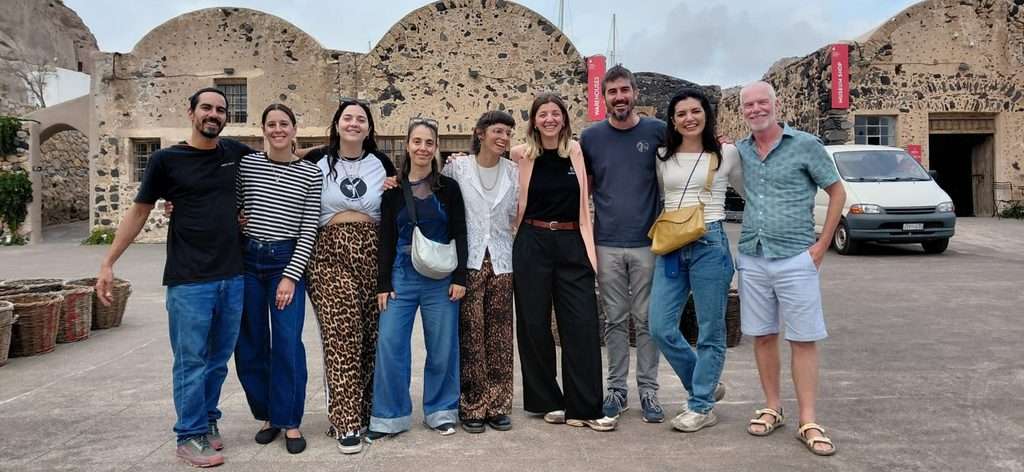
To conclude the summit, Gordon Dalton, coordinator of the PHAROS and ISLA BONITA projects, extended his heartfelt congratulations to the entire Impact Hub Athens team for seamlessly designing and hosting an exceptionally organised Santorini Living Lab. Immense gratitude goes to Sophie Lamprou, Co-founder and Founder of Impact Hub Athens, and Dimitris Kokkinakis, Co-founder leading Community & Programming, for their visionary leadership and dedication throughout the event. Special appreciation is also owed to Project Manager Renata Pylarinou and Senior Manager Marina Paraskevaidi for their meticulous coordination, alongside key collaborators Violetta Tsitsiliani and Mikel Oleaga for their vital work across European innovation and ocean initiatives. Finally, sincere thanks go to Anastasia Dimitriou for capturing the spirit and story of the summit through her extraordinary photography, ensuring the impact of this gathering resonates far beyond Santorini.
When you visit our website, it may store information through your browser from specific services, usually in the form of cookies. Our Privacy Policy can be read here.
Here you can change your Privacy preferences. It is worth noting that blocking some types of cookies may impact your experience on our website and the services we are able to offer.
Click to enable/disable Google Analytics tracking code.
Click to enable/disable Google Fonts.
Click to enable/disable Google Maps.
Click to enable/disable video embeds.
Our website uses cookies, mainly from 3rd party services. Define your Privacy Preferences and/or agree to our use of cookies.