Floating Wind Turbine Off French Coast Doubles as Underwater Nursery for Young Fish
Floating Wind Turbine Off French Coast Doubles as Underwater Nursery for Young Fish https://pharosproject.eu/wp-content/uploads/2026/08/iPiccy-img-19.jpg-e1786617980577-1024x673.webp 1024 673 PHAROS Project https://pharosproject.eu/wp-content/uploads/2026/08/iPiccy-img-19.jpg-e1786617980577-1024x673.webpA single floating wind turbine 10 miles from shore in the Mediterranean is testing whether clean energy infrastructure can help restore marine life.
By Kelly Lippke
AUG 12, 2026
Source: Ecoportal
Off the coast of France in the Mediterranean Sea, a single floating wind turbine stands in about 230 feet of water. It is located 10 miles from shore near Leucate. Below the surface, the seafloor is mostly sand and silt. Natural reef structures do not exist in these waters.
This leaves young fish exposed to larger predators. Without rocky crevices or other hiding places, small fish struggle to survive in the open water.
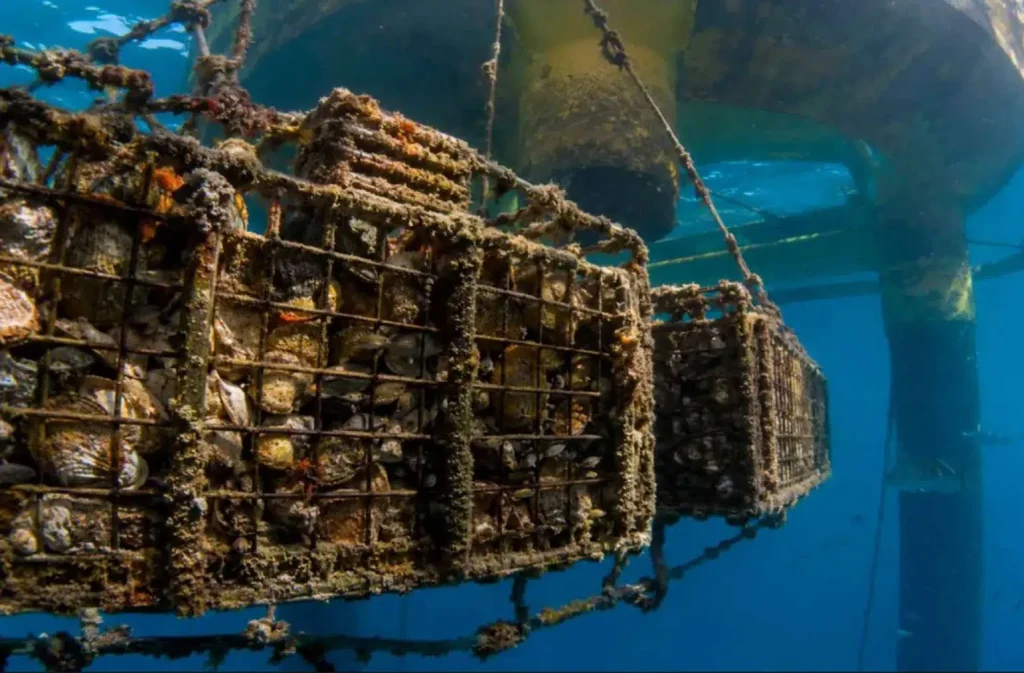
Marine biologists are now looking at whether the steel platforms used for offshore wind turbines can also become marine habitats. The goal is to use these structures for conservation. They have installed 32 special cages on the floating turbine. These cages act like underwater hotels for small marine life. Inside them are oyster and scallop shells. The shells come from local seafood processing facilities. They are packed inside heavy-duty stainless steel mesh. This keeps them secure even in rough seas.
The shells create a dense network of small gaps and crevices. Young fish can swim into these spaces where larger predators cannot follow. Within weeks of the cages being installed, scientists observed young fish gathering around them.
The Problem with Smooth Steel
When the turbine was first put in place, young fish started gathering around the hull and mooring lines within weeks. But smooth steel walls and thick cables do not offer much protection. Adult fish like sea bass and amberjacks patrol the area. They feed on the young fish that cluster near the structure.
For young Mediterranean fish, the move from open water to coastal areas is very dangerous. More than 90 percent do not survive this stage. They are eaten by predators in unprotected waters.
Unmodified offshore structures can actually make things worse. They attract marine life but do not offer hiding places. This turns them into feeding zones for large predators.
Engineering a Solution
Adding these habitat modules to a floating turbine is not simple. Floating platforms move with deep water swells. Any attached structures must withstand constant wave action and drag. They cannot add too much weight. They also must not risk damage during Mediterranean storms.
The shell cages are designed to handle these conditions. They are made of steel and mounted along the submerged hull. The shells inside are held in place by strong mesh.
The hope is that these structures can help increase regional fish populations. But there are limits. Over time, barnacles and sediment can clog the shell spaces. This reduces the available shelter.
For now, monitoring is limited to this one test platform. Scientists cannot yet say whether these structures will make a measurable difference across full commercial wind farms.
A Step Toward Clean Energy and Conservation
Engineers are finding smart ways to make clean energy infrastructure work with conservation. This is important as the world moves toward green power. The floating turbine off Leucate shows that wind energy and marine protection can go together. But more testing is needed to understand the long-term impact.
This article is based on reporting by Kelly Lippke for Ecoportal. Read the original story here.