What Is CO2 Sequestration in Marine Ecosystems?
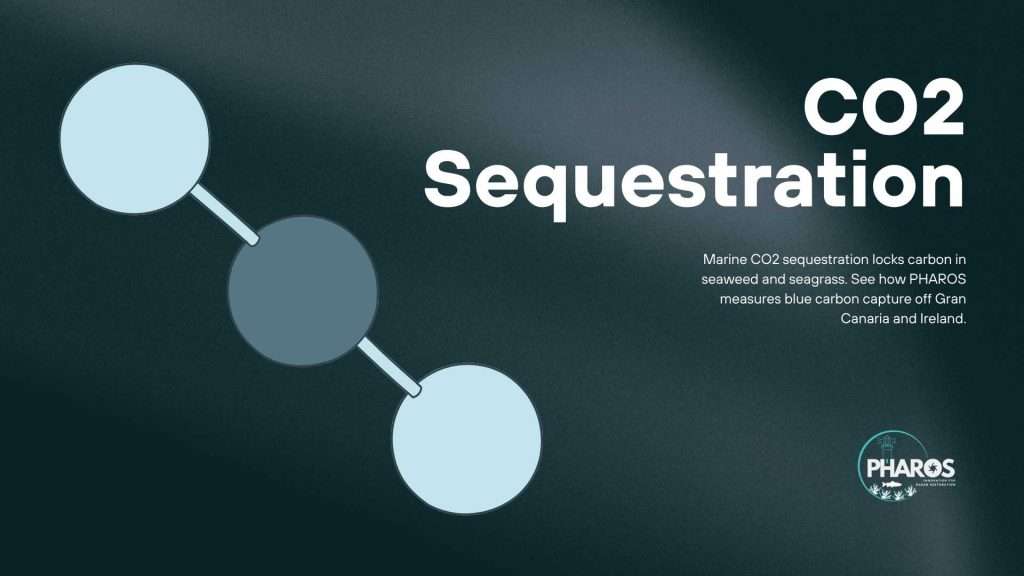
What Is CO2 Sequestration in Marine Ecosystems? https://pharosproject.eu/wp-content/uploads/2026/07/CO2-Sequestration-1024x576.jpg 1024 576 PHAROS Project https://pharosproject.eu/wp-content/uploads/2026/07/CO2-Sequestration-1024x576.jpgCO2 sequestration in marine ecosystems, often called blue carbon, is the process by which ocean habitats capture atmospheric carbon dioxide and lock it away for long periods, sometimes for centuries, inside living tissue or seafloor sediment. This natural filtration system already does staggering amounts of work: the ocean has absorbed roughly one-third of all human-generated CO2 since the Industrial Revolution, alongside more than 90% of the excess heat trapped by greenhouse gases. Blue carbon ecosystems specifically, mangroves, seagrasses, tidal flats, and macroalgae forests, together store an estimated 26% of the world’s carbon locked away in vegetated coastal systems.
How the Process Actually Works
The mechanism is essentially the underwater version of what forests do on land. Macroalgae and seagrass absorb dissolved CO2 from seawater during photosynthesis, using it to build their own tissue, and as that plant material dies, breaks down, or gets buried in seafloor sediment, a portion of that carbon gets locked away rather than cycling straight back into the atmosphere. Two separate mechanisms are actually at play here that many people conflate. Carbon capture happens the moment CO2 is absorbed and converted into biomass through photosynthesis, while carbon sequestration refers specifically to the longer-term storage of that carbon in sediment, roots, or exported material that settles somewhere it can’t easily re-enter circulation. A plant capturing carbon today doesn’t guarantee that carbon stays locked away permanently, which is exactly why scientists distinguish between the two terms so carefully.
One Analogy: A Bank Account, Not Just a Cash Register
Carbon capture and carbon sequestration work like the difference between a cash register and a savings account. The cash register, capture, records every transaction the moment it happens, tracking exactly how much CO2 a kelp forest or seaweed farm pulls out of the water on any given day. But money sitting in a register isn’t secure long-term, it needs to be deposited somewhere it will actually stay. Sequestration is that deposit, the carbon actually buried in seafloor sediment or locked into slow-decaying tissue for decades or centuries. A marine ecosystem can capture huge amounts of carbon daily and still sequester very little of it long-term if that carbon simply washes back into circulation instead of settling permanently.
The Numbers Behind Blue Carbon
Recent research has forced scientists to substantially raise their estimates of how much carbon macroalgae actually lock away, since seaweed was historically excluded from official blue carbon accounting frameworks. Some of the most notable figures now on record include:
- Macroalgae can sequester approximately 0.97 metric tons of carbon per hectare every year, a figure now being used directly in PHAROS’s own carbon accounting for its Gran Canaria demo
- Sediment studies in Mediterranean macroalgal forests recorded organic carbon burial rates roughly four times higher than earlier estimates had suggested, at 7.4 grams per square metre annually
- Scientific consensus now holds that seaweed acts as a net global sequestrator of CO2 at levels potentially matching the combined output of tidal marshes, mangroves, and seagrass ecosystems
- Since the Industrial Revolution, ocean CO2 absorption has driven a 30% increase in seawater acidity, directly threatening shell-forming organisms like corals and shellfish
- The expected macroalgae biomass yield in PHAROS’s Gran Canaria IMTA system ranges from 0.5 to 1.2 kilograms of fresh weight per metre of cultivation rope
Fighting Acidification at the Same Time
CO2 sequestration and ocean acidification are two sides of the same coin, since the excess carbon dioxide the ocean absorbs is precisely what lowers seawater pH and stresses shell-building marine life. Restoring macroalgae forests and seagrass meadows doesn’t just remove carbon from the atmosphere in the abstract, it directly reduces local acidity levels in the water immediately surrounding these habitats, giving nearby corals, shellfish, and other calcifying organisms a fighting chance in an increasingly hostile chemical environment.[pharosproject]
PHAROS: Turning Carbon Capture Into Measurable Data
PHAROS treats CO2 sequestration as a core, measurable output of its restoration demos rather than a vague side benefit. At the Gran Canaria site, macroalgae ropes are strategically positioned in both horizontal and vertical arrangements specifically to intercept and capture emissions drifting downstream from the adjacent fish farm, turning what would be pollution into carbon-fixing biomass. Real-time monitoring data on this process feeds directly into the PHAROS Digital Twin Ocean, letting researchers track the ecosystem’s actual carbon capture performance as it happens rather than relying on periodic manual sampling. The same monitoring approach extends to the neighbouring artificial reef and marine forest demo, where researchers plan to compare macroalgal growth and resulting carbon sequestration on both restored and unrestored patches of seabed, generating a direct before-and-after dataset.[pharosproject]
In Ireland’s Bantry Bay, the same principle is being tested under very different environmental conditions, evaluating how macroalgae growth around a salmon farm contributes to carbon sequestration while simultaneously improving water quality and supporting biodiversity. What makes this data valuable beyond PHAROS itself is the emerging commercial angle: verified carbon sequestration from macroalgae cultivation is increasingly framed as a genuine revenue stream through carbon sequestration credits, alongside food production and bioremediation services, giving coastal communities a direct financial incentive to keep these carbon-capturing ecosystems healthy.[pharosproject]