Sunken Civilisation and Living Reefs: Parque de la Atlántida
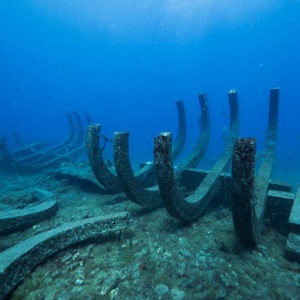
Sunken Civilisation and Living Reefs: Parque de la Atlántida https://pharosproject.eu/wp-content/uploads/2026/02/parque-submarino-la-atlantida-4-300x300-1.jpg 300 300 PHAROS Project https://pharosproject.eu/wp-content/uploads/2026/02/parque-submarino-la-atlantida-4-300x300-1.jpgHovering thirty metres below the surface of the Atlantic, a school of barracuda drift through the stone columns in a sunken temple at Parque de la Atlántida. Light filters down in dusty shafts, illuminating structures that feel ancient and mythical.
On the final day of January, the waters surrounding Gran Canaria and Lanzarote became less a tourist playground and more a living laboratory. The PHAROS project, an ambitious EU project aimed at restoring ocean health across the Atlantic and Arctic basins, threw open its hatches for a Citizen Science Marine BioBlitz. The mission was twofold: to engage the public in marine data collection, and to showcase a radical proposition, that we can build ecosystems back from scratch.
What the assembled divers and marine biologists encountered on the seabed here is not merely a series of pretty dive sites. It is potential evidence of a new methodology for marine conservation.
The crown jewel of this underwater showcase, and the site that holds particular emotional weight for the PHAROS team, is the Parque de la Atlántida.
Located just a short boat ride from the picturesque harbour of Puerto de Mogán, this underwater park is a curious marriage of art, tourism, and hard science. It was here, in the vessels of the Golden Shark submarine, that the PHAROS consortium held its inaugural meeting, peering through portholes at the very site that might prove their thesis correct.
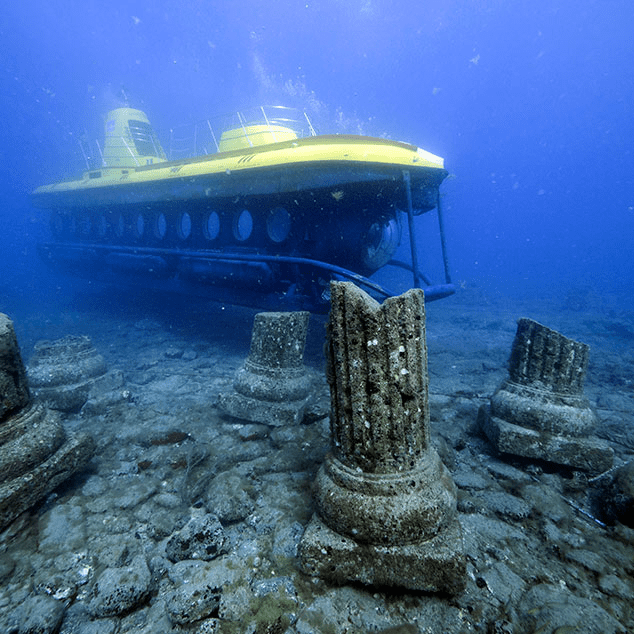
The park is a deliberately designed seascape featuring over 350 individual structures crafted from pH-neutral concrete and high-density fibreglass. The aesthetic choices were deliberate; the modules are cast to resemble the ruined architecture of a lost civilisation, a deliberate nod to the Atlantis myth to capture the public imagination.
In less than a decade, these artificial ruins have ceased to be “artificial.” The bare concrete is now smothered in a Technicolor crust of algae, sponges, and coral. The open water spaces between the columns are thick with fish life. On the dive, we observed dense shoals of bream using the structures as shelter, while a marbled ray skated across the sandy bed below. Two sunken fishing boats, deliberately placed to supplement the habitat, have become hotspots for predator species.
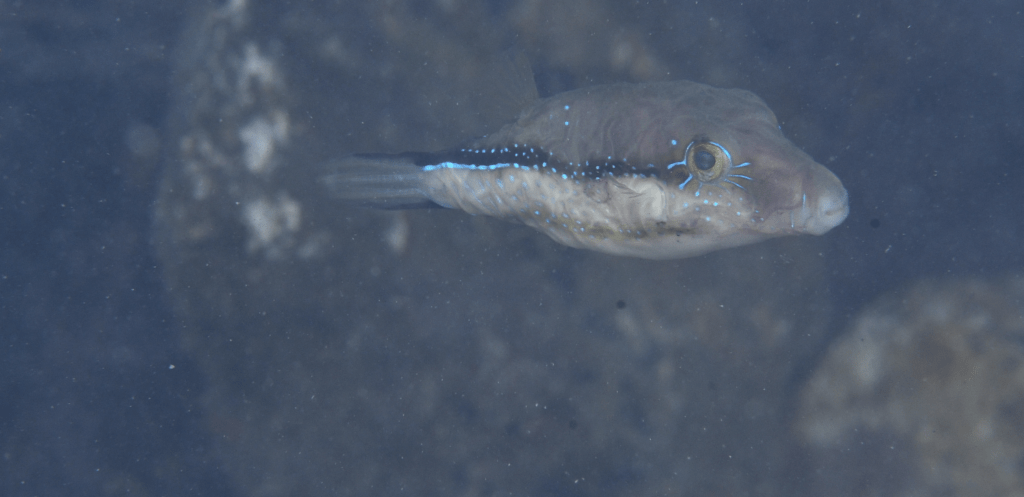
The structural complexity of the park supports a surprisingly diverse cast of residents. Dense shoals of white seabream (Diplodus sargus) and zebra bream (Diplodus cervinus) shelter between the columns, whilst schools of bastard grunts (Pomadasys incisus) drift in loose formation over the sandy floor. Trumpet fish (Aulostomus strigosus), with their needle-thin profiles, hover motionless in the water column, waiting to ambush smaller prey. Parrotfish (Sparisoma cretense), their vivid pinks and blues incongruous against pale concrete, graze on the algal crust that covers every surface. Moray eels occupy the darker recesses of the structures, their heads visible in the mouths of crevices. Octopuses, highly intelligent and surprisingly bold, navigate the ruins like locals. The sunken fishing boats at the deeper end of the site have attracted a particularly impressive cohort of predators, including large groupers that use the hull cavities as permanent address. A life-size blue whale skeleton, one of the park’s most striking structural elements, has been colonised along its entire length and regularly attracts circling shoals of bogues (Boops boops), making it one of the most photographed subjects at any depth in the Canary Islands
That is the crucial data point PHAROS is collecting. The Parque de la Atlántida proves that if you build it, they will come. But the question the scientists are now asking is: can we build it better? And can we do it on a scale large enough to mitigate the damage done by trawling, pollution, and rising sea temperatures?
For the citizens who descended into the depths that day, the experience was a powerful piece of advocacy. To see a barren sandflat transformed into a thriving reef in less than a decade is to witness hope in an era usually dominated by marine despair.
As the Golden Shark submarine slowly ascended back towards the glare of the Canarian sun, leaving the “sunken city” to the barracuda, the implication was clear. The myths that once spoke of lost worlds beneath the waves may need updating. Here, at least, the world beneath the waves is not lost, it is being rebuilt, one pH-neutral block at a time. The challenge for PHAROS now is to prove this can work in the cold, dark waters of the Arctic just as effectively as it does in the luminous Atlantic off Gran Canaria.
The Parque de la Atlántida proves the concept works. The real ambition of PHAROS reaches further.
The Gran Canaria demonstration aims to recover habitats that rival the finest natural benchmarks these islands possess. The El Cabrón Marine Reserve supports more than 400 species including endangered angel sharks and endemic Canarian fauna. The Tufia Site of Scientific Interest shelters gorgonians, seahorses, and butterfly rays within a volcanic labyrinth of caves. Both represent what the ocean looks like when left undisturbed. Both are what PHAROS is working towards.
To close that gap, PHAROS partner Underwater Gardens International will deploy Smart Enhanced Reefs (SER®), built from calcium carbonate, biomaterials, and cement, and engineered using the reefhopper® design protocol to maximise current interaction, light distribution, and organic particle retention. These are not passive substrates. They are designed for active ecological gardening, supporting the transplantation of gorgonians, sponges, black corals, and macroalgae pre-cultivated before integration into the wild.
Combined with IMTA systems farming seaweed and shellfish alongside the new reefs, PHAROS is not simply building habitats. It is engineering the conditions for the kind of full ecological recovery that El Cabrón and Tufia prove is possible