Scaling Citizen Science in Marine Restoration: CSIC showcases PHAROS Living Labs and MINKA at WCMB 2026
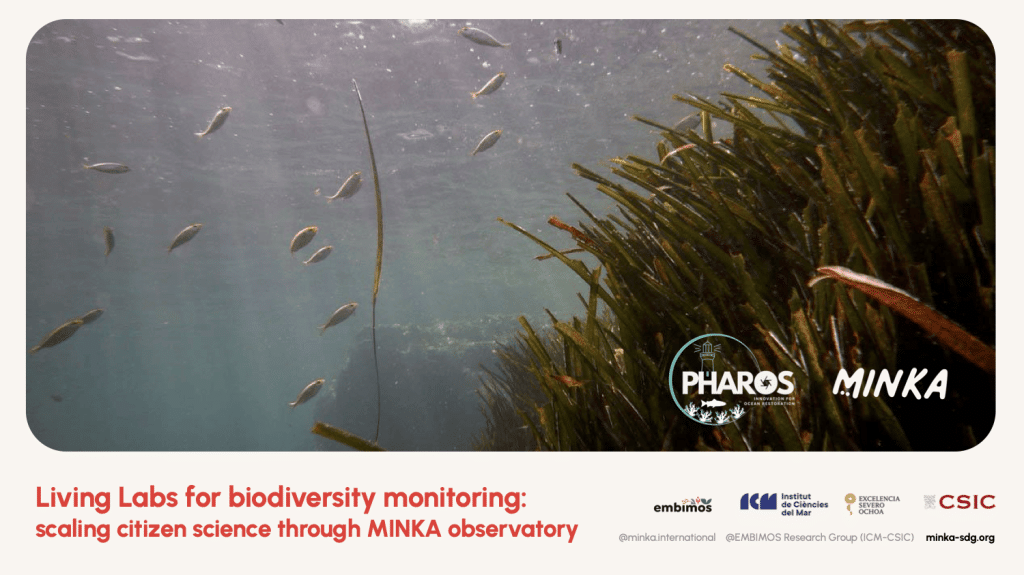
Scaling Citizen Science in Marine Restoration: CSIC showcases PHAROS Living Labs and MINKA at WCMB 2026 https://pharosproject.eu/wp-content/uploads/2026/11/VD2026_WCMB_Pharos_LL-1-1024x575.png 1024 575 PHAROS Project https://pharosproject.eu/wp-content/uploads/2026/11/VD2026_WCMB_Pharos_LL-1-1024x575.pngAt the 7th World Conference on Marine Biodiversity (WCMB 2026), held at the Concert Hall Bruges in Belgium, the Institut of Marine Science from the Spanish National Research Council (CSIC) presented how local communities are helping monitor and protect European waters. Representing the Horizon Europe PHAROS project, researchers from the EMBIMOS Research Group at ICM-CSIC delivered a talk titled “Living Labs for biodiversity monitoring: scaling citizen science through MINKA observatory”.
CSIC leads Work Package 2 on stakeholder engagement within PHAROS, coordinating the Living Lab methodology to support the EU Ocean Mission’s goals of restoring marine ecosystems, cutting pollution, and building a sustainable blue economy.
Connecting four communities through the MINKA Citizen Observatory
The presentation explored how citizen science can support biodiversity monitoring by connecting local communities, researchers, organisations and public authorities. Drawing on experience in Barcelona and Catalonia, it showed how collaboration around the MINKA Citizen Observatory (minka-sdg.org) has generated biodiversity knowledge for education, research and environmental management, and how this experience is informing the development of Living Labs within PHAROS.
At the time of the presentation, MINKA held 818,163 observations covering 13,900 species from 2,900 registered profiles. Its approach connects four communities with complementary, sometimes overlapping, roles.
- Participatory Community: Everyday citizens, divers, and volunteers collecting field records.
- Mobilisatory Community: Small businesses and NGOs driving local action on the ground.
- Scientific Community: Universities and research institutes verifying species and analysing trends.
- Facilitatory Community: Local governments and public administrations using the data for marine management.
Through this four-way model, volunteer observations turn into seasonal species maps, first local records, tracking of threatened or invasive species, peer-reviewed research papers, and public municipal portals.
Real-World Impact: From Gran Canaria to the Danube Delta
Building on the experience in Catalonia, PHAROS is supporting Living Labs that use MINKA to address local biodiversity challenges, including sites in Ireland, Iceland, Sweden, mainland Portugal, and the Azores. At WCMB 2026, presenter Berta Companys, on behalf of Meritxell Turó highlighted two contrasting regional examples alongside co-authors from Ukraine and the Canary Islands:
- Gran Canaria Living Lab: Led by the Canary Islands Maritime Cluster (CMC). Working with the Canary Islands Underwater Activities Federation (FEDECAS), Ciudad de Mar, PLOCAN, and ULPGC, the team has logged roughly 800 observations and brought 22 schools into co-creation activities, launching the Canary Islands Network of Blue Schools. Main challenges now are sustaining volunteer energy beyond one-off events, which remains an ongoing hurdle, and keeping local outreach through events like the Ciudad de Mar Fotosub competition.
- Danube Delta Open Living Lab: Led by the Schmalhausen Institute of Zoology. Partnering with Ukrainian institutions like Lviv Polytechnic National University, Rewilding Danube Delta, and NGOs like Real People, this hub has amassed more than 30,000 biodiversity records. Over 10,000 of those records are verified, spanning 1,400 species. Main challenges are about operating under strict safety constraints; the team is now looking to connect with local citizen science platforms across the border in Romania.
Five Lessons for Community-Led Ocean Monitoring
To close the session, CSIC shared five practical takeaways drawn from the Catalan experience and the development of PHAROS Living Labs for building lasting citizen science programmes:
- Bring all four community groups together so each contributes its own strengths.
- Translate platforms and guides into local languages to remove barriers for volunteers.
- Anchor projects around a shared local problem that residents genuinely care about.
- Share discoveries back with volunteers and publicly credit their work.
- Invest in steady local coordination and regular feedback to keep monitoring active over the long term.
Download the full presentation and explore the Pharos Zenodo community.