The economic case for marine protected areas and what the evidence shows
The economic case for marine protected areas and what the evidence shows https://pharosproject.eu/wp-content/uploads/2026/11/The-economic-case-for-marine-protected-areas-1024x576.jpg 1024 576 PHAROS Project https://pharosproject.eu/wp-content/uploads/2026/11/The-economic-case-for-marine-protected-areas-1024x576.jpgMarine protected areas have conserved biodiversity for decades. The latest claim is that they also feed the fisheries around them rather than competing with them. Stocks build up inside the boundary, and the surplus doesn’t stay put.
Mark John Costello, professor at the Faculty of Biosciences and Aquaculture at Nord University in Norway, set out to test whether the economic case is as thin as critics say. His 2024 paper in Scientia Marina, Evidence of economic benefits from marine protected areas, draws on around 200 studies covering 51 protected areas in more than 30 countries, across North America, South America, Europe, Africa, Asia and Oceania. The count came to 48 examples of fishery-related economic benefit in 25 countries, and 31 examples of tourism benefit in 24. Benefits to fisheries next to a protected area showed up in 46 of the 51 MPAs, or 90%. Catch rose in 76% of cases. Body size increased in 25%, and spillover was measured in 16%.
The habitats were not a narrow set. Coral reefs, kelp forests, mangroves, rocky reefs, salt marshes, mudflats, sandy seabed. Species ran from lobsters and scallops up to migratory tuna. Critics have argued for years that fishery benefits from MPAs are too context-dependent to generalise from. Costello’s reply is that across this evidence base, net costs to fisheries never appeared. Even sub-optimally designed MPAs returned something.
Why the economic models understate protection
Most models that cost out an MPA leave out something basic. They don’t price the fishery management already in place, or the absence of it. Those costs sit outside the ledger, so protection shows up as pure loss. A second asymmetry follows from the first. Close a whole fishery temporarily and the models credit the closure with stock recovery. Close a fraction of one for the long term inside an MPA and that credit disappears. Costello’s reading is that MPAs banning all fishing cost less to manage and deliver more, ecologically and for fisheries, than complex fishery regulations applied inside a protected area. His conclusion is blunt. The models need substantial revision, not adjustment at the margins.
The comparison is narrower than it looks, too. In some regions, quota limits and gear restrictions already constrain fishing over a wider area than any MPA, and most MPAs still permit some fishing. Withdraw protection and the gains go with it. An analysis of the long-term effects of marine reserves in Sweden found the reserves complemented existing fishery management measures. Where they were reopened to fishing, even briefly, the benefits went quickly.
Reservoir, not loss
Banning fishing in one place to get more fish somewhere else sounds backwards. The mechanism is replenishment. Protected populations grow larger and reproduce more, and both larvae and adults cross the boundary into the surrounding fishery. Costello pushed the point harder in a 2024 paper in PNAS, Fully protected Marine Protected Areas do not displace fisheries. Claims that MPAs force fishing effort out, in proportion to the area closed, get repeated often enough to pass as settled. His argument is that the evidence doesn’t support them.
He frames the economics in financial terms: capital is invested, and people live on the interest. Counting the designation of an MPA as a cost to fisheries, on that reading, is like counting interest earned on money as a cost.
Revenue depends on access
Protected areas that people can reach, and that hold biologically diverse habitats, earn money. Costello’s review puts annual tourism revenue associated with the Great Barrier Reef at US$6.4 billion, and the figure for the Medes Islands Marine Reserve in Spain at US$7.4 million.
Entrance fees are the small part of it. The rest comes from businesses that grow up around a protected area, the jobs they create and what that does to local living standards and national GDP. The review found tourism benefits in 24 countries, in tropical and sub-tropical waters as well as temperate ones. Longer-established MPAs earned more than recent ones. A separate review of 118 studies found the largest gains to human wellbeing in no-take MPAs that were well enforced and long established. Protection level and enforcement do the work. Designation on its own does not.
The tourism case has limits worth stating plainly. Revenue depends on access, on marine life being visible, and on visitor infrastructure that not every site has. Visitor pressure brings its own management burden. And the income doesn’t distribute itself: whether coastal communities see any of it depends on who owns the operators, the moorings, the accommodation.
Ballantine’s Law
The biggest gains to fisheries and biodiversity, at the lowest management cost, came from areas where no marine wildlife may be killed or removed. That principle is Ballantine’s Law, named for the late New Zealand marine biologist Bill Ballantine, often called the father of marine reserves.
In the 1970s Ballantine argued for a position then treated as radical: protected areas should be permanent and entirely no-take. Marine reserves, in other words, not protected areas with carve-outs. The argument produced New Zealand’s first marine reserve, at Goat Island. Costello worked with him. A study the two published in 2015 found that 94% of MPAs allowed fishing, and that three-quarters of coastal countries had no marine reserve at all. The implication is awkward for the way progress gets reported. If partially protected areas don’t return the benefits to biodiversity, fisheries or wellbeing that fully protected ones do, the unqualified term “MPA” hides more than it tells, and headline coverage figures add together protection of very different strengths.
How much ocean is actually protected
When Costello wrote in 2024, the figure in circulation was that under 3% of the global ocean held any form of protection. The numbers have moved. What matters now is the distance between designated and effective. In April 2026, IUCN and UNEP-WCMC confirmed that 10.01% of the ocean sits inside protected and conserved areas, up from 8.6% in 2024. That covers 18,200 MPAs and 199 other area-based conservation measures. Around 5 million km² was added in two years, an area bigger than the European Union.
| Measure | Share of global ocean | Source |
|---|---|---|
| Designated as protected or conserved | 10.01% | IUCN / UNEP-WCMC, April 2026 |
| Fully or highly protected (extraction banned) | 3.3% | MPAtlas, March 2026 |
| Beyond national jurisdiction (high seas) | 1.66% | IUCN / UNEP-WCMC, April 2026 |
| Management effectiveness assessed and reported | 1.3% | Protected Planet Report 2024 |
| 30×30 target for 2030 | 30% | Kunming-Montreal Global Biodiversity Framework, 2022 |
The two headline numbers say different things. Designated coverage has passed 10%, a real milestone, reached six years after the original deadline. Protection that actually bans extraction sits at roughly 3.3%, close to the number Costello cited. The strongest form of protection, the one his review found delivers most, has barely grown.
Hitting the 2030 target means roughly tripling designated area within four years. And the Swedish reserves are a reminder that coverage can fall as well as rise, taking the benefits with it.
Most protected areas are unexamined
PHAROS works in five Living Labs: Gran Canaria, Lanzarote, Ireland, the Danube Delta and Santorini. In all of them fishing is a livelihood and a culture, and in several it is the main local argument against new restrictions. Whether protection costs fishing communities money is not an academic question there. It’s the first one asked, at the first meeting.
Costello’s review doesn’t settle it for any single site, and shouldn’t be read as doing so. What it does is move the burden of proof. A claim that a proposed MPA will impose net costs on a local fishery now needs evidence of its own, rather than resting on an assumption the global literature doesn’t support.
The review also points at where the real weakness sits, which is measurement. Only 1.3% of the ocean has had its management effectiveness assessed and reported. Most protected areas are, in evidential terms, unexamined. The BLUE4ALL Blueprint MPA Platform that PHAROS is extending aims at that gap: governance tools for MPA managers, an ecological corridor module covering species movement and genetic diversity, and a link to the Digital Twin Ocean built on in situ sensors, live IoT data and high-performance computing. Monitoring is moving the same way. DTU is putting environmental DNA (eDNA) tools, qPCR and metabarcoding, on a robotic buoy to detect invasive species faster and across wider areas than ship-based sampling allows. Detection limits are still a live methodological question. And eDNA tells you a species was present, not how many or in what condition.
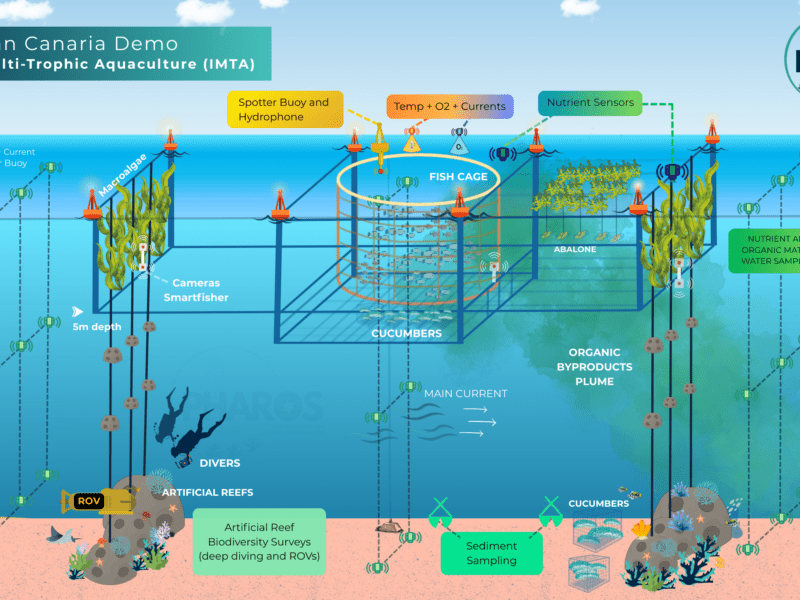
On the production side, the advanced Integrated Multi-Trophic Aquaculture (IMTA) system in Ireland grows seaweed alongside abalone and uses sea cucumbers to absorb waste from fish farms, with the aim of restoring nutrient-rich waters rather than depleting them. Commercial viability at scale isn’t demonstrated yet, in PHAROS or anywhere else in the sector. The same holds for the Smart Enhanced Reefs made from calcium carbonate, biomaterials and cement, now being tested at demonstration scale.
Two caveats belong next to the optimism. The benefits in Costello’s review were clearest in older, well-enforced, fully protected areas, a standard no five-year project can meet inside its own lifetime, which is why baselines and the handover of monitoring matter more than headline results. The second is publication bias. A review of reported benefits draws on studies that found an effect, and spillover was actually measured in only 16% of the MPAs examined. The mechanism is well argued. It is not always observed.
PHAROS runs from September 2024 to August 2029, coordinated by the Oceanic Platform of the Canary Islands (PLOCAN), with 24 organisations across 12 countries and an EU contribution of approximately €9.5 million under Grant Agreement no. 101157936.
Where this leaves the argument
A global analysis has already mapped where protection should go to meet the pledge to protect at least 30% of ocean habitats by 2030, a goal backed by the Convention on Biological Diversity, the UN Convention on the Law of the Sea and the International Union for Conservation of Nature. Placement decides what protection returns, not area alone. The practical conclusion is that siting protected areas is a fisheries management tool as much as a conservation one. Fishery scientists and fishers have a direct interest in where MPAs go, and more to gain from shaping that placement alongside conservation scientists than from fighting designation itself.
None of this makes protection quick or automatic. Restoration runs on decades. Enforcement costs money every year, and the evidence base is thinner than the headline percentages suggest. What’s hardest to argue with is the counterfactual: business-as-usual for global fisheries is not a stable baseline to defend.