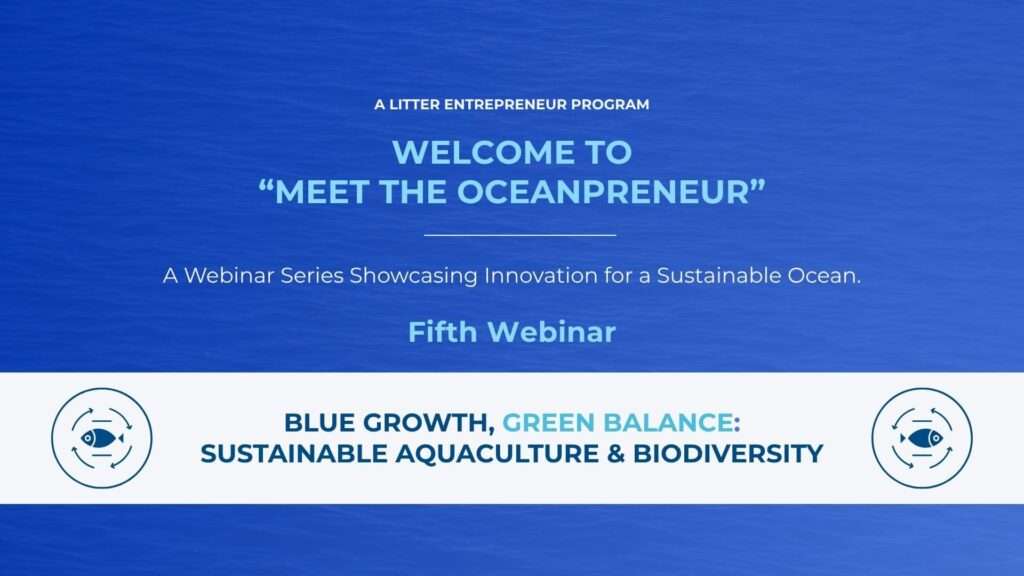
PHAROS Hosts Webinar: Blue Growth, Green Balance: Sustainable Aquaculture & Biodiversity Webinar
PHAROS Hosts Webinar: Blue Growth, Green Balance: Sustainable Aquaculture & Biodiversity Webinar https://pharosproject.eu/wp-content/uploads/2026/05/Blue-Growth-Green-Balance-Sustainable-Aquaculture-Biodiversity-1024x576.jpg 1024 576 PHAROS Project https://pharosproject.eu/wp-content/uploads/2026/05/Blue-Growth-Green-Balance-Sustainable-Aquaculture-Biodiversity-1024x576.jpgOn 8 June 2026, the fifth session of the Meet the Oceanpreneur webinar series under the PHAROS Project brought together speakers working at the intersection of sustainable aquaculture, biodiversity restoration, and blue economy innovation. The discussion featured Dimitris Kokkinakis of Impact Hub Athens, moderator Marion Besançon of Ifremer, Marc Garcia-Durán Huet of Underwater Gardens International, and George Birch of Oyster Heaven.
The session opened with a clear premise: the blue economy cannot grow at the expense of the ecosystems that sustain it. Dimitris Kokkinakis opened the conversation around a central challenge for Europe and beyond; how to expand ocean-based activity while protecting marine ecosystems and biodiversity.
Marion Besançon then introduced the two speaker cases as practical examples of restoration-led entrepreneurship. Her role as moderator was not simply to guide the discussion, but to connect science, innovation, policy, and business into one shared conversation. She emphasized that sustainable blue growth required solutions that were scientifically grounded, economically viable, and aligned with marine conservation goals.
Themes Covered
A major theme throughout the webinar was the idea that restoration and aquaculture should be designed as systems, not isolated projects. Dimitris explained that the session focused on sustainable aquaculture, regenerative ocean practices, biodiversity protection, and nature-based approaches to marine ecosystem restoration. He also highlighted the PHAROS Project’s role in deploying nature-based solutions and supporting a sustainable blue economy across Atlantic and Arctic regions.
Another important topic was the relationship between nature and finance. Both speakers returned repeatedly to the question of how restoration can be funded at scale. Rather than relying only on philanthropic support, they argued for business models that connect ecological outcomes with commercial value, long-term contracts, and measurable performance indicators.
Underwater Gardens International
Marc Garcia-Durán Huet, founder and CEO of Underwater Gardens International, presented a vision of marine regeneration built on biotechnology, ecological engineering, and financial innovation. He described the company’s efforts to create a toolbox of technologies for restoring marine habitats, including Reef Hopper, Smart Enhanced Reefs, and sea-garden concepts designed to support marine animal forests.
His core argument was that restoration becomes scalable only when ecological action is paired with financial logic. Marc explained that his team worked to define biodiversity targets, translate ecological data into measurable parameters, and link those outcomes to financial KPIs. He also discussed the idea of a biodiversity carbon index and biodiversity credits as a possible language for bridging the environmental and financial worlds, while acknowledging that such mechanisms are still evolving.
Marc also stressed the importance of collaboration over competition. He argued that the challenge ahead is too large for isolated actors and that the sector must move from small pilot efforts to systemic, large-scale restoration. He highlighted the need for long-term financing, long-term monitoring, and faster administrative processes so that restoration projects do not disappear after short funding cycles end.
Oyster Heaven
George Birch, founder and business lead of Oyster Heaven, grounded his talk in the ecological history of oysters and the practical business model behind reef restoration. He described oysters as once abundant foundation species that shaped the North Sea and British coastline, filtering water, supporting fish populations, and creating resilient coastal habitats. His presentation showed how oyster reefs function as living infrastructure rather than a simple conservation symbol.
George explained that Oyster Heaven restores reefs using clay substrates pre-seeded with juvenile oysters, then allows natural biological processes to rebuild biodiversity over time. He shared that their restoration sites had shown strong survival rates and rapid biodiversity recovery, and that the company had grown into a large-scale restoration organization with projects across multiple countries.
His business model was one of the most practical parts of the webinar. George argued that biodiversity credits alone are not the best immediate solution for every client. Instead, Oyster Heaven works with organizations facing concrete commercial problems, such as water-quality issues or nutrient management, and creates bespoke contracts where payment depends on measurable ecological improvement. In his view, the strongest business case comes from showing how nature restoration solves real operational risks and creates value for companies, investors, and local communities.
Collaboration And Scale
The live discussion between the speakers and moderator moved into the practical barriers that shape this sector. One recurring issue was scale: both Marc and George said the field has many successful small projects, but far fewer mechanisms for turning those pilots into long-term, large-scale operations. Marc pointed out that current political and administrative cycles often work against restoration, while George argued that finance is easier to attract when a project can demonstrate repeated success across different locations and use cases.
They also discussed collaboration with local communities and fishers. George explained that restoration works best when fishing communities are treated as partners rather than antagonists, and Marc echoed the importance of building from local knowledge while connecting to larger industrial stakeholders. Together, they suggested that the future of blue economy innovation depends on making restoration a shared responsibility across science, business, policy, and local practice.
Policy And Permits
A final topic centered on regulation and permitting. Both speakers described licensing as a major bottleneck, especially for small projects that cannot absorb high legal and administrative costs. George noted that permit systems often treat active restoration as if it were an industrial risk, even when the intervention is designed to improve biodiversity. Marc added that Europe still struggles with fear of innovation in administrative systems and that many restoration efforts are slowed by lengthy approvals rather than ecological uncertainty.
The session ended on a cautious but hopeful note. Dimitris summed up the key message by stressing that the sector must be honest about uncomfortable trade-offs while continuing to build market mechanisms, community engagement, and policy change around regenerative aquaculture and ecosystem restoration. He also announced that the next session would focus on ports, blue logistics, ecotourism, and sustainability in that space.