How Scientists Track Invasive Pink Salmon in Iceland Rivers
How Scientists Track Invasive Pink Salmon in Iceland Rivers https://pharosproject.eu/wp-content/uploads/2026/03/einar-h-reynis-oiweyxAyAts-unsplash-1024x768.webp 1024 768 PHAROS Project https://pharosproject.eu/wp-content/uploads/2026/03/einar-h-reynis-oiweyxAyAts-unsplash-1024x768.webpThe rivers of northern Iceland are known for their crystal clear waters and world class fishing. Arctic char swim alongside brown trout and Atlantic salmon in waters that have supported local communities for generations. But something has changed in recent years. An unwanted visitor has begun showing up in greater numbers, and people are worried.
That visitor is pink salmon, a species native to the Pacific Ocean that was introduced to the White Sea by the Soviet Union back in the 1950s. For decades it stayed mostly in place. But recent events have caused it to spread rapidly across Europe and the Arctic region. Now it has established itself as an invasive species pretty much all over Iceland.
A team from DTU Aqua, the Technical University of Denmark, has been working on a way to detect these fish earlier and more effectively. Erik Karlsson leads the work, and he explains why Iceland matters so much. Icelandic rivers are prized for very pristine fishing, he says. Local communities are quite cautious about invasive species that might come and disrupt this valuable resource they have. The fear is that these non native invasive species will disrupt the ecosystem and cause harm to biodiversity.
The Bigger Picture
This work is part of a larger effort. Invasive species pose significant threats to biodiversity, the economy, and public health. They can facilitate the spread of infectious diseases. Nearly 20 percent of Europe’s Red Listed species are under threat from invasive organisms. The Mission Atlantic and Arctic Lighthouse strives to restore ecosystems and protect biodiversity from these threats.
Previous work from the H2020 project ECOTIP, also led by DTU, has conducted extensive mapping of Arctic biodiversity and how it responds to pressures like climate change and expanding commercial activities. That research laid the groundwork for what comes next. Building on it, PHAROS is now undertaking Demonstration 4 in Iceland, focusing on the detection, monitoring, and control of invasive pink salmon. The goal is to revolutionise how invasive species are managed using advanced detection and intervention measures.
The Rivers Under Watch
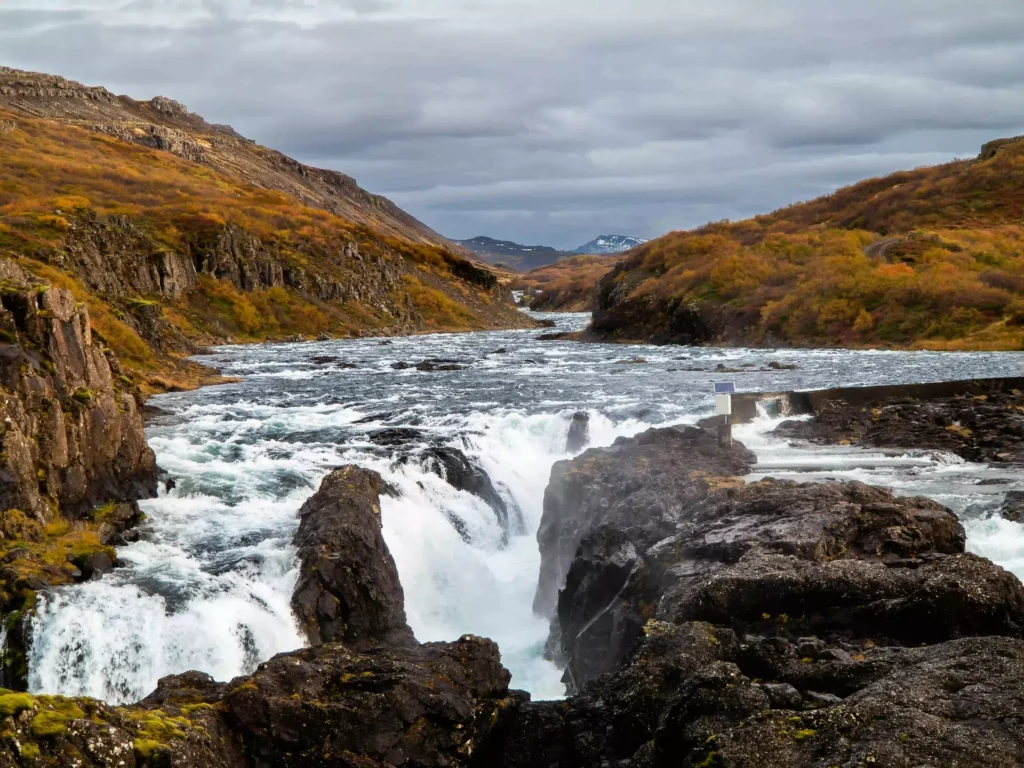
The demonstration areas in Iceland were selected based on where pink salmon have been found spawning. The Eyjafjardará river winds its way down the Eyjafjardar valley before reaching the Eyjafjordur fjord. It stretches some 60 to 70 kilometres. It is best known for its thriving population of Arctic char. Brown trout and Atlantic salmon also inhabit its waters, adding to the river’s rich fishing tradition. But in recent years, pink salmon have begun appearing in greater numbers, raising concerns about their impact on the river’s delicate biodiversity and natural balance.
Erik Karlsson explains the timeline: We only have two proper years, 2025 and 2027, because we are studying pink salmon that has a biannual spawning cycle. Spawning events occur in 2025 and 2027. Those are our main two focus events for this project.
The demonstration focuses on detection, monitoring, and control of invasive pink salmon using automated environmental DNA sampling. This has been proposed as a new way to manage invasive species. The idea is simple: Early detection allows for quicker intervention and prevention of invasion, which extends to biodiversity protection.
Understanding the Invader
Pink salmon are salmonids native to North America in the Pacific Ocean. They were introduced to the Atlantic, or more precisely the White Sea, by the Soviet Union in the 1950s. For a long time they did not spread too far. But something changed, and they have now spread rapidly across Europe and the Arctic region.
There are two populations of pink salmon. One spawns in even years and one spawns in odd years. For reasons that are not fully understood, only the odd year population has established itself in Europe. Those are the fish the team is targeting.
How eDNA Sampling Works
Environmental DNA is the genetic material that all organisms leave behind in any type of environment. In this case, water. The question the team is testing is whether they can use that DNA to measure and detect pink salmon at an early stage.
They are working in northern Iceland near the town of Akureyri. They are targeting the spawning migration, when the fish go into freshwater to spawn every two years.
The key piece of equipment is an automated eDNA sampler called an Environmental Sample Processor, or ESP. It was developed and built by the Monterey Bay Aquarium Research Institute (MBARI). There are a handful of these machines in existence. They are what Erik calls artisanal.
The ESP works by filtering water from the environment. It pumps water in and filters it, then extracts the DNA from that filter. It has an internal qPCR module to measure the DNA from each sample. It can target up to six species at a time.
For this deployment, they programmed it to target pink salmon three times over to ensure accuracy. They also target Arctic char and trout. And they include an internal positive control, synthetic DNA that tells them the process is working correctly.
In addition to the real time analysis done in the field, the ESP can also take archival samples. These are stored and retrieved at the end of deployment, then analysed back in Denmark.
Choosing the Right Spot
The team deployed their equipment in the Eyjafjarðará river. They chose this location because there was documented presence of pink salmon. But there was another reason. They had access to a container with electricity, which made logistics much easier.
Multiple Ways of Watching
The automated sampler is not the only tool they are using. The team also does manual eDNA sampling at eight sites along the river. This helps them see how far the pink salmon spread, what type of habitat they prefer, and whether there is overlap and competition with other species in the water. Mainly trout, Arctic char, and Atlantic salmon. The manual sampling also serves as a way to validate what the ESP is detecting. The method is simple, they take a water sample and filter it with a normal syringe through a filter holder.
These manual samples, along with the archival samples from the ESP, can be used for additional testing through metabarcoding. That allows them to get biodiversity measurements, which could potentially reveal more effects of the pink salmon invasion.
The team is also using visual and acoustic monitoring. In 2025 they used a simple setup with GoPro cameras installed next to the ESP, filming in four directions. Starting in 2026, Blue Oasis will take over the video work and it will be much more professional.
What They Found in 2025
The ESP was operational from July 6 2025 to September 15, 2025. It sent real time data back to the team as the season progressed.
The first thing they wanted to know was whether the automated sampler could detect pink salmon DNA at all. It did. More importantly, it detected pink salmon before the first physical observation. This is a river that is quite heavily fished throughout the season. People are on the water constantly. The team is quite confident that if pink salmon are there, they will be spotted at some point. The machine beat them to it. That was the first big success, validating that the system works as an early detection tool for invasive species.
There were some technical issues that caused breaks in the time series. But the archival samples, analysed back in Denmark, told an even clearer story. They detected pink salmon DNA on roughly the same dates as the real time samples, but the detections were more consistent. Where the real time samples had some negatives in between positives, the archival samples showed more continuous detection of pink salmon throughout the season.
The manual sampling along the river produced a detailed timeline. In early July, the first sampling date, they detected pink salmon at the mouth of the river. That was way earlier than anyone actually caught a pink salmon, almost one month before anyone physically saw one. By mid July there were some detections further upstream. In August, when they would expect pink salmon to have invaded to start spawning, detections were widespread. In September they slowly decreased. This pattern corresponds exactly to what they would expect from the size and timing of spawning runs.
The Year That Defied Expectations
The pink salmon community had been bracing for something big in 2025. Since 2017, when they started emerging in large numbers in Europe, there had been steady heavy increases every year. 2023 was the biggest year yet, massive especially in Norway. Everybody was expecting it to be even worse in 2025, but it was not.
Erik Karlsson has spoken to colleagues in Norway, Sweden, and Denmark. Everyone says the numbers are way lower than the fear or expectations. In Iceland, it seems only a few individuals were detected. Nobody knows exactly why yet, but it is a reminder that nature does not always follow predictions.
What May Happen in 2026
There will be no spawning in 2026. That is the off year in the biannual cycle. But there will be fry emerging in spring. Pink salmon fry behave in a distinctive way. They emerge and migrate out to sea while they are only about two to three centimetres long. They do this in late spring, around late May.
The team plans to deploy the ESP again in April. They will add a CTD sensor to collect more abiotic data, things like conductivity, temperature, and depth. Blue Oasis is taking over the video monitoring this year. It will be continuous, which should give much more reliable records of fish presence and much better validation of the ESP.
There will also be hydrophones deployed by Blue Oasis. The river itself is too shallow for them, so they will be placed at the river mouth. The hydrophones will not be able to detect pink salmon directly because pink salmon do not really give off any sound. But they might be able to detect mammals as an indirect measurement. If pink salmon start migrating, the team expects that mammals like seals will follow them and eat them. That would indicate added negative effects of the invasion.
The team has three primary research questions for 2026. Can the emigration of fry be detected using eDNA? Can they identify the ideal timing of that emigration? And is culling of juveniles a viable alternative to culling of adults?
There is also additional work continuing on the 2025 samples. They are not nearly done with all the analysis. It will include metabarcoding and similar techniques to understand broader biodiversity changes. They plan to write up their findings and publish in a scientific journal.
The Scalability Question
If early detection is the goal, you would want a method that can be installed in many places, perhaps all around Iceland. But ESPs are expensive and rare. Erik Karlsson thinks it is scalable in principle, but at the moment these machines are a bit too expensive. There are only about ten that have ever been made. The technique itself is not super new. It has been around for about ten years. With more demand, it becomes easier to mass produce.
What You Can and Cannot Detect
For real time analysis, you need to know exactly what you are looking for. You look at a specific piece of DNA that you know is unique to that species. You cannot monitor unknown species in real time. You need to target very specific ones.
But you can always look at archival samples afterwards to see if you can detect new sequences. There is no limitation that way. There is a limitation from a time constraint point of view. It takes about two hours to analyse each species. You cannot really analyse more than five or six species. Otherwise you run into the next day. Also, you only get so much sample from each sampling event. Six is basically the maximum number of species you can target. Hopefully visual AI cameras would help make this scalable.
Beyond detection, there is also the task of reduction. The project is supposed to cull the invasive pink salmon. Volunteers will be needed to help remove them, likely using electro stun methods.