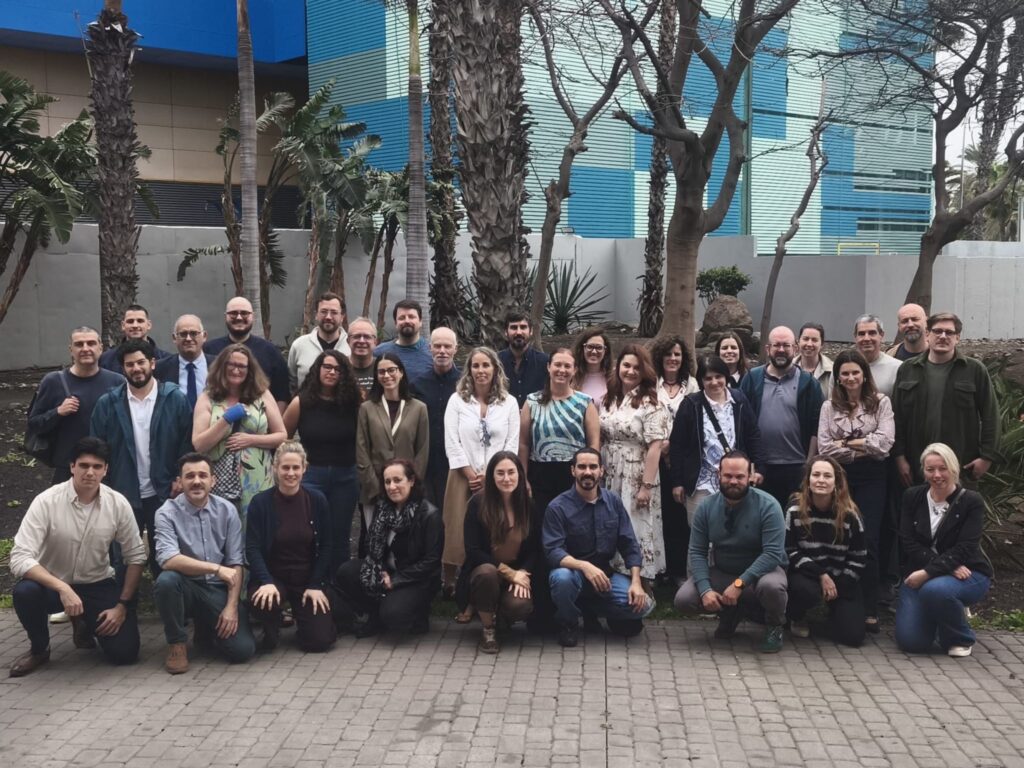
MarCoLab Officially Launched: We can transform the coast of the Canary Islands
MarCoLab Officially Launched: We can transform the coast of the Canary Islands https://pharosproject.eu/wp-content/uploads/2026/02/Pharos-AGM-Group-Photo-1024x768.jpg 1024 768 PHAROS Project https://pharosproject.eu/wp-content/uploads/2026/02/Pharos-AGM-Group-Photo-1024x768.jpgGovernment officials, scientists, and industry leaders gathered at the Canary Islands Maritime Cluster (CMC) to inaugurate MarCoLab, a new “Living Lab” for the PHAROS project, with a simple yet powerful message: protecting the sea is no longer a task that can be left to experts alone.
The press conference (on January 30, 2026) marked the official start of a collaborative experiment that will transform the coast of Gran Canaria into a living laboratory, where citizens armed with smartphones become the eyes and ears of marine science.
“The Science is Citizen Science”
The opening session was led by Elba Bueno Cabrera, Manager of the Canary Islands Maritime Cluster, who set the tone by framing PHAROS as a project designed to improve the health of our seas by merging three critical elements: science, technology, and citizen participation. “If we understand better what happens in the ocean, we can protect it much better,” she stated, announcing the launch of Marcolab as a “space open to collaboration.”
It was the intervention of Raúl García Brink, Councillor for the Environment, Climate, Energy and Knowledge at the Gran Canaria Island Cabildo, that grounded the high-concept project in the reality of the islands’ rugged terrain.
Mr. García Brínk acknowledged that the term “citizen science” often meets with scepticism. “Even where I go and start talking about citizen science, people raise their hands and say, ‘Science isn’t citizen-based’,” he explained. He used a distinctly local example to illustrate its value: the counting of feral goats. He explained that technical staff cannot safely access the island’s most treacherous ravines, so the Cabildo relies on local jumpers and hikers to report sightings.
“That concept of citizen science seems key to me,” he asserted, linking it directly to the nature-based solutions that PHAROS aims to develop. He pointed to the Charca de Maspalomas as a local example where co-creation with the public is already underway. “We are absolutely clear that this project addresses issues that are very important to us,” he said, reaffirming the island’s commitment and predicting “synergies” between Marcolab and other local initiatives.
MINKA – A Digital Tool for a “Huge Ocean”
Mrs Bueno detailed the ways of how the public can contribute, introducing MINKA, an international citizen science platform. She explained that residents can upload photographs of marine and coastal species with location data, which is then validated by experts, forming part of a global data network. “Citizen science allows us to collect data on a scale that no scientific team can achieve alone,” she emphasized, framing it as a tool for building “awareness, commitment, and a sense of shared responsibility.”
This sentiment was powerfully echoed by the Vice Minister for Ecological Transition, Climate Change and Energy, Government of the Canary Islands, Julieta Schallenberg, who brought a stark dose of administrative reality to the proceedings. She highlighted the immense challenge faced by her department: just two people are responsible for marine biodiversity for the entire province of Las Palmas.
“You can imagine the amount of work those two people have to protect a huge ocean that surrounds the entire Canarian Archipelago,” she said, her tone underlining the impossibility of the task.
For her, citizen science is not a luxury but a necessity born of limited resources. She described it as a way for the public to become “watchdogs”, not just for identifying species, but for flagging pollution and illegal activities. “What is not known is not appreciated, and what is not appreciated is not protected,” she stated. “Either we involve everyone, or it’s going to be very difficult.” She urged the public to participate in a coastal walk planned for the following day to identify both species and marine litter, turning data collection into a tangible act of stewardship.
From Testing Tech to Protecting Nature
The project also received a strong endorsement from the innovation ecosystem. Javier Franco Hormiga, Director of the Canarian Agency for Research, Innovation, and the Information Society, placed Marcolab within a broader strategic context. He framed it as a direct evolution of previous projects like AQUAING, which tested emerging technologies in the open sea and identified critical regulatory bottlenecks.
“MarCoLab is not just a space for blue innovation; it is a shared framework,” Mr. Franco Hormiga explained, describing it as a “demonstration territory” where technology, regulation, and social participation meet. He stressed that for innovation to reach the market, “technological innovation must always be accompanied by administrative and regulatory innovation.”
He noted that Gran Canaria’s unique conditions, including facilities like the Plocán Test Bed, position the islands as a “European platform for validating technologies.” The Living Lab, he concluded, represents a “Canary Islands that leads from European cooperation, that breaks barriers for blue innovation, and that turns knowledge into real impact.”
A Collective Force for the Sea
MarCoLab is designed to be the nexus where the passion of the public meets the rigour of science and the authority of government. It is a recognition that in the face of vast challenges like marine litter, biodiversity loss, and climate change, the traditional boundaries between expert and amateur, manager and citizen must dissolve.
Mrs Bueno’s closing words served as the project’s manifesto: an invitation for everyone to become “a real force for protecting the sea we all share”. With the launch of Marcolab, Gran Canaria is betting that the collective power of its people, hikers, divers, and beachgoers, will be the most potent instrument for safeguarding its most precious asset.