IMTA for Ecosystem Preservation and Aquaculture diversification

PHAROS is building a pilot IMTA system off the coast of Gran Canaria, the first of its kind in the region, designed to produce high‑value seafoodmeasure the bioremediation capacity of the production system, and promote biodiversity. It is a blueprint for reducing aquaculture’s environmental impact while enhancing production, introducing new species to the market, and developing a tool for ocean restoration.

What is IMTA?

Integrated Multi-Trophic Aquaculture (IMTA) can be understood as an evolution of conventional fish farming, designed to reduce its environmental impacts while improving overall system efficiency. In typical aquaculture operations, fed species such as fish release nutrients and organic matter into the environment through excretion and uneaten feed. These outputs include dissolved inorganic nutrients and particulate organic matter, which, if unmanaged, can contribute to water quality degradation and seabed impacts.

IMTA systems address this by incorporating additional species from lower trophic levels that utilise these by-products as resources. Macroalgae absorb the dissolved inorganic nutrients, helping to control nutrient enrichment in the water column. Filter feeders, such as shellfish, capture and consume suspended particulate organic matter. Meanwhile, detritivores like sea cucumbers process organic deposits that settle on the seabed, contributing to sediment cleaning and oxygenation. In some configurations, species such as abalone can also be included, feeding on the macroalgal biomass produced within the system.

An Oligotrophic Environment (nutrient‑poor)

This way of farming mirrors traditional land‑based agricultural practices used for millennia, which promote ecosystem balance across different organisms as well as ecosystem preservation. IMTA mimics nature’s own nutrient cycles and can be used as a tool to promote nature‑based solutions, allowing the production of high‑value species while preserving marine ecosystems. It’s a way of farming that doesn’t just take from the ocean, but gives back.

Imagine an underwater apartment building where each resident plays a role in keeping the building clean.

The waters around Gran Canaria are considered an oligotrophic environment (nutrient‑poor), with limited primary production, in which external inputs of nutrients can alter the natural balance of the ecosystem. But nature already knows how to fix this. In healthy ecosystems, waste from one species becomes food for another. Nothing is wasted, everything cycles.

By structuring aquaculture in this way, IMTA transforms waste from fish farming into valuable inputs for other organisms. This leads to more efficient nutrient usereduced environmental impact, and the co-production of multiple marketable species within a single, more sustainable system.

How PHAROS’ IMTA is planned to be implemented

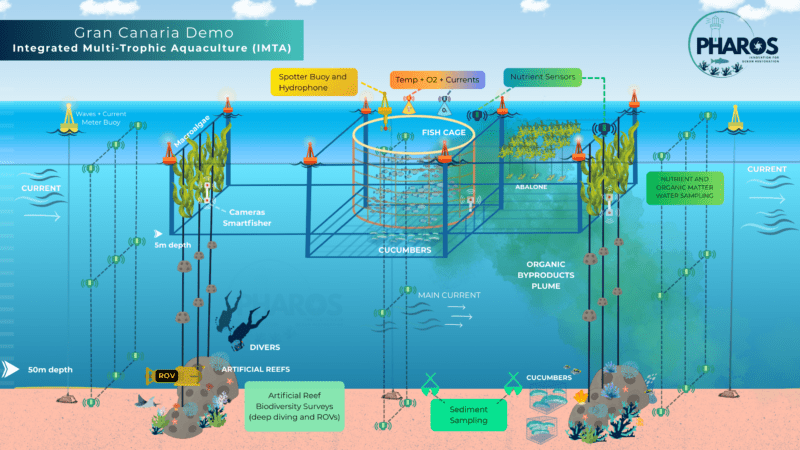
The system will combine production and restoration units that will each play a distinct role. Together, they will form a self‑sustaining cycle that cleans the water, creates habitat, and produces food.  

1. The Fish Cage

At the centre will sit a 25‑metre circular cage holding gilthead seabream. These fish will receive feed, grow for about 18 months, and naturally release excretion material (faeces and dissolved nutrients) that either enters the water column or sinks and is transported by currents.

In a conventional farm, that matter would accumulate on the seabed and eutrophicate the waters, causing damage to benthic communities through the accumulation of organic matter. As it decomposes, it can drastically reduce dissolved oxygen levels. In this system, it will become fuel for the next trophic level.

2. The Macroalgae Forest

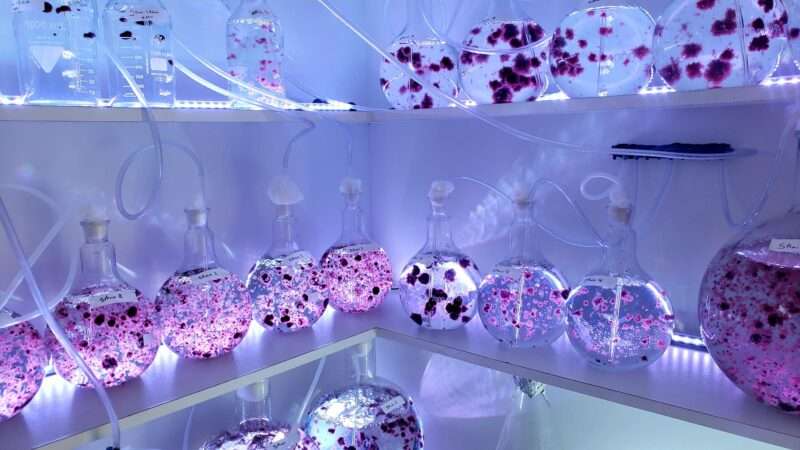
Downstream from the fish cage, long ropes of seaweed will stretch horizontally and vertically through the water column. The species here, Ulva rigida and Gracilaria gracilis, are fast‑growing and excellent at absorbing dissolved nutrients. They act like a natural chemical filter, capturing the nitrogen and phosphorus released by the fish.

The horizontal lines will sit near the surface where light is strongest. The vertical ropes will reach deeper, pulling nutrients from different water layers. Together, they will form a floating forest that cleans the water while producing biomass that can be harvested for food, feed, or even bioplastics.

There will also be vertical ropes on the upstream side of the IMTA to compare the growth and performance of the macroalgae in natural oligotrophic conditions against the nutrient‑rich side downstream.

3. The Abalone

In between the seaweed ropes, mesh cages will hold abalone, high‑value shellfish prized in European and Asian markets. These animals will feed on the nutritious macroalgae growing just beside them, so no external feed will be needed.

This abalone production highlights the circularity of the system: the algae that biofilter fish effluents are turned into nutrient‑rich biomass that meets the abalone’s nutritional requirements.

4. The Sea Cucumbers

Below the fish cage, another set of cages will hold sea cucumbers native to the Canary Islands. These animals will contribute to bioremediation and ecosystem preservation. They will feed on the organic particulate matter that sinks and can accumulate on the seabed. By recycling this material, they prevent it from accumulating and smothering the seabed.

Sea cucumbers also have growing markets in Europe and Asia, adding another potential revenue stream.

5. The Artificial Reefs

On the seabed and suspended at different depths in the water column, the team will place artificial reefs. These structures are specifically designed to enhance the colonisation of local biodiversity by providing hard surfaces for sponges, corals, and other sessile species to settle on.

Over time, they will become hubs of biodiversity, attracting demersal organisms such as fish, crustaceans, and molluscs. In the longer term, these aggregations may in turn attract pelagic predators (including marine mammals), though such attraction is indirect and secondary compared to the direct use by demersal groups.

One set of reefs will sit upstream as a control. Another will sit directly in the nutrient‑rich outflow from the fish cage. Comparing colonisation on both reef locations will help assess the aquaculture impact and the IMTA bioremediation potential.

Strategy Behind

The original idea behind PHAROS IMTA is not to restore a damaged ecosystem, but to prevent and mitigate potential impacts before they take hold.

How can we design a production system that embeds mitigation measures?

The PHAROS team started with a simple question: How can we design a production system that embeds mitigation measures?

Conventional fish farming releases nutrients and particulate matter into the water that can affect surrounding species and environments. But in a healthy ocean, waste from one species becomes food for another. We saw an opportunity to mimic that natural cycle to prevent and mitigate potential impacts before they take hold.

Rather than focusing on remediation after harm has occurred, our strategy is to design a production system that embeds mitigation from the start. By combining fed species (fish) with extractive species (seaweed, abalone, sea cucumbers) in a single integrated system, we aim to capture and reuse nutrients.

In doing so, we transform a potential source of pressure (nutrient enrichment) into a driver of circular production, bioremediation, and habitat enhancement.

This is a proactive model for sustainable aquaculture. The goal is to demonstrate that aquaculture can coexist with healthy marine ecosystems by managing its own waste streams, creating value from what would otherwise be environmental cost.

If successful, this approach can be replicated elsewhere as a blueprint for mitigating the impacts of fish farming, turning a potential pressure into a net benefit for both the industry and the ocean.

The design and set‑up of the IMTA demonstration in Gran Canaria will rest on three pillars:

1. Design for the ecosystem first

Before building anything, several months have been spent gathering baseline data: water chemistry, currents, seabed conditions, existing biodiversity. That data will serve as the benchmark against which impacts and effects will be measured.

2. Build infrastructure that lasts

The system to be installed is not planned as a temporary experiment. The moorings, the fish cage, and the sensor network will all be built to withstand Atlantic conditions and remain in place after the project ends. This could allow future researchers and entrepreneurs to pursue new ideas without starting from scratch.

The artificial reefs will also be kept in place to preserve the newly created habitats and to allow colonisation by slow‑growing fauna such as sponges and corals.

3. Let the system learn

Every sensor placed on the infrastructure will stream data in real time to a Digital Twin, a virtual replica of the underwater system. This will allow us to test changes virtually before touching anything in the water. The idea is to be able to ask that Digital Twin “what if” questions: for example, what if we move the seaweed ropes closer to the surface? What if we add more sea cucumbers? The Digital Twin will be able to propose the likely outcome, helping us adapt faster and with less risk.

This design is about creating the right conditions, and then letting nature do the rest.

The Tools and Frameworks

Building a system this complex requires more than just good engineering. It needs a set of shared tools and frameworks that keep everyone (scientists, engineers, local stakeholders, and policymakers) working toward the same goals.

The Five‑Phase Framework

From the very beginning, we applied a structured approach that ensures nothing is left to chance. Every activity within the demonstration site follows five clear phases:

Define what success looks like.

Set measurable goals aligned with the EU Mission Ocean targets.

Baseline Assessment

Collect data on the site before any intervention: water quality, biodiversity, socio‑economic conditions.

Monitoring & Adaptive Management

Track progress continuously.

Adjust methods based on what the data shows.

Evaluation & Impact Assessment

Compare results against targets.

Analyse what worked and what didn’t.

Implementation, Maintenance & Long‑term Suitability

Build, operate, and plan for the future.

Ensure the system remains useful after the project ends.

Feedback loops connect each phase to the others. If monitoring shows something unexpected, we loop back to adjust the monitoring plan or even revisit the original goals. The framework keeps us flexible without losing sight of the overall mission.

The DTO is the nervous system of the demonstration site. It is a virtual model of the underwater site, fed by real‑time data from multi‑sensor platforms measuring temperature, oxygen, nutrients, waves, and currents. These platforms include hydrophones listening for marine organisms (e.g., fish, seals, vessels) and underwater cameras tracking species movement and reef colonisation. 

All the data is planned to flow into a platform that can simulate how the system behaves. Researchers could then test scenarios (such as “what happens if a marine heatwave hits?” or “where should we place the next artificial reef?”) without disturbing the physical site. 

The DTO will also make the project transparent. Anyone (from local fishers to European policymakers) could see the same data, understand the trends, and participate in decisions about what comes next.  

None of this works if the data isn’t consistent. That is why the consortium has adopted the EMODnet Marine Data Management Guidelines. Every measurement, every image, every acoustic recording will follow the same format, use the same metadata standards, and be stored in a way that other European projects can use it. 

This means the insights from Gran Canaria won’t stay in Gran Canaria. They could feed into larger European platforms such as EDITO (the European Digital Twin of the Ocean), helping other restoration projects learn from the PHAROS experience.  

Success needs to be measured. We have defined a set of KPIs specifically for the IMTA system, each tied directly to the data streams flowing into the Digital Twin. These indicators tell us whether the system is restoring the ecosystem and whether it can become a viable commercial model.

Fish growth and health – Gilthead seabream (Sparus aurata) are weighed and measured every three months. Growth performance is assessed using biometric data, including specific growth rate (SGR), weight gain (WG), and Fulton’s condition factor (K). In addition, feed conversion ratio (FCR), feed intake, survival, and coefficient of variation (CV) are evaluated to determine the biological and economic performance of the culture system. Fish health status is assessed every six months through metabolic analyses of blood samples. The metabolic parameters analysed include glucose (GLU), total cholesterol (TC), triglycerides (TG), total CO₂ (tCO₂), calcium (Ca), phosphorus (PHOS), albumin (ALB), total protein (TP), globulin (GLOB), the albumin/globulin ratio (A/G), total bilirubin (TB), gamma‑glutamyl transferase (GGT), aspartate aminotransferase (AST), alanine aminotransferase (ALT), alkaline phosphatase (ALP), total bile acids (TBA), amylase (AMY), low‑density lipoprotein (LDL), lactate dehydrogenase (LDH), creatine kinase (CK), creatinine (Crea), uric acid (UA), urea (UREA), and the urea/creatinine ratio (U/C). These parameters are monitored through manual sampling and provide information on fish performance and their response to IMTA conditions. Additionally, biochemical analyses of fish tissues, including muscle and liver, together with histological sampling, are conducted every six months to further assess fish health status. These data will be compared with those obtained from commercial farms as references.

Macroalgae yield – The seaweed ropes are harvested and weighed periodically to measure biomass per metre. This tells us how efficiently the algae are absorbing nutrients from the fish waste. Target yields are expected to range from 0.5 to 1.2 kg of fresh weight per metre of rope.

Abalone and sea cucumber growth and survival – Both species are monitored through regular sampling. Growth rates, survival, and nutritional quality (fatty acid profiles, protein content) are analysed.

Nutrient capture – Continuous sensors measure nitrogen, phosphorus, and ammonia concentrations upstream and downstream of the IMTA system. Monthly water samples provide validation. The difference tells us how much nutrient pollution the system removes from the water column.

Physical parameters for modelling and prediction – A network of sensors tracks water temperature, salinity, dissolved oxygen, current speed and direction, and wave height. These data feed the Digital Twin, enabling it to simulate how the system responds to changing conditions and to predict outcomes under future scenarios (e.g., marine heatwaves, altered current flows).

Biodiversity monitoring – Underwater cameras and acoustic hydrophones continuously record species activity around the artificial reefs and macroalgae forest. Cameras track fish and invertebrate abundance; hydrophones detect vocalising species (fish, cetaceans) and anthropogenic noise. Periodic diver and ROV surveys provide ground‑truthing. Together, these tell us whether the system is attracting and supporting new marine life.

Wildlife monitoring (acoustic) – Hydrotwin‑S devices listen 24/7. They detect and classify marine mammal sounds, fish chorusing, and vessel noise. This data helps us understand how wildlife uses the restored habitat and whether human activity is affecting their behaviour. It also supports compliance with marine noise regulations.

All this technology would be useless without the people it’s meant to serve. The Gran Canaria Living Lab will bring together local fishers, aquaculture businesses, researchers, and government representatives to shape the project from the inside. 

Based on the species that will be produced, they’ll have access to the business models that will be developed. And after the project ends, they’ll be consulted on the decision to scale the system or adapt it to stakeholders’ needs. 

The Living Lab will ensure that the tools and frameworks we build are socially rooted. 

Together, these tools create a system that is measurable, adaptable, and shareable. The IMTA demonstration in Gran Canaria is more than a pilot project. It’s a blueprint, one that can be picked up by coastal communities across the Atlantic and Arctic, adapted to their own waters, and scaled to meet the EU’s 2030 restoration targets.  

The plan and the timeline

The system is designed to run for at least 18 months of active growth, with monitoring continuing throughout. The infrastructure (moorings, frame, and fish cage) will remain in place after the project ends, creating a permanent research asset for future experiments.

(Sep 2024 – Dec 2026)

Key Activities

Site assessment, engineering design, permit applications 

(Jan 2027 – Apr 2027)

Key Activities

Mooring blocks, artificial reefs, fish cage, macroalgae lines and buoys, and sensor network deployed.

(May 2027)

Key Activities

Fish, macroalgae, abalone, and sea cucumbers introduced.

(May 2027 – Nov 2028)

Key Activities

Continuous sensor data, monthly sampling, biodiversity surveys.

(November 2028)

Key Activities

Species harvested.

(May 2027 – Jun 2029)

Key Activities

Data analysed against KPI targets.

(August 2029)

End of project

Permanent infrastructure retained for future research. 

IMTA demonstration interest for various PHAROS' WPs

Living Labs

The fishing community in the different areas is involved in the project activities. Local fishers and seafood businesses will have access to the business models developed from the trials.

Digital Twin Ocean (DTO)

Every sensor on the production systems streams data in real time to the PHAROS Digital Twin. This virtual model lets researchers and managers simulate changes (adjusting the biomass of fish, invertebrates and seaweed) and see how the system and production could respond before touching anything in the water.

Marine Protected Areas (MPAs)

The artificial reefs and biodiversity gains from this system could provide information of interest for MPAs management and the inclusion of production activities within MPAs. If nutrient‑rich aquaculture can actually boost reef life, it could change how we think about where to place protected areas and what activities to allow inside them.

Blue Schools

The Blue Schools Network of the project will use the demonstration sites as a living classroom. Students could track water quality data, watch biodiversity increase, and see how a circular economy works in practice.

Work Packages (WP) related to IMTA

Methodology and Preparation (Led by Deltares)

Establishes the baseline data collection, monitoring, evaluation, and design methodology specifically for the IMTA system, including nutrient cycling, species performance, and environmental impact protocols.

Stakeholder engagement, MPA, Education, Fisher Guardian and Citizen Litter Entrepreneur programs (Led by CSIC)

Engages the local fishing community, SMEs, and other stakeholders through Living Labs to co‑develop the IMTA concept, ensure social acceptance, and integrate the fisher guardian program as a complementary pollution reduction effort.

Build, Implementation and Evaluation of demos (Led by ULPGC)

Directly builds and operates the IMTA demonstration (Demo 1) in Gran Canaria: deploys the fish cagemacroalgae cultivation linesabalone and sea cucumber cages, and artificial reefs; manages all growth trials and harvests.

Monitoring, DTO modules and project wide protocols, and MPA platform (Led by blueOASIS)

Deploys and manages the sensor network (water quality, acoustics, cameras) on the IMTA site; feeds real‑time data into the Digital Twin of the Ocean (DTO)develops protocols for data harmonisation and interoperability.

Replication and Exploitation (Led by PLOCAN)

Co‑creates business plans and replication roadmaps for the IMTA model; assesses market potential for IMTA products (seaweed, abalone, sea cucumber); organises investor brokerage events.

Dissemination and Communication (Led by ICoRSA)

Disseminates IMTA results through publications, events, webinars, and the project website; communicates the ecological and economic benefits of IMTA to scientific, policy, and public audiences.

Project coordination and management (Led by PLOCAN)

Co‑ordinates the procurement, installation, insurance, and risk management for the IMTA infrastructure; ensures timely delivery of components and compliance with health and safety requirements.

Deliverables related to IMTA

D1.1 Methodology: baseline data, monitoring, evaluation and demo planning and design

Establishes the five‑step framework for data collection, monitoring, and evaluation across all demonstrations, including protocols for environmental and biological parameters.

Defines the specific baseline and monitoring methodologies applied to the IMTA system (Gran Canaria Demo), including water quality sampling, benthic assessments, and performance indicators such as nutrient uptake, fish, invertebrates and macroalgae growth, and biodiversity changes.

D1.2 Report covering EIA, regulatory, consent licences, permits, H&S

Documents the environmental impact assessmentlegal approvalshealth and safety plans, and permits obtained for each demonstration site.

Contains the EIA and regulatory documentation specific to the IMTA installation in Gran Canaria, including permits for the fish cagemacroalgae linesabalone and sea cucumber cages, and artificial reefs.

D1.3 High level Project Plan, budget and techno‑economic

Provides the overall project scheduledetailed budget breakdown, and techno‑economic analysis for the four demonstrations.

Includes the construction budget, infrastructure specifications, and techno‑economic projections for the IMTA system, covering IMTA set‑up procurement, mooring installation, and expected operational costs.

D1.4 Demo plans (including Demo 1)

Delivers site‑specific implementation plans for each demonstration, following the five‑phase framework (analysis, baseline, monitoring, evaluation, implementation).

Dedicated section (3.1) describes the IMTA designtechnical specificationsmooring layoutspecies selectioninstallation timeline, and adaptive management strategy for Demo 1.

D1.5 Baseline data report for each demo site

Presents the initial environmental, biodiversity, and socio‑economic data collected at each site before restoration activities begin.

Reports baseline water quality (nutrients, dissolved oxygen, temperature), benthic community composition, and acoustic data collected at the PLOCAN site, against which the impact will be measured after the set‑up and running of the IMTA demonstration.

D3.1 Final Report on Demo 1 action, impact and outcomes

Summarises the results of the IMTA demonstration after full implementation, including performance against KPIsecological impacts, and lessons learned.

Directly evaluates the success of the IMTA system:: nutrient capture efficiencyfish, invertebrates and macroalgae growthmacroalgae and sea cucumber bioremediation efficiencybiodiversity changes, and overall impact reduction outcomes.

D4.1 Interim and final monitoring reports

Documents periodic monitoring results from all demonstrations, including sensor data, manual sampling, and biodiversity surveys.

Contains interim data on water quality trendsmacroalgae biomassfish and invertebrate growth, and sensor performance from the IMTA site, enabling early adaptive management.

D4.2 DTO plan for Las Palmas, Gran Canaria and Iceland demo sites

Outlines the architecturedata streams, and integration strategy for the Digital Twin of the Ocean (DTO) at the Gran Canaria and Iceland sites.

Describes how the sensor network (hydrophones, multi‑parametric probes, underwater cameras) will feed real‑time data into the DTO, enabling predictive modelling and scenario analysis for the production system.

D4.3 DTO trial report

Evaluates the performance of the DTO during initial operation, including data qualitymodel calibration, and early forecasting capabilities.

Assesses the accuracy of the DTO’s simulations for the IMTA site, such as nutrient dispersionmacroalgae growth predictions, and “what‑if” scenarios (e.g., changing current direction, stocking density).

D4.4 PHAROS DTO protocols on data and results

Defines the standardised formatsmetadata, and quality control procedures for all data entered into the DTO, ensuring interoperability with EMODnet and EDITO.

Establishes the data management protocols specifically for sensors (nutrient analysers, CTD probes, acoustic and video feeds) to guarantee FAIR (Findable, Accessible, Interoperable, Reusable) compliance.

D4.7 Final monitoring reports

Provides the complete dataset and analysis of monitoring activities across all demonstrations after the project ends.

Compiles the full time‑series of environmental and biological data from the systems, enabling comprehensive assessment of restoration outcomes and serving as a reference for replication.

D5.2 SoA of existing relevant business models

Reviews existing business models for ecosystem restoration, aquaculture, and circular economy initiatives in Europe and internationally.

Identifies potential revenue streams and commercial frameworks applicable to the demonstrations (e.g., carbon credits, high‑value abalone sales, macroalgae for bioproducts) to inform the business plans developed later.

D5.3 Toolset and guidelines for business plan preparation

Provides a practical toolkit and guidance document to help local entrepreneurs and SMEs develop business plans based on the PHAROS demonstrations.

Includes templates and examples tailored to demonstrations, covering cost structuresrevenue projections, and investment requirements.

D5.4 Co‑created business plans

Presents the business plans developed collaboratively with local Living Labs and stakeholders for each demonstration.

Contains one or more business plans, co‑created with fishers, aquaculture businesses, and investors, outlining pathways to commercial scalability.

D5.6 Market research report for the PHAROS Mission solutions

Analyses market potential for PHAROS solutions across the Atlantic‑Arctic basin, including demand, competitors, and growth opportunities.

Includes a dedicated section on the market for IMTA‑produced goods (e.g., seaweed, abalone, sea cucumber) and for IMTA as a service (bioremediation, carbon sequestration) in the EU and beyond.

Consortium Partners involved in IMTA

PLOCAN (Consorcio para el Diseño, Construcción, Equipamiento y Explotación de la Plataforma Oceánica de Canarias)

Role in IMTA: PLOCAN co‑ordinates the demo implementation overall and is responsible for farming the fish; provides the offshore test site and infrastructure.

Expertise: PLOCAN manages offshore permitting for aquaculture operations. Offshore test site operationmarine infrastructure management, project coordination in ocean energy and aquaculture R&D. Nutrient sensorsremote fish feeding, and fish cage sensing.

GOBCAN (El Gobierno de Canarias)

Role in IMTA: GOBCAN co‑ordinates the demo implementation.

Expertise: Finfish farming expertise.

ULPGC (Universidad de Las Palmas de Gran Canaria) Ecoaqua

Role in IMTA: Ecoaqua leads the macroalgae and invertebrate cultivationmanages species selection and growth trials.

Expertise: Marine aquaculture researchintegrated multi‑trophic systemslarval rearing and nutrition of high‑value species (abalone and sea cucumbers).

ULPGC (Universidad de Las Palmas de Gran Canaria) Spanish Algae Bank

Role in IMTA: Supplies native macroalgae strains and provides cultivation expertise.

Expertise: Macroalgae biodiversitycultivation and conservationalgal biotechnology and strain banking.

UGI (Underwater Gardens International)

Role in IMTA: Designs and deploys the artificial reefs.

Expertise: Artificial reef designecological restorationmarine habitat engineering3D‑printed reef structures.


blueOASIS

Role in IMTA: Installs and manages the sensor network and Digital Twin integration.

Expertise: Underwater acousticsAI‑based species detectionreal‑time monitoringDigital Twin development for marine environments.

Deltares

Role in IMTA: Develops methodologies to track and assess the system performance.

Expertise: Hydrodynamic and biogeochemical modellingcoastal systems analysisopen‑source modelling frameworks (MOHID, Delft3D).

Privacy Preferences

When you visit our website, it may store information through your browser from specific services, usually in the form of cookies. Our Privacy Policy can be read here.

Here you can change your Privacy preferences. It is worth noting that blocking some types of cookies may impact your experience on our website and the services we are able to offer.

Click to enable/disable Google Analytics tracking code.
Click to enable/disable Google Fonts.
Click to enable/disable Google Maps.
Click to enable/disable video embeds.
Our website uses cookies, mainly from 3rd party services. Define your Privacy Preferences and/or agree to our use of cookies.