Gran Canaria’s Blueprint for Atlantic Marine Restoration
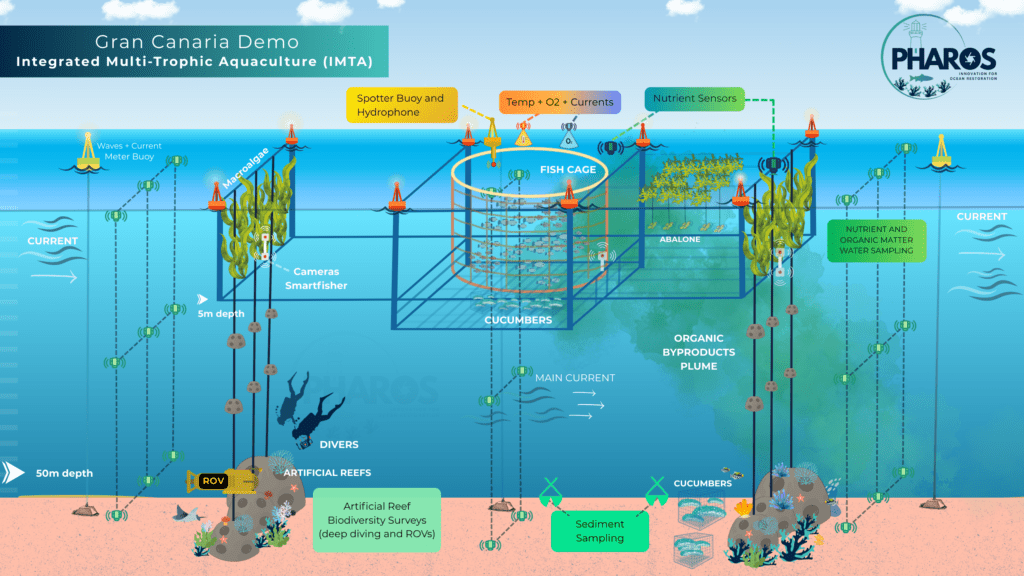
Gran Canaria’s Blueprint for Atlantic Marine Restoration https://pharosproject.eu/wp-content/uploads/2025/09/DEMO-1-AND-2-PHAROS-1024x576.png 1024 576 PHAROS Project https://pharosproject.eu/wp-content/uploads/2025/09/DEMO-1-AND-2-PHAROS-1024x576.pngOff the coast of Gran Canaria, within the PLOCAN research area, a meticulously orchestrated Atlantic marine restoration project is moving from concept to reality. It aims to transform aquaculture from a perceived environmental burden into an engine for ecosystem restoration. The Gran Canaria Demonstration, a complex, eighteen month trial scheduled to commence in May 2027, seeks to validate a model where commercial fish farming actively enhances biodiversity and cleanses its own waters.
The IMTA Loop: Turning Waste Into a Resource
At its heart lies a sophisticated Integrated Multitrophic Aquaculture (IMTA) system, a productive, ecosystemic and circular economy model for the ocean. The primary nutrient source will be a single fish cage stocked with gilthead seabream. The cage’s nutrient rich effluent is not viewed as waste but as a resource.
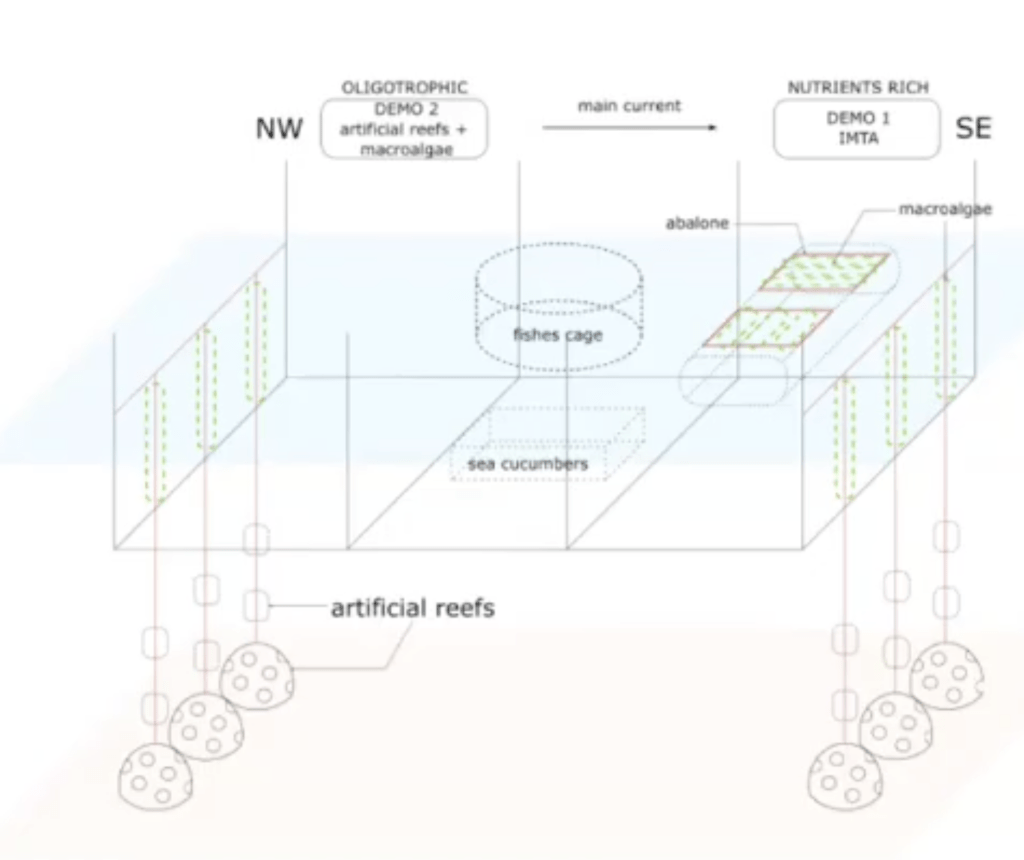
Directly downstream, a “marine forest” of the fast growing green macroalgae Ulva lactuca will be deployed on longlines to capture these dissolved compounds in the form of dissolved nutrients. Furthermore, sea cucumber cages will be positioned beneath the fish cage to consume the particulated organic matter, and abalone farmed in cages too, will be fed by the macroalgae production, completing a multi trophic recycling loop while bringing this new species to the national and local aquaculture offshore.
Farming Invertebrates: The Science Behind the Species
The production of these invertebrates is a science in itself. The University of Las Palmas de Gran Canaria (ULPGC) detailed the land based process for abalone, which involves conditioning broodstock, inducing spawning, and culturing larvae in settlement tanks for four to five months until they graduate from feeding on diatoms to macroalgae.
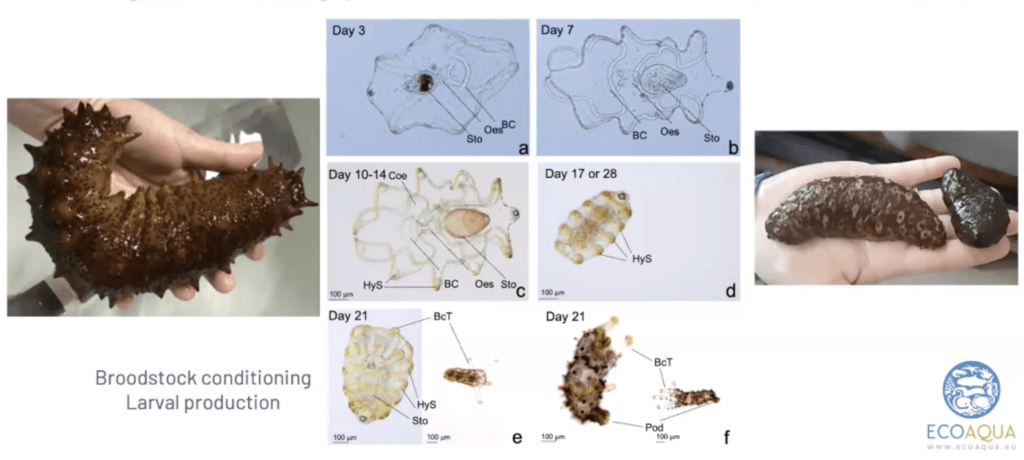
For sea cucumbers, a significant challenge was identified; traditional growth monitoring via pit tags is impossible as the animals eject them. The team is exploring innovative solutions, with advisory board input confirming tagging does not work and suggesting AI powered camera systems to measure growth from imagery, an approach deemed promising.
Artificial Reefs: When Regulation Drives Innovation
Beyond the IMTA loop, the project’s second transformative pillar is the deployment of artificial reefs for active biodiversity restoration. The journey here has been shaped by regulatory reality. As Oscar Aller from Underwater Gardens explained, Spanish regulations on artificial reefs led authorities to recommend a pivotal integration: “the authorities recommended integrating all the artificial reefs into the IMTA permit to avoid multi year permitting delays.” This necessitated merging the original Demo 1 and Demo 2, relocating the reefs from 15 metres to a deeper site at approximately 49 metres, and redesigning the entire layout.
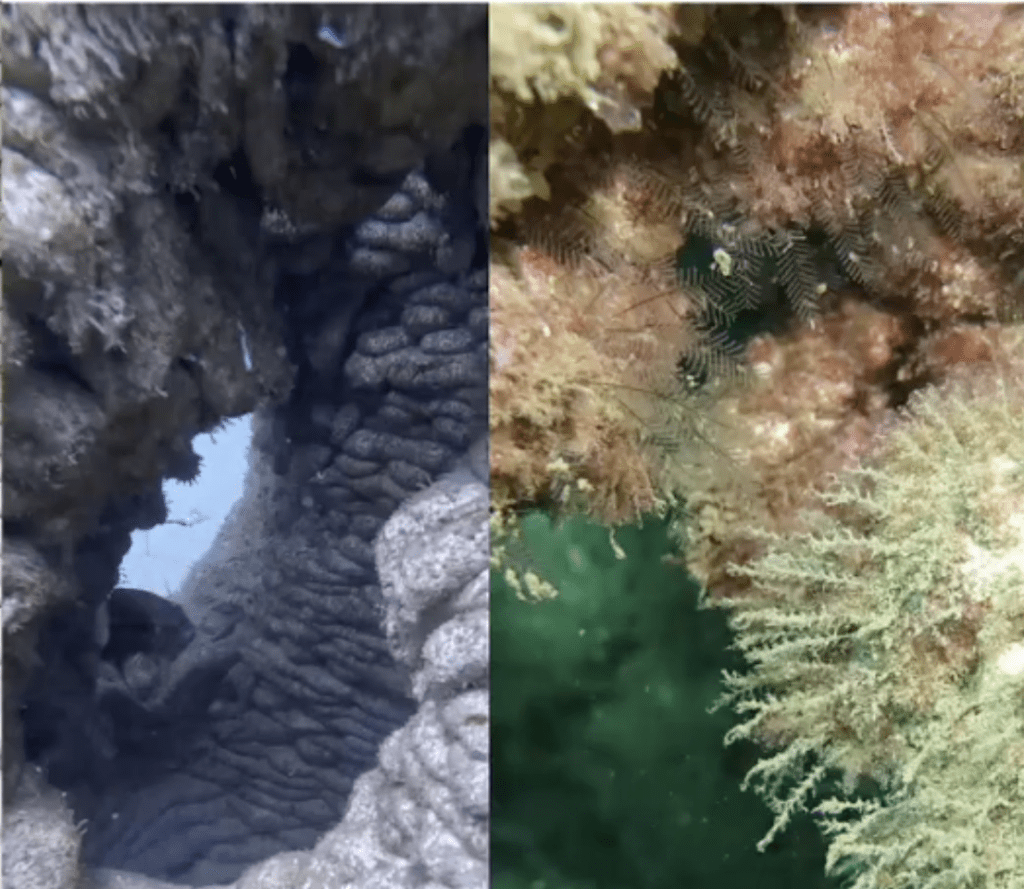
This constraint, however, bred innovation, leading to the development of three distinct reef types targeting different ecological niches: ten Type A for benthic species; twenty four Type B “clamping”, semi submerged floating reefs to attract pelagic species; and sixteen Type C “cavity reefs” integrated into mooring blocks for small demersal and encrusting life. Fabrication is underway, with delivery to Gran Canaria expected by the end of 2026 for its deployment alongside the IMTA by March 2027.
Monitoring the Atlantic Marine Restoration in Real Time
The entire demonstration will be a hub of continuous, real time data collection, led primarily by Blue Oasis. Their smart buoy system will host a hydrophone with embedded AI to detect marine mammal vocalisations and shipping noise, alongside current meters assessing wave spectra and flow dynamics. A key monitoring strategy involves deploying two nutrient sensors; one directly at the fish cage, the expected nutrient hotspot, and a second downstream of the macroalgae forest to measure the decrease in concentration after algal uptake. This sensor array will measure nitrites, nitrates, total nitrogen, phosphate, and ammonia. Complementing this, there will be monthly surveys to take samples of water at different stations and depths around the IMTA. To assess the impact of the IMTA and the macroalgae forest to increase the native biodiversity a network of underwater cameras, some employing AI for species identification, will be positioned around the macroalgae lines; year deep diving surveys helped with ROVs will inspect the deeper artificial reefs colonization. Related to the telemetry and power for these cameras, a decision leaning towards battery powered units with a pull up retrieval system to avoid complex, failure prone cabling across the dynamic mooring system. All this data will be transmitted via 4G mobile networks to onshore dashboards, feeding the broader PHAROS Digital Twin.
Five Partners, One Coordinated System
The operational complexity is staggering, coordinated by PLOCAN but reliant on a consortium of five partners. Responsibilities are clearly demarcated but interdependent. PLOCAN is procuring and installing the core IMTA infrastructure, managing permitting, and will contract an aquaculture company for daily operations including fish transport, net cleaning, and mortality removal. They will also contract the scientific deep diving team for at least two surveys during the trial to monitor reef colonisation. ULPGC and the Spanish Bank of Algae (BA) are responsible for supplying and maintaining the macroalgae and invertebrates, conducting monthly water sampling for nutrients and dissolved organic matter. Underwater Gardeners is finalising reef design and overseeing fabrication and shipment. Blue Oasis is providing the acoustic and current monitoring hardware and telemetry.
Measuring What Matters
The project also includes an extensive environmental surveillance programme, with three surveys throughout the trial: before deployment, one mid trial, and a final survey after eighteen months. A novel scientific analysis using stable isotopes will be conducted to precisely quantify the nutrient transfer from the fish to the macroalgae, offering irrefutable evidence of the system’s efficiency. The Gran Canaria Demo is more than an experiment; it is a full scale prototype for a restorative blue economy, proving that with intelligent design, human industry can become a fundamental part of the ocean’s healing process.