Enhanced Blue4All MPA Solutions Hub

The enhanced Blue4All MPA Solutions Hub (previously known as the Blueprint Platform), being developed within the PHAROS project, gives these managers a powerful ally. It helps them quickly spot emerging problemsfind proven solutions from other MPAs, and make confident decisions, even under uncertainty. Marine Protected Area (MPA) managers will benefit from a strategic framework that promotes adaptive management practices responsive to environmental changes. The platform’s integrated governance tools facilitate collaborative decision-making among diverse stakeholders, from local fishers to national authorities.

Perhaps most importantly, a dedicated ecological corridor management module helps MPAs work together across vast ocean distances, supporting species movement and genetic diversity. And by connecting the platform to the Digital Twin Ocean (DTO), live digital replica of marine environments, managers gain real-time insights into what is happening in their waters and what might happen next.

PHAROS aims to transform the MPA Solutions Hub into an all-encompassing toolset. We want to empower MPA managers to efficiently tackle challenges, implement adaptive strategies, engage stakeholders, and ensure the long-term sustainability of MPAs through effective co-management practices.

Why this matters: A reef that nobody supports is just a pile of concrete. A protected area that cannot adapt to change will not protect anything for long. The MPA Solutions Hub turns good intentions into effective action.

What is the Enhanced Blue4All MPA Solutions Hub?

Imagine trying to manage a protected area the size of a small country, with limited staff, competing demands from fishing and tourism, and a changing climate that keeps shifting the rules. That is the daily reality for Marine Protected Area (MPA) managers across Europe.

The MPA Solutions Hub began its journey in the Blue4All project, where it was designed as a web-based guide for effective, efficient, and resilient MPA management. Think of it as a smart assistant for anyone responsible for protecting marine life, from a small coastal reserve to a vast network of protected areas spanning thousands of square kilometres.

But a simple collection of PDFs and links would not help anyone. So the Blue4All team built something smarter: a solution-oriented system that tackles management problems from both human and environmental angles.

What the platform already does (the foundation):

  • Centralised tool catalogue – A searchable library of ecological, social, and governance tools, each tagged with clear, non-technical descriptions

  • Intelligent filtering – Find the right tool for your specific problem using keywords, categories, and multi-layer search

  • Networking hub – Connect with other MPA managers through the MPA Community Network (powered by BlueBioMatch) to share experiences and best practices

  • User-friendly interface – Designed to be usable by anyone, from a seasoned scientist to a community volunteer

What PHAROS is adding (the enhancement):

PHAROS is taking this solid foundation and expanding it in four major ways:

  1. Geographic expansion – Adapting the platform for the Atlantic and Arctic basins, including the EU’s outermost regions (AOM islands) like the Azores, Madeira, and the Canary Islands

  2. Ecological corridor module – Helping MPAs connect with each other so species can move, migrate, and adapt to climate change

  3. Digital Twin Ocean integration – Bringing real-time data and predictive modelling directly into the platform

  4. Decision Support System (DSS) – Giving Living Labs access to oceanographic data layers for scenario planning

The result is a bridge between high-level policy targets (like protecting 30% of EU seas by 2030) and the practical, on-the-water decisions that make those targets real.

Strategy Behind

The EU Biodiversity Strategy for 2030 set ambitious targets: legally protect at least 30% of EU seas, with one third under strict protection. That is a lot of new MPAs. But designating an MPA on paper is easy. Making it work, with limited budgets, competing interests, and climate change, is hard.

PHAROS built its strategy on a simple observation: MPA managers across Europe face similar problems, but they rarely talk to each other. And when they do talk, they often use different languages, follow different regulations, and work with different tools.

The evidence behind our approach

Between October 2024 and February 2026, the PHAROS team engaged directly with MPA practitioners from Madeira, the Azores, Cabo Verde, the Canary Islands, Ireland, and the Danube Delta (Ukraine). Through interviews and questionnaires (see Deliverable 2.3, “SoA report on local MPA & ecological corridor status”), we identified six categories of recurring challenges.

Policy & Legal Framework

Fragmented government coordination… insufficient legal backing for co-management… slow political action

Ecological Integrity & Conservation

Controlling nutrient enrichment, protecting critical habitats, preventing biodiversity loss, safeguarding connectivity across ecosystems

Stakeholder Engagement

Resistance from fishers… logistical barriers between islands… limited understanding of regulations

Management & Planning

Lack of technical capacity for monitoring… boundary disputesresponse to emerging threats like climate change

Resources & Capacity

Additional personnel, equipment, and access to training would significantly strengthen our ability to monitor.

Education & Awareness

Need for ocean literacy… outreach campaigns to inform tourists about how their activities can damage sensitive habitats

The strategic response

Rather than building yet another tool from scratch, PHAROS chose to enhance an existing, tested platform – the Blue4All MPA Solutions Hub. This decision was strategic for three reasons:

  1. Speed – The foundation already exists. We can focus on adding value where it is needed most

  2. Coherence – One unified platform, not multiple competing systems

  3. Sustainability – The platform continues beyond PHAROS, hosted by the MPA Community Network

Our strategy centres on co-creation. We are not building features based on guesswork. Every enhancement comes from direct feedback from MPA practitioners through structured workshops, user stories, and continuous testing.

What success looks like

By the end of PHAROS (August 2029), the enhanced MPA Solutions Hub will be a live, operational tool used by MPAs across the Atlantic and Arctic basins – not because someone told them to use it, but because it genuinely makes their work easier and more effective.

How PHAROS Plans to Enhance the Blue4All MPA Solutions Hub

The enhancement plan, detailed in Deliverable 4.5 (Blueprint MPA Platform Plan), is built around four strategic modules.

Geographic and Thematic Expansion

PHAROS is extending the platform to cover the Atlantic and Arctic basins, including the EU’s outermost regions (AOM islands). This means:

  • Onboarding new MPAs from these regions into the MPA Community Network

  • Adapting the tool catalogue to address regional challenges (e.g., island-specific issues, Arctic conditions)

  • Translating key content where needed

The Living Labs established under PHAROS are the first step in this expansion, providing real-world testing and feedback.

Ecological Corridor Management Module

Currently, most MPAs do not actively consider ecological connectivity in their design and management. Yet species do not respect boundary lines. Fish migrate, larvae drift, turtles travel thousands of kilometres.

The new ecological corridor module will help MPA managers:

  • Identify priority areas for corridor establishment using Lagrangian models (simulating how larvae disperse with ocean currents)

  • Spatialise pressures (marine heatwaves, fisheries, shipping, tourism) across archipelagos

  • Design interconnected marine corridors that maintain genetic flow and species movement

This work is being developed in close collaboration with the Blue Connect project, which focuses specifically on connectivity in the Macaronesia region (Azores, Madeira, Canary Islands, Cabo Verde).

Digital Twin Ocean (DTO) Integration

All harmonised data lives in a hybrid cloud storage system managed through the EDITO platform. The architecture has three tiers:

  • Raw tier: Original, unprocessed data – Auditing, reprocessing
  • Processed tier: Cleaned, validated, flagged – Daily analysis, visualisation
  • DTO ready tier: Aggregated, model compatible – AI training, scenario testing

The PHAROS Digital Twin Ocean (DTO), developed for demo sites in Gran Canaria and Iceland, will be integrated into the MPA Solutions Hub as a tool within the catalogue.

What the DTO brings:

  • Real-time data from multi-parametric sensors (wave, current, wind, temperature, salinity)

  • AI-based species identification (acoustic and camera-based)

  • Predictive modelling of climate impacts

  • Early warning systems for marine extreme events (storm surge, heatwaves)

In the initial phase, the DTO viewer will be integrated as an external tool (accessible via secure hyperlink). This allows for testing, feedback collection, and functional separation. Based on user feedback, PHAROS may embed the viewer directly into the platform.

Decision Support System (DSS) for Living Labs

The DSS will give Living Labs access to open-source data layers (EMODnet, Copernicus, CMCC models) for scenario analysis and planning.

Preliminary data layers include:

  • Marine & Coastal Environment – Temperature, salinity, currents, waves

  • Oceanographic characteristics & Climate – Model-based projections, climate scenarios

  • Operative maritime activities – Shipping traffic, fishing intensity

  • Socio-economic information – Coastal communities, economic dependencies

  • Governance information – MPA boundaries, regulations, enforcement capacity

The DSS will feature an ocean visualiser with interactive maps, temporal trends, and key performance indicators (KPIs) . This draws on existing tools like the ReMAP project’s “Input Data” module, which will be included in the MPA Solutions Hub catalogue as a reference for integrating MPA management with Maritime Spatial Planning (MSP) principles.

The Tools and Frameworks

A platform is only as good as the thinking behind it. The enhanced MPA Solutions Hub is built on three interconnected frameworks.

The Integrated Solutions Framework

This is the conceptual backbone of the platform. It organises tools around three dimensions:

  • Phases – Planning → Implementation → Management → Reviewing

  • Dimensions – Environmental/ecological / Social / Governance / Economic

  • Components – Stakeholder engagement, sustainable financing, capacity building, enforcement, ecological monitoring, etc.

Every tool in the catalogue is tagged using these elements, creating multiple entry points for discovery. Need a tool for stakeholder engagement during the planning phase? The framework will find it.

Socio-Governance Tool Typology

This classifies tools based on three fundamental aspects of MPA management:

  • Knowledge & Understanding – Tools for gathering baseline data, mapping, assessment

  • Engagement & Participation – Tools for stakeholder mapping, co-creation, communication

  • Policy & Intervention – Tools for regulation, enforcement, compliance

The typology also distinguishes between top-down (government-led) and bottom-up (community-led) approaches, recognising that different contexts require different strategies.

Ecological & Environmental Tool Characterisation

Based on a systematic review of existing Decision Support Tools (DSTs), the platform classifies ecological tools across multiple dimensions:

  • Tool Structure – Model, guideline, protocol, software

  • Tool Function – Mapping, monitoring, assessment, prediction

  • Thematic Focus – Biodiversity, water quality, habitat, species

  • Technical Aspects – Access (open/restricted), data handling, output type, transferability

  • User-Friendliness – Knowledge requirements, ease of use, documentation, user support

The Database Structure (Non-Hierarchical)

Tools are tagged using a flexible, non-hierarchical database with five main groups:

  • Solutions Framework – 3 categories, 26+ options

  • Typology – 3 categories, 9 options

  • Characterisation – 7 categories, 57 options

  • Technical Aspects – 11 categories, 40+ options

  • User-Friendliness – 5 categories, 20 options

This structure allows a single tool to be tagged across multiple dimensions. A participatory mapping tool, for example, might be tagged under “Engagement & Participation,” “Knowledge & Understanding,” and “Technical Aspects: Mapping.”

Graphical User Interface (GUI) Principles

The platform is designed to be usable by anyone, regardless of technical expertise. Key features include:

  • “Grandma to use” interface – Clear, intuitive navigation

  • Multilingual support – Users can choose their preferred language

  • User profiles – Personalised settings and saved favourites

  • AI-assisted search (planned for 2026) – Smart recommendations based on user profiles and tool metadata

  • Tool assessment – Spider charts comparing tools across user-friendliness and technical dimensions

The Plan and the Timeline

The PHAROS project started on 1 September 2024. The timeline below shows when each enhancement phase happens.

Important context: The Blue4All project is developing the core MPA Solutions Hub in parallel. Blue4All will release an alpha version in January 2026 and the final version 1.0 in December 2026. PHAROS enhancements are timed to align with these releases.

Phase 1: Needs Assessment and User Story Creation (September 2025 – June 2026)

What happens, when, and key activities:

  • Engagement with MPA practitioners – October 2024 – February 2026 (ongoing)
    Key activities: Interviews, questionnaires, validation of needs (Deliverable 2.3 completed February 2026)

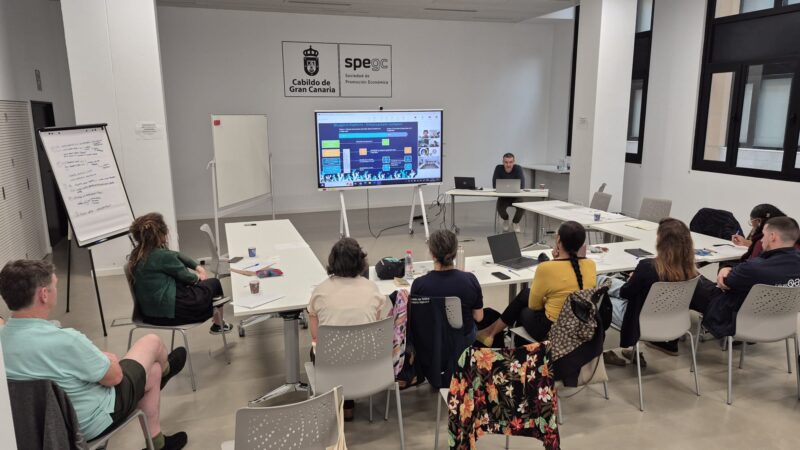
  • Co-creation workshop at PHAROS Mega Event – January 2026 (Gran Canaria)
    Key activities: MPA managers and Living Lab participants co-create user stories for platform enhancements

  • User story analysis and prioritisation – February – April 2026
    Key activities: Translating feedback into technical requirements

  • Mock-up development – April – June 2026
    Key activities: Visual prototypes of new features (ecological corridors, DTO integration, DSS)

Output: Prioritised list of user stories and mock-ups for all four enhancement modules.

Phase 2: Functional Expansion and Integration (July 2026 – October 2027)

What happens, when, and key activities:

  • Alpha version of MPA Solutions Hub released (Blue4All) – January 2026
    Key activities: PHAROS begins testing with Living Labs

  • Development of ecological corridor module – July – December 2026
    Key activities: Integration of Lagrangian models, pressure spatialisation, corridor design tools

  • DTO integration (external viewer) – January – June 2027
    Key activities: Secure hyperlink integration, testing with Demo 1, 2 and 4 data

  • DSS development for Living Labs – April – October 2027
    Key activities: Oceanographic data layers, visualiser, scenario configuration

  • Blue4All version 1.0 released – December 2026
    Key activities: PHAROS enhancements build on this stable foundation

Output: Enhanced MPA Solutions Hub with all four modules integrated (initially as external tools, with embedded evaluation ongoing).

Phase 3: Fine-Tuning and Progressive Versioning (November 2027 – August 2029)

What happens, when, and key activities:

  • Living Lab testing and feedback – November 2027 – December 2028
    Key activities: Real-world use cases, guided sessions, feedback collection via platform tools

  • Progressive versioning – January – December 2028
    Key activities: Regular updates based on user feedback (every 3–4 months)

  • Embedding decision (if applicable) – Early 2029
    Key activities: Evaluate whether to embed DTO viewer and other modules natively

  • Final validation – June – August 2029
    Key activities: Testing with MPA managers across Atlantic and Arctic basins

  • Milestone (MS13): MPA Solutions Hub live – Month 39 (November 2027)
    Key activities: Milestone achieved – platform operational with all enhancements

Final deliverable: D4.6 – Final report on MPA platform development (Month 51, January 2029)

MPA Solutions Hub Live (MS13)

November 2027 – MPA Solutions Hub operational with all enhancements

Connections with other parts of PHAROS

Living Labs

The Living Labs established in each demo and replication site are the primary source of user feedback for platform enhancements. MPA managers from Madeira, the Azores, the Canary Islands, and other regions participate in co‑creation workshops, test new features, and validate that the platform meets their needs.

Connection direction: Living Labs → MPA Solutions Hub (feedback loop)

MPA Working Group

PHAROS established a joint MPA Working Group with the Blue Connect project, bringing together MPA practitioners from Macaronesia (Madeira, Azores, Canary Islands, Cabo Verde). This group meets every 3–4 months to discuss shared challenges and co‑develop solutions, directly informing the ecological corridor module.

Connection direction: MPA Working Group → Ecological Corridor Module

Blue Schools Network & MINKA

While not a direct integration, the MPA Solutions Hub will reference educational resources from the Blue Schools Network and citizen science projects from the MINKA platform. MPA managers can use these to design outreach campaigns and community monitoring programmes.

Connection direction: MPA Solutions Hub → links to Blue Schools / MINKA resources

Fisher Guardian & Litter Entrepreneur Programmes

MPAs often struggle with marine litter and abandoned fishing gear. The MPA Solutions Hub will include tools from the Fisher Guardian and Citizen Litter Entrepreneur programmes in its catalogue, giving MPA managers tested, ready‑to‑use solutions for pollution reduction.

Connection direction: Fisher Guardian / Citizen Litter Entrepreneur → MPA Solutions Hub catalogue

UGent Marine Training Unit

The training modules developed for MPA practitioners (hosted on UGent’s e‑learning platform) will be directly linked from the MPA Solutions Hub. Topics include:

  • Management effectiveness evaluation tools

  • Designing management plans

  • Communication and stakeholder engagement

  • Climate change adaptation

  • Innovative monitoring approaches

Connection direction: Training modules → MPA Solutions Hub (resource links)

Work Packages (WP) related to MPA

Work Package 2 (WP2): Stakeholder Engagement, MPA, Education, Fisher Guardian and Citizen Litter Entrepreneur Programmes

Lead partner: CSIC

This Work Package handles the human side of the MPA Solutions Hub – understanding what MPA managers truly need, engaging them in genuine co-creation, and training them to use the platform effectively.

  • State of the Art (SoA) review (Task 2.2.1) – The work began with a thorough assessment of the current landscape. The team completed a review on local MPA and ecological corridor status, capturing the real‑world challenges and gaps faced by practitioners across the Atlantic and Arctic basins.

  • Adaptation for Atlantic and Arctic (Task 2.2.2) – Building on that foundation, PHAROS worked to adapt the BLUE4ALL MPA Solutions Hub for the specific needs of these regions. This involved gathering insights from Living Labs and feeding that information directly into the technical development team (WP4) to ensure the platform’s features matched local realities.

  • Training and support sessions (Task 2.2.3) – A platform is only useful if people know how to use it. The team implemented a plan to extend the platform and actively engaged Living Labs through dedicated training and support sessions. MPA managers and local stakeholders learned how to navigate the catalogue, apply the tools, and share their feedback.

  • Plan for new/upgraded MPAs (Task 2.2.4) – Looking ahead, the team developed a practical plan to create new MPAs or upgrade existing ones using the MPA Solutions Hub’s tools and methodologies. This plan covers everything from stakeholder involvement to legal and governance frameworks.

  • Ongoing support for adoption (Task 2.2.5) – Finally, the team put that plan into action, supporting Living Labs and MPA managers as they adopted the platform in their daily work. This ensures the MPA Solutions Hub becomes a trusted, go‑to resource, not just another digital shelf.

Work Package 4 (WP4): Monitoring, DTO Modules and Project Wide Protocols, and MPA Platform

Lead partner: Blue Oasis (bO), with MPA platform tasks led by CMCC in cooperation with RBINS

This Work Package handles the technical development of the platform enhancements – turning ideas and user stories into a working, scalable digital tool.

  • Blueprint platform plan (Task 4.4.1) – The first major task was to develop a plan tailored to the Atlantic and Arctic basins. This plan included new governance modules to support collaborative decision‑making, as well as AI‑driven issue identification to help MPA managers spot emerging threats before they escalate.

  • Implementation of the platform plan (Task 4.4.2) – Once the plan was ready, the team moved to build the features, integrate the databases, and prepare the platform for real‑world testing with Living Labs.

  • Ecological corridor management module (second Task 4.4.2) – A particularly important innovation was the integration of a dedicated module into the MPA Solutions Hub. This module helps MPA managers design, monitor, and maintain interconnected marine corridors, supporting species movement and genetic diversity across vast ocean distances.

  • Final report (Task 4.4.3) – In January 2029 the team will deliver a final report on the completed MPA platform development, documenting all enhancements, lessons learned, and recommendations for future updates.

Key Deliverables

  • D2.3 SoA report on local MPA & ecological corridor status – Lead: RBINS – Due: February 2026

  • D2.4 Plan to create MPAs/upgrade existing MPAs and for Ecological Corridors – Lead: RBINS – Due: August 2026

  • D2.5 Final Report on MPA platform and network – Lead: RBINS – Due: June 2029

  • D4.5 Blueprint MPA platform plan – Lead: CMCC – Due: November 2025

  • D4.6 Final report on MPA platform development – Lead: CMCC – Due: January 2029

Lead Partners

FONDAZIONE CENTRO EURO MEDITERRANEO SUI CAMBIAMENTI CLIMATICI (CMCC)

  • Role: Technical lead for platform enhancement

  • Expertise brought: MPA manager GUI platform, decision-making tools, Ocean Decades programme

  • General Expertise: Climate change research and modelling, Earth system science, high‑performance computing, policy support for adaptation

Supporting Partners

CSIC (Spain)

PLOCAN (Consorcio para el Diseño, Construcción, Equipamiento y Explotación de la Plataforma Oceánica de Canarias)

blueOASISnewlogo

BLUE OCEAN SUSTAINABLE SOLUTIONS LDA – blueOASIS (bO)

STICHTING DELTARES

The MPA Working Group (with Blue Connect project)

ARDITI

MPA Practitioners Engaged in Needs Assessment

Privacy Preferences

When you visit our website, it may store information through your browser from specific services, usually in the form of cookies. Our Privacy Policy can be read here.

Here you can change your Privacy preferences. It is worth noting that blocking some types of cookies may impact your experience on our website and the services we are able to offer.

Click to enable/disable Google Analytics tracking code.
Click to enable/disable Google Fonts.
Click to enable/disable Google Maps.
Click to enable/disable video embeds.
Our website uses cookies, mainly from 3rd party services. Define your Privacy Preferences and/or agree to our use of cookies.