Artificial Reef Restoration

Artificial reef restoration is a core component of the PHAROS project, led by partner Underwater Gardens International (UGI).

Artificial reefs are to be deployed as part of the Gran Canaria demonstration site (Canary Islands, Spain). The technology involves the deployment of Smart Enhanced Reefs (SER®), designed using UGI’s proprietary reefhopper® parametric intelligence platform. The reefs are intended to enhance biodiversity and ecosystem restoration.

What Is Artificial Reef Restoration?

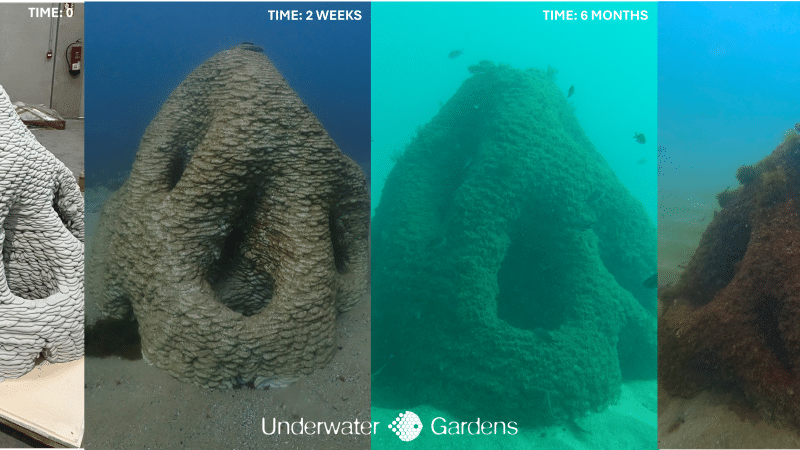
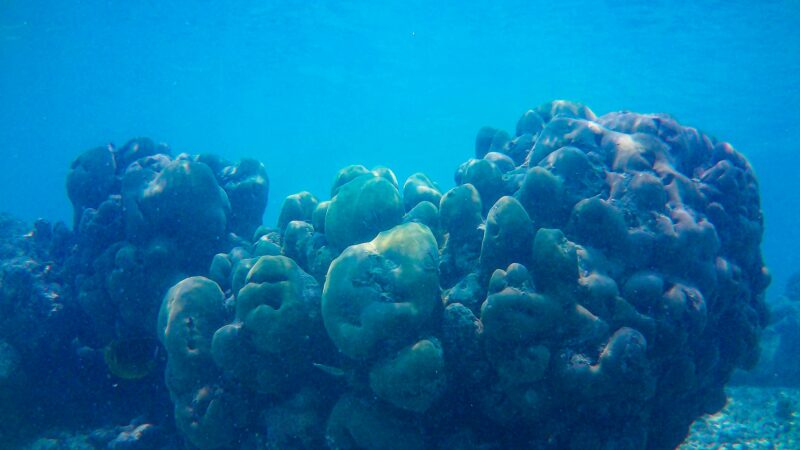
Imagine dropping a handful of stones into a barren stretch of seabed. Within weeks, small fish start sheltering between them. Within months, algae and other sessile colonisers (such as hydrozoans, bryozoans and sponges) begin to grow. Within a year, what was once empty sand has become a thriving underwater community.
That’s the idea behind artificial reefs, but PHAROS is taking it much further.

To restore the oligotrophic environment around Gran Canaria (often described as a marine desert due to its low primary production and limited biodiversity) PHAROS will deploy the SER® to create new habitats by providing complex hard substrate for habitat‑forming species to settle, which in turn form new feeding and nursery grounds for other native species.

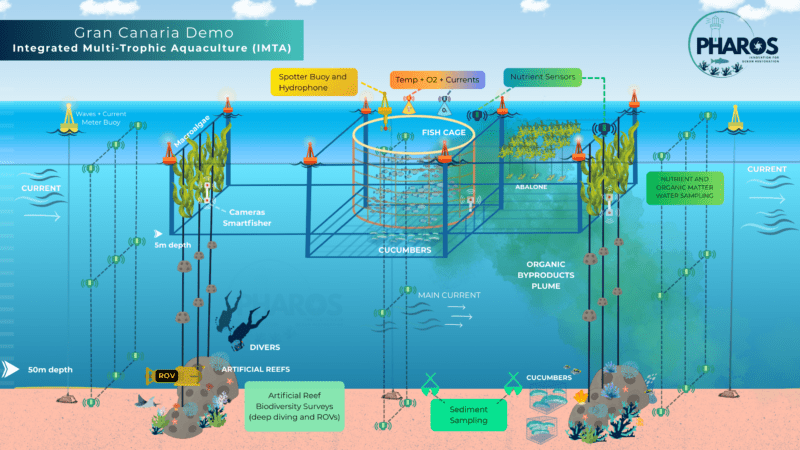
key innovation of PHAROS is the extension of habitat restoration beyond the seabed, throughout the water column and up to the surface. This is achieved by combining seabed‑based reefs with additional structures suspended from vertical mooring lines, alongside macroalgal forests established along the upper sections of these lines. Moreover, these structures serve a dual purpose.

The mooring lines form part of the foundation of an IMTA (Integrated Multi‑Trophic Aquaculture) system, within which the artificial reefs are integrated. In this context, the seabed reefs function as biomimetic blocks that provide anchoring support for the macroalgal forests located closer to the surface.

PHAROS artificial reefs are designed to accelerate that recovery. They provide the hard surfaces that marine life needs to settle, grow, and thrive.

But unlike a simple pile of rocks, these reefs are engineered to work with nature, capturing nutrients, filtering water, and creating complex habitats that support everything from tiny invertebrates to large fish.

The result is a structure on the seabed, a catalyst for ecosystem recovery.

The Technology: Smart Enhanced Reefs (SER®)

PHAROS uses a technology called Smart Enhanced Reefs (SER®) , developed by our partner Underwater Gardens International (UGI). These are carefully designed using a tool called reefhopper®, a parametric intelligence platform that calculates exactly how a reef should be shaped, positioned, and structured for its specific environment.

What Makes a Reef "Smart"

Designed to work with currents and local biodiversity

The shape and orientation of each reef are calculated to optimise how water flows around it. This means more organic particles get trapped, providing food for filter feeders. It also means light reaches the right places for algae and seagrasses.

Made from the right materials

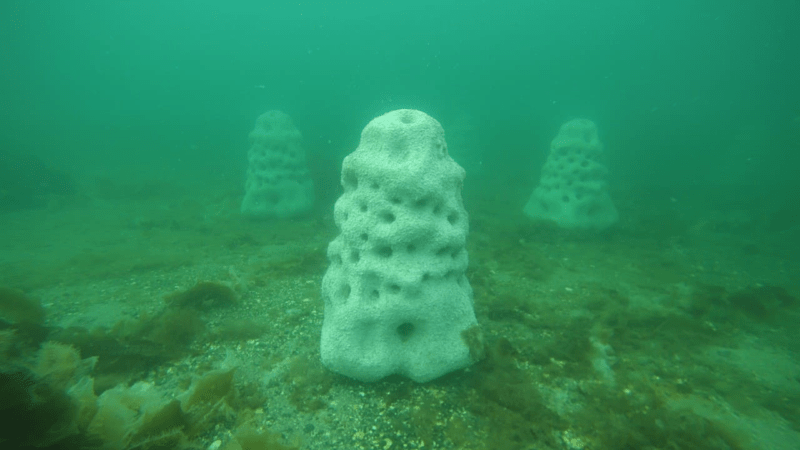
The reefs are cast from concrete and coated with a mix of calcium carbonate and biomaterials. The surface texture is carefully controlled and, together with the coating, encourages colonisation by marine life. It’s a structure designed to create spots for creatures to call home.

Self-learning over time

The algorithms behind reefhopper® are designed to be iterative. As more information is provided and data is input, the design process improves.

Built to last

Every reef is engineered to withstand Atlantic conditions: strong currents, seasonal storms, and wave action. They’re placed with commercial-grade moorings and inspected regularly to ensure structural integrity.

Strategy Behind

How we can help marine ecosystems recover faster, better, and at scale?

The artificial reefs in PHAROS are part of a deliberate strategy designed to answer fundamental questions about how marine ecosystems recover, and how we can help them do it faster, better, and at scale. Most artificial reef projects aim for a single outcome: more fish, more habitat, or coastal protection. But restoration is rarely that simple. What works in one place may not be successful in another. A reef that attracts one species may inadvertently favour another. Without a clear strategy, there is a risk of building structures that look good on paper but deliver little ecological value.

By deploying artificial reefs on both sides of the IMTA system, we can compare the colonisation performance between the control side upstream the main current (representing more natural, oligotrophic conditions) and the nutrient- and organic matter-enriched side downstream. This comparison can also be extended to assess macroalgal growth on both sides, and in so doing, the carbon sequestration from the surrounding environment. The macroalgae used will be Gracilaria spp., one of the most resistant local species to grazing and harsh offshore conditions, to provide continuous substrate and shelter throughout the 18-month trial.

While some artificial reefs are deployed individually on the seafloor, in PHAROS we introduce the suspended artificial reefs that connect what otherwise would be separate environments through the water column, from the surface down to the bottom at a depth of approximately 50 metres. PHAROS treats each reef as a testable hypothesis. Every design choice (shape, material, placement, depth) is made with a question in mind. By structuring the deployment as an experiment, we turn every reef into a source of knowledge that can be applied anywhere.

  • Iterative design – The algorithms behind reefhopper® improve continuously. Each reef is smarter than the last.
  • Legacy thinking – Reefs remain in place after the project ends, continuing to provide habitat and serve as long-term study sites.
  • Replicability built in – From day one, PHAROS documents everything so others can replicate our methods, not just our structures.

The result is a strategy that doesn’t just restore a patch of seabed. It builds the knowledge and tools to restore marine ecosystems across the Atlantic and Arctic and beyond.

The most powerful tool in our strategy is the paired design of the two Gran Canaria reef sites with the IMTA demo:

  • Downstream demo sits near a fish farm, exposed to nutrient-rich effluent.
  • Upstream demo lies in an oligotrophic zone, where nutrients are naturally scarce.

This setup isolates a single variable: nutrient availability. By comparing colonisation rates, species richness, and growth between the two, we can separate the effect of the reef itself from the effect of extra nutrients. This kind of controlled comparison is rare in marine restoration, and it gives us confidence that what we learn is transferable.

Our success metrics go beyond simple counts. We track:

  • Species richness and community similarity – Are the reefs supporting the right mix of species?
  • Benthic cover – Is the reef surface being colonised at a rate that indicates a healthy, functional habitat?
  • Structural integrity – Is the reef holding up under real-world conditions?

These indicators are tied to specific targets. If a reef fails to meet them, we adapt, adjusting monitoring, refining the design, or changing deployment methods for future cycles.

Phases

Artificial reef deployment in PHAROS follows a structured approach, designed to ensure we learn at every stage.

I. Design

Using reefhopper®, we determine the optimal shape, size, and placement for each reef, based on seabed surveys and current modelling.

II. Fabrication

Reefs are cast using marine-grade concrete and specialised materials. Some are made with 3D printing for complex shapes.

III. Deployment

Reefs are transported to the PLOCAN test site off Gran Canaria and placed precisely on the seabed using crane barges and divers.

IV. Colonisation & Monitoring

Over 18 months, marine life begins to settle. We monitor species richness, benthic cover, and structural integrity.

V. Long-term Management

After the project, reefs remain in place to continue providing habitat. Some may be adapted for future research or educational use.

The Tools and Frameworks

Behind every artificial reef deployed in PHAROS lies a set of tools and frameworks that ensure each structure is purposeful, measurable, and part of a larger learning system. They are the scaffolding that turns a concrete structure into a scientific instrument.

reefhopper®: The Design Engine

At the heart of every reef is reefhopper®, a parametric intelligence platform that calculates the optimal shape, size, and placement for each reef based on local seabed topography, current patterns, and ecological goals.

The platform’s algorithms are iterative, so each successive reef is better adapted to its environment.

Digital Twin of the Ocean (DTO)

The artificial reefs will be part of a Digital Twin Ocean (DTO) , a dynamic digital replica of a physical system, process, or environment, enabling continuous monitoring, analysis, and simulation of its behaviour under real-world conditions.

By incorporating “what if” scenarios, it allows decision-makers to explore alternative strategies, assess risks, and predict potential outcomes before implementing changes in the actual system, supporting more informed and resilient planning.

In this system, the reefs and macroalgae forest will be monitored by a series of diving surveys (that will take samples to be afterwards analysed in the lab) and instruments (recording and some streaming live too) like underwater cameras, hydrophones, and environmental sensors. Data streams into the PHAROS Digital Twin of the Ocean, where it is visualised in real time and combined with hydrodynamic models.

The DTO allows researchers and stakeholders to:

  • Observe colonisation patterns as they happen.
  • Simulate future scenarios (e.g., how a reef might respond to climate change).
  • Detect anomalies early (e.g., structural damage, invasive species).

This integration transforms raw data into actionable intelligence.

Replication Roadmaps

Finally, the tools and frameworks extend beyond the reefs themselves.

Together, these tools and frameworks ensure that PHAROS artificial reefs are not isolated experiments but building blocks of a scalable, evidence-based approach to marine restoration.

Where Are the Reefs Going?

PHAROS artificial reefs are deployed at two locations off Gran Canaria, as part of the Gran Canaria Demonstration site.

Gran Canaria Downstream Demo

IMTA and Reef Combination

Location: Downstream of an aquaculture fish cage
Purpose: Test whether nutrient-rich effluent from the fish farm boosts reef colonisation and growth

Arrangement:

  • 18 artificial reefs (6 A-type, 6 B-type, 6 C-type) + 6 vertical lines with macroalgae
  • Depth: Approximately 40 metres

Gran Canaria Upstream Demo

Marine Forest & Reef Restoration

Location: Upstream of the aquaculture system, in an oligotrophic (nutrient-poor) zone
Purpose: Compare reef performance under natural, low-nutrient conditions

Arrangement:

  • 18 artificial reefs (6 A-type, 6 B-type, 6 C-type) + 6 vertical lines with macroalgae
  • Depth: 45 metres at the seabed, with macroalgae growing in the top 5 metres of the water column

What’s on the Reefs?

A-type reefs

Anchor biomimetic blocks for macroalgae ropes, providing both benthic habitat and vertical structure

B-type reefs

Mid-water suspended reefs designed to attract fish and increase habitat complexity

C-type reefs

Seabed structures with high surface roughness designed to be attached to traditional mooring concrete blocks, to favour the colonisation by sessile species like sponges and ascidians

What We’re Measuring

We track artificial reef performance against a set of Key Performance Indicators (KPIs). These tell us whether the reefs are doing what they’re supposed to do.

KPI Target
Species richness on SER® +30% within 12 months
Benthic cover on SER® ≥40% after one year
Structural integrity No damage or displacement under storm/flow conditions
Community similarity (Bray-Curtis Index) ≥0.5 between artificial reefs after 18 months
Habitat complexity Measurable increase via AI-driven video surveys

These targets are compared against baseline data collected before the reefs were deployed. If results fall short, we adjust: repositioning reefs, modifying monitoring, or adapting the design for future deployments.

The Plan and Timeline

We don’t deploy all reefs at once. The strategy follows a phased approach, allowing us to learn and adapt at each step.

Design & Permitting

Site surveys, hydrodynamic modelling, reef shape optimisation with reefhopper®, engineering drawings (ELIMAT), environmental impact assessments, licensing (Ministerio de Agricultura, Pesca y Alimentación).

Deliverable:
D1.4 – Demo Plans (M8)

Milestone:
MS6 – All demo site permits secured (M24)

Fabrication

Casting of SER® units using marine-grade concrete, biomaterials, and cement; 3D printing for complex shapes (type B midwater structures).
M12–M24 (Sep 2025 – Aug 2026)

Milestone:
Reef construction completed 

Deployment

Transport to PLOCAN test site; placement using crane barges and divers.

  • Demo 1 reefs deployed alongside aquaculture infrastructure;
  • Demo 2 reefs placed with vertical macroalgae ropes.

M24–M32 (Sep 2026 – Apr 2027)

Milestones:
MS8 – Demo 2 reef installed (M31)
MS10 – Aquaculture cage installed (includes Demo 1 reefs) (M32)

Monitoring & Adaptive Management

  • Continuous data collection (sensors, cameras, hydrophones); diver surveys;
  • AI-driven species detection.
  • Real-time integration into the Digital Twin of the Ocean (DTO).

M24–M54 (Sep 2026 – Feb 2029)

Deliverables:
D4.1 – Interim monitoring reports (M39 – November 2027)
D4.3 – DTO trial report (M44 – April 2028)
D4.7 – Final monitoring reports (M54 – February 2029)

Evaluation & Reporting

  • Analysis against KPIs (species richness, benthic cover, structural integrity).
  • Interim and final reports synthesising ecological outcomes.

M45–M58 (Jun 2028 – Jul 2029)

Deliverables:
D3.1 – Demo 1 final report (M58 – July 2029)
D3.2 – Demo 2 final report (M58 – July 2029)

Long-Term Management

Reefs remain in situ to provide permanent habitat; may be used for future research or educational activities.

Reefs permanently in place; possible adaptation for further research
Post M60 (from Sep 2029)

Connections to other parts of PHAROS

Living Labs

Local communities, fishers, and dive operators are engaged through our Living Labs. Their knowledge helps us understand local biodiversity patterns and ensures the reefs are seen as assets, not obstaclesLiving Labs embed local stakeholders into the decision-making loop, ensuring that the reefs are not only ecologically effective but also socially valued.

Digital Twin Ocean (DTO)

Reefs are monitored using underwater cameras, hydrophones, and periodic diver surveys. All data feeds into the PHAROS Digital Twin of the Ocean (DTO) , where we can model reef performance over time and simulate future scenarios.

Marine Protected Areas (MPAs)

Artificial reefs can complement Marine Protected Areas by creating additional habitat and connecting ecological corridorsInsights from PHAROS will be shared with MPA managers through the Blueprint platform

Replication

What we learn about reef design, placement, and monitoring will be packaged into toolkits and replication roadmapsWP5 packages the knowledge gained into replication roadmaps, making it possible for other regions (in the Atlantic, Arctic, and beyond) to deploy similar reefs without reinventing the process.

Work Packages (WP) related to IMTA

WP1 Methodology and Preparation

(Led by Deltares)

This WP sets the stage for the demos. It includes the methodology and detailed planning for the artificial reef deployments.

  • Detailed planning for artificial reefs, covering site investigationsspecies selectionrisk assessment, and logistics.
  • The final demo plans include the specific designs for the reefs.

Deliverable:

D1.4: 4 Demo plans – This deliverable includes the specific plans for the artificial reefs in Gran Canaria Demo.

WP3 Build, Implementation and Evaluation of Demos

(Led by ULPGC)

This WP is responsible for the physical construction, deployment, and evaluation of the artificial reefs.

  • Gran Canaria Demo activities: Drafting plans for the SER® reefsprocuring and installing the artificial reefs, and integrating multi-specific transplants of marine forest species onto them.
  • Gran Canaria Demo: A combined marine forest and reef restoration project, including reef designfabrication, and installation. This includes using the reefhopper® tool to design the spatial distribution and size of the reefmanufacturing the reefs using advanced construction technologies like 3D printing, and transporting and installing the reefs followed by multi-specific transplants.

Deliverables:
D3.1 & D3.2: Final Reports on Gran Canaria Demo actions, impact, and outcomes – These reports will specifically cover the results of the artificial reef deployment.

WP4 Monitoring, DTO Modules and Project-Wide Protocols, and MPA Platform

(Led by blueOASIS)

This WP is responsible for monitoring the demos, which includes tracking the performance and impact of the artificial reefs.

Coordinated monitoring of the artificial reefs as part of the wider demo sites.

Deliverables:
D4.1 & D4.7: Interim and final monitoring reports – These will contain data on the biological and physical performance of the artificial reefs.

D4.2 & D4.3: DTO plans and trial reports for the Gran Canaria site, which will incorporate data from the reef monitoring.

Consortium Partners involved in Artificial Reefs

UGI (Underwater Gardens International)

Role: Lead partner for reef design and fabrication. Develops the SER® and reefhopper® technology.

Expertise:
Artificial reef design, parametric intelligence, marine habitat restoration, biomaterials, 3D printing for reef fabrication.

PLOCAN (Consorcio para el Diseño, Construcción, Equipamiento y Explotación de la Plataforma Oceánica de Canarias)

Role: Hosts the test site off Gran Canaria, manages deployment logistics, and coordinates maintenance and monitoring

Expertise: Offshore test site operation, marine infrastructure, project coordination, multi-use of space, stakeholder engagement.

ULPGC (Universidad de Las Palmas de Gran Canaria) Ecoaqua

Role: Cultivates macroalgae species for the vertical ropes attached to reefs.

Expertise: Macroalgae cultivation, marine forest restoration, algae biology, hatchery and laboratory-scale production.


blueOASISnewlogo

blueOASIS

Role: Provides monitoring equipment (cameras, hydrophones) and integrates reef data into the Digital Twin of the Ocean (DTO).

Expertise: Digital Twin of the Ocean, AI-based monitoring (SmartFISHER), underwater acoustics (Hydrotwin-S), real-time data integration.

Deltares

Role: Supports monitoring methodology and data analysis.

Expertise: Hydrodynamic and biogeochemical modelling, monitoring protocols, data assimilation, marine data analysis, open-source platforms (HiSea).

Privacy Preferences

When you visit our website, it may store information through your browser from specific services, usually in the form of cookies. Our Privacy Policy can be read here.

Here you can change your Privacy preferences. It is worth noting that blocking some types of cookies may impact your experience on our website and the services we are able to offer.

Click to enable/disable Google Analytics tracking code.
Click to enable/disable Google Fonts.
Click to enable/disable Google Maps.
Click to enable/disable video embeds.
Our website uses cookies, mainly from 3rd party services. Define your Privacy Preferences and/or agree to our use of cookies.