Success needs to be measured. We have defined a set of KPIs specifically for the IMTA system, each tied directly to the data streams flowing into the Digital Twin. These indicators tell us whether the system is restoring the ecosystem and whether it can become a viable commercial model.
Fish growth and health – Gilthead seabream (Sparus aurata) are weighed and measured every three months. Growth performance is assessed using biometric data, including specific growth rate (SGR), weight gain (WG), and Fulton’s condition factor (K). In addition, feed conversion ratio (FCR), feed intake, survival, and coefficient of variation (CV) are evaluated to determine the biological and economic performance of the culture system. Fish health status is assessed every six months through metabolic analyses of blood samples. The metabolic parameters analysed include glucose (GLU), total cholesterol (TC), triglycerides (TG), total CO₂ (tCO₂), calcium (Ca), phosphorus (PHOS), albumin (ALB), total protein (TP), globulin (GLOB), the albumin/globulin ratio (A/G), total bilirubin (TB), gamma‑glutamyl transferase (GGT), aspartate aminotransferase (AST), alanine aminotransferase (ALT), alkaline phosphatase (ALP), total bile acids (TBA), amylase (AMY), low‑density lipoprotein (LDL), lactate dehydrogenase (LDH), creatine kinase (CK), creatinine (Crea), uric acid (UA), urea (UREA), and the urea/creatinine ratio (U/C). These parameters are monitored through manual sampling and provide information on fish performance and their response to IMTA conditions. Additionally, biochemical analyses of fish tissues, including muscle and liver, together with histological sampling, are conducted every six months to further assess fish health status. These data will be compared with those obtained from commercial farms as references.
Macroalgae yield – The seaweed ropes are harvested and weighed periodically to measure biomass per metre. This tells us how efficiently the algae are absorbing nutrients from the fish waste. Target yields are expected to range from 0.5 to 1.2 kg of fresh weight per metre of rope.
Abalone and sea cucumber growth and survival – Both species are monitored through regular sampling. Growth rates, survival, and nutritional quality (fatty acid profiles, protein content) are analysed.
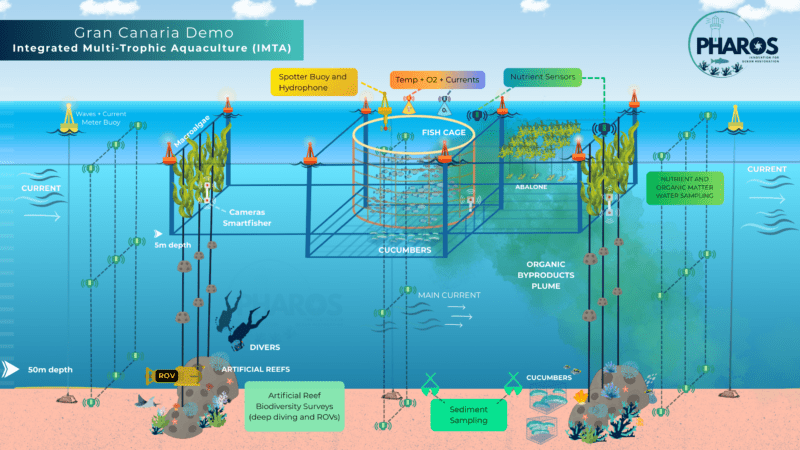
Nutrient capture – Continuous sensors measure nitrogen, phosphorus, and ammonia concentrations upstream and downstream of the IMTA system. Monthly water samples provide validation. The difference tells us how much nutrient pollution the system removes from the water column.
Physical parameters for modelling and prediction – A network of sensors tracks water temperature, salinity, dissolved oxygen, current speed and direction, and wave height. These data feed the Digital Twin, enabling it to simulate how the system responds to changing conditions and to predict outcomes under future scenarios (e.g., marine heatwaves, altered current flows).
Biodiversity monitoring – Underwater cameras and acoustic hydrophones continuously record species activity around the artificial reefs and macroalgae forest. Cameras track fish and invertebrate abundance; hydrophones detect vocalising species (fish, cetaceans) and anthropogenic noise. Periodic diver and ROV surveys provide ground‑truthing. Together, these tell us whether the system is attracting and supporting new marine life.
Wildlife monitoring (acoustic) – Hydrotwin‑S devices listen 24/7. They detect and classify marine mammal sounds, fish chorusing, and vessel noise. This data helps us understand how wildlife uses the restored habitat and whether human activity is affecting their behaviour. It also supports compliance with marine noise regulations.