The Heartbeat of the Ocean: How a Canarian School Turned a Musical Dream into a Blue Revolution
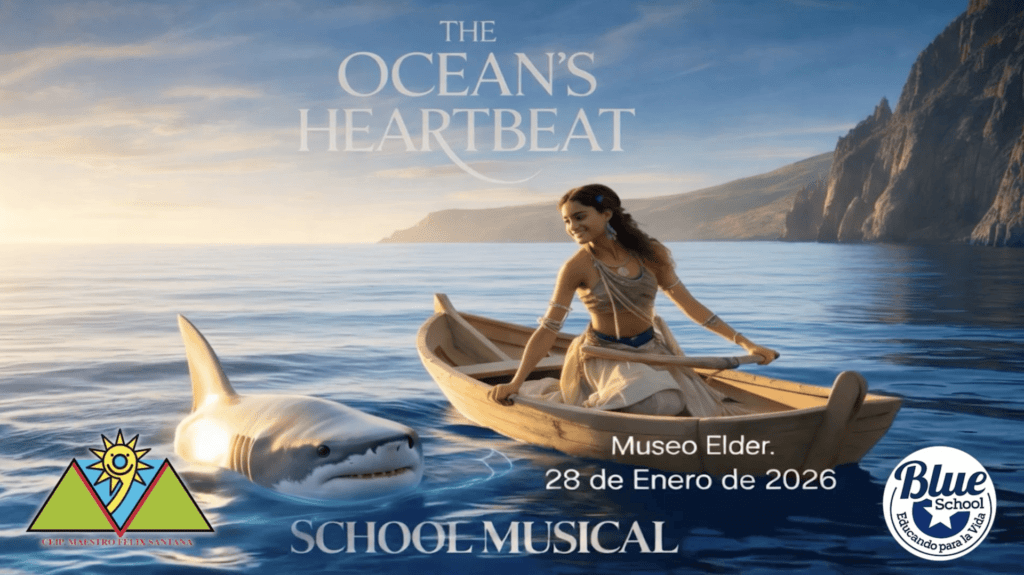
The Heartbeat of the Ocean: How a Canarian School Turned a Musical Dream into a Blue Revolution https://pharosproject.eu/wp-content/uploads/2026/03/Gran-Canaria-CEIP-Maestro-Felix-Santana-Musical-on-Plastic-Pollution-The-Heartbeat-of-the-Ocean-1024x575.png 1024 575 PHAROS Project https://pharosproject.eu/wp-content/uploads/2026/03/Gran-Canaria-CEIP-Maestro-Felix-Santana-Musical-on-Plastic-Pollution-The-Heartbeat-of-the-Ocean-1024x575.pngJanuary 30, 2026, Las Palmas, Gran Canaria: A public school in Gran Canaria has earned a recognition through PHAROS project after turning a teacher’s offhand comment into a full-scale musical about ocean conservation. “The Heartbeat of the Ocean,” written and performed by students at the CEIP Maestro Félix Santana, has shown how arts education can connect children with environmental issues and inspire community action.
Families, educators, and representatives from the Maritime Cluster of the Canary Islands gathered for what the event host described as a “very special afternoon.”
“The truth is, this is one of those events that spreads good vibes,” the master of ceremony began, addressing the audience with visible emotion. “A real desire to smile, to celebrate, and to share that… well, it leaves us with this sort of silly grin on our faces.”
Throughout the afternoon attendees witnessed the culmination of a year-long journey that began with a simple question: “Do you want a musical?”
The Maritime Cluster: Bridging Business and Society
Before the performance, Elba Bueno Cabrera, Manager of the Canary Islands Maritime Cluster, took the stage to explain not only the PHAROS project but also why a business association would champion a primary school’s artistic endeavor.
“I’d like to start by explaining a little bit about what a cluster is,” Mrs Bueno began, acknowledging the puzzled looks her title often receives. “Well, clusters are business associations, but we also have a mission to bring a specific sector (in our case, the marine and maritime sector) to society.”
What sets the Maritime Cluster apart, she emphasized, is its commitment to the citizen.
“We work with businesses, but without forgetting that the essence is always with the citizen, always. And bringing people, sectors, and professions closer together is one of the most beautiful parts of our day-to-day work.”
This philosophy led them to the Maestro Félix Santana school and its visionary teacher, Ana Delia Miranda.
“Getting to know this wonderful school first-hand, and its teaching staff, has been a great discovery for us. Being able to support him in their initiative, which won us over from the very first moment, and being here with them today seems to us one of the greatest privileges we can have in our daily work.”
PHAROS: Where Science Meets Citizenship
Mrs Bueno then elaborated on the PHAROS project, a European initiative that the Cluster helps bring to the Canary Islands. Its objective is both simple and ambitious: improving the health of the sea through a trinity of forces: science, technology, and citizen participation.
“The idea behind PHAROS is very simple, but also powerful. If we better understand what’s happening in the ocean, we can protect it much more effectively,” she explained, gesturing toward the young performers waiting backstage. “And that’s exactly what the children we’re about to see will be doing from now on.”
The project’s emphasis on citizen science is no accident. Mrs Bueno stressed that experts and researchers, while essential, cannot do the job alone.
“We also need people like you, people who observe, who participate, and who get involved in caring for the sea. That’s why citizen science activities are the essential part of PHAROS.”
The project works to ensure that decisions about marine protected areas, fragile ecosystems, and coastal zones are based on real, up-to-date information. But beyond data collection, PHAROS aims to accelerate solutions for marine protection and support the management of protected areas.
“PHAROS works to improve the connection between science, institutions, and citizens. Scientific knowledge often doesn’t always get applied. The project aims to build bridges between researchers, administrations, and local communities, because we are all part of the solution in this context.”
A key development is the launch of MarCoLab, a living lab described as “an open collaborative space where science, management, and citizens meet to test ideas, share experiences, and co-create real solutions in the sea.”
“It’s not just a traditional laboratory, but a living environment connected to the territory, where we will learn by doing and where people’s participation is key.”
The Blue School: A Recognition of Excellence
As Mrs Bueno concluded, the host returned to pose a question that many in the audience were likely asking: What exactly does it mean to be a certified “Blue School”?
To answer this, Eli Bonfíl, coordinator of the Pro Bleu project from the European Union at the Spanish National Research Council (CSIC), took the stage wearing what she described as her “Spanish Network of Blue Schools hat.”
“Besides working on this project, on PHAROS, my task is to promote Blue Schools,” Mrs Bonfíl began. “And today I’m also here to congratulate your children, the families, and the teachers on achieving this Blue School recognition, because it’s something very special.”
She provided context that put the achievement in perspective.
“In the world right now there are around 2,600 Blue Schools. In Europe we have 13 of them. In Spain, 250, and in the Canary Islands, 19. And one of these 19 is the Maestro Félix Santana school.”
The applause that followed was both proud and somewhat astonished. The school had entered a global network.
“It’s an important recognition because it places your school in the world, on the world map of educational centres committed to ocean literacy, to water culture,” Bonfíl continued. “It shows that this school is interested in helping your students get to know the sea better, feel closer to it, feel more connected to it, and want to do something to improve and conserve it.”
Blue School status connects the Canarian school with educational centres worldwide, can facilitate funding for ocean-themed projects, and provides teachers with specialized training opportunities.
“I think some very interesting things are going to come out of this for your school, and you should be very happy that these teachers are so motivated and want to get involved in such a task, which, in the end, is extra effort for them.”
The host couldn’t resist adding local pride: “Well, one of 19 in the Canary Islands is quite an achievement… In Spain, that puts the Canary Islands right up there. Those of us with children in public schools in the Canary Islands are very proud of this school’s teaching staff, and not just the staff, even the area inspector who’s here with us this afternoon, but especially the whole community, because the families are also part of this great achievement.”
Anadelia Miranda: “We Started to Dream Big”
The moment came for Anadelia Miranda, the teacher who took up the baton when the school director posed his seemingly impossible request.
“With so many lovely things being said, I don’t know if what I’m going to say will fall a bit flat,” she admitted with humility. “But first of all, thank you all very much for being here.”
She traced the project’s origins to a moment almost exactly one year prior.
“It was in January, the headteacher came and said, ‘I want a musical,’ as if it were, well, as simple as buying a loaf of bread. And so we started to dream, to dream big, to dream and dream.”
What emerged was a vision of education that transcended traditional boundaries.
“We wanted to imagine a school where learning also meant listening, feeling, and creating. Beyond language, maths, English, science, which are also important, we decided that our educational approach should include music, theatre, and emotion. And that’s how ‘The Heartbeat of the Ocean’ was born.”
The dream became reality through collective effort.
“The families here present, the students, and the teachers joined forces to transform that dream, which is all well and good, into a reality. And so the dream became voice, movement, and stage.”
In May of the previous school year, the full production premiered at the Juan Ramón Jiménez Theatre in Telde. “It was a beautiful experience.”
“Today our school is a Blue School. And now we want to say something simple and important. We want to keep dreaming big, very big, so boys and girls discover the best in themselves because this is education.”
“We hope many schools choose music and art as an important part of a complete education and feel inspired to become a Blue School, helping to protect life on our planet.”
Mrs Miranda also noted the timing of the event fell just before the Canary Islands’ Day of Peace and Non-Violence, celebrated annually on January 30th.
“How lovely it is that today we are all here together, families, teachers, companions, and we want to somehow also celebrate today, this afternoon, the School Day of Peace and Non-Violence. Let’s start celebrating it today. Peace is also learned by listening, by respecting those around us, and by listening to the heartbeat of our ocean.”
THE HEARTBEAT – A MUSICAL JOURNEY THROUGH THE CANARIAN SOUL
The lights dimmed. A hush fell over the audience. Then, a voice announced: “A new world unites magic, music, and awareness.”
What followed was not merely a children’s performance but an allegorical voyage through the Canary Islands’ relationship with the sea, a story of beauty, destruction, and redemption that would leave no eye dry.
The Call of Ansite
The narrative begins with Eneida, introduced as “a daughter of the ocean,” who travels to the Canary Islands with a sacred mission: to restore harmony between the land and the sea.
The young protagonist’s journey is guided by Achamán, a protective spirit who whispers counsel from the sky. As Eneida navigates the islands’ waters, she witnesses both wonder and warning, dolphins at play, but also the insidious creep of pollution.
“The ocean asks for help without shouting,” she sings, her voice carrying the weight of generations. “The waves tell stories of the place where fish swim without thinking that plastic could trap them.”
The song weaves through the archipelago’s landscapes—from Teide’s volcanic majesty to crystal-clear coastal waters, each verse a love letter to home.
“The volcanoes and forests keep secrets that the night hides. The wind whispers a sincere call. Saving the planet comes first.”
But even as Eneida celebrates her homeland’s beauty, a shadow looms.
The Rise of the Plastic Villain
The performance’s antagonist emerges not with subtlety but with theatrical flair. Plastic (personified as a flamboyant, arrogant villain) commands the stage.
“Let me go, please. Let me go. Welcome to my kingdom,” he declares when challenged.
“Don’t be silly,” responds Eneida, another young protagonist. “You are the reason the sea is sick.”
Plastic’s retort is chilling in its accuracy: “Interesting. And what are you going to do? Humans adore me. They created me and they cannot live without me. I am plastic.”
His song is a boastful anthem of destruction:
“I am invincible plastic, born from evil, created by humans in their trivial world… I destroy the beauty of nature. Nothing resists me. I am pure weed. I am plastic, the villain, with my black shine, I reign without peace.”
The audience (children and adults alike) watches transfixed as this unlikely antagonist struts across the stage, a mirror held up to humanity’s most problematic creation.
The Foreign Octopus Brings Perspective
Into this conflict arrives an unexpected diplomat: a foreign octopus, touring the Canaries and offering an outsider’s view of the crisis.
“The water so blue, with shiny brine, I see the fish, so divine. We must take care of the ocean every day, every night, so we can all dream more and more.”
His bilingual song, switching between English and Spanish, adds both humour and gravity:
“I’m a foreign octopus, I come from another country, I’m touring the Canaries and I’ll tell you straight… In the ocean we must keep it serene. Take care, every creature big and small, for my dream to be real, no to rubbish, please.”
Guayota’s Wrath
The stakes escalate as Guayota, the ancient guardian and defender of the Canary Islands, awakens in fury. Representing the islands’ volcanic soul, he witnesses plastic bleeding from mountains into sea and rises against those who defy nature.
“I am here with my veins and lava in my hands. I rise against those who defy nature. I’m the ancient guardian, the defender of the Canary Islands.”
His song is thunderous, a warning from the earth itself:
“I see you on Teide when the sun goes out. Humans destroy without thinking, what irony. They want peace, but they destroy their own lives… Roar, Teide, with all your brilliance. My hot lava will be your new challenge. And if they don’t care for the land I gave them, it will be their end and I will reign here.”
The volcanic deity’s anger is palpable, a reminder that nature’s patience is not infinite.
Eneida’s Intervention
Just as destruction seems inevitable, Eneida, guardian of both ocean and sacred mountain, steps between Guayota and humanity.
“Guayota, no. Guayota, wait, please,” she pleads.
Her wisdom cuts through the fury: “She has seen that the power to destroy plastic with anger is not the way. It only brings destruction.”
She negotiates a reprieve: “OK, you have two days. Two days to find harmony between ocean, land, and human.”
Voices from the Ecosystem
In a series of poignant scenes, the islands’ creatures add their voices to the plea.
A giant lizard emerges from the ravine:
“I come from the ravine, with fury in the land, with my long tail I drag myself among the stones. I am the giant lizard and I’m going to tell how my home is about to burst. Bursting with soda cans and plastic flying around, piling up in my forest. The trees are dying. Don’t you see the connection? Human progress is our destruction.”
His final words hang in the air: “Stop your rubbish, save my home. Let’s live together in peace. Let me breathe.”
Then come the fish (the “viejas” and their companions) who transform their lament into a playful but urgent competition:
“No to rubbish, please. The old wife and the mother approach eagerly. The mackerel and the sardine, the longorón in the corner. No, no, no. Don’t throw rubbish. The jellyfish under the sea are about to start a competition. Who will leave their crown cleaner?”
The Turning Point
The crisis reaches its peak as Plastic begins to melt, not from anger, but from the collective will to change.
“Look, the plastic is melting,” someone cries.
Plastic’s bravado crumbles: “Help me. Help me. Look, plastic is dying. And you have great life. Help me. I’m melting.”
The moment is both literal and metaphorical, a recognition that even humanity’s most indestructible creation can be overcome when people unite.
The Celebration of Life
The musical concludes not with a tidy resolution but with an explosion of joy, a carnival of life itself.
“We will keep watch under the light of a white moon. Hope is more than ever, never ending. With joy, every step and every laugh. Hearts beat full of hurry, because everything fills with life, life, life, life, life. In every corner, life shines.”
The children dance, the families clap, and the message is unmistakable: the ocean’s heartbeat is also humanity’s. To silence one is to silence the other.
“Here in the Canaries, life is a party, where love has no protest. Because everything fills with life.”
APPLAUSE, TEARS, AND GRATITUDE
As the final notes faded and the young performers took their bows, the audience erupted. The host, visibly moved, returned to the stage.
“I think they deserve a big round of applause.”
But she was not finished.
“A round of applause too for the families who helped us make the decorations: the boat, the turtles… all of that was done by mums and families. So they also deserve a round of applause.”
Then, with evident pride: “And, of course, even if it’s a bit biased because I am a teacher at the Maestro Félix Santana school, with great pride, a round of applause for the group of teachers, please. Come out here, please, come out.”
The teachers emerged to sustained applause, their faces a mixture of exhaustion and joy.
The Gifts: Art from Waste
In a touching gesture, the Canary Island Maritime Cluster presented handmade gifts to the children. The master of ceremony explained their significance.
“We’re going to give out some little gifts… Look, the hammerhead shark, made from recycled plastic. The plastic turned into a hammerhead shark, one of those beautiful ones found deep in the seas.”
The master of ceremony revealed the artisans behind the creations: Miguel Carrasco from Precious Plastics Gran Canaria and also Adelina de la Jara, a colleague from the CMC who had worked quietly behind the scenes with recycled material.
Words of Pride
The master of ceremony’s closing remarks captured the afternoon’s significance.
“And it’s been a real pleasure for us. It’s an honour to have had you here with us today.”
She addressed the wider community: “And to all the families, to the entire school community, to everyone who came from the project.”
Then, with a knowing smile: “This is contagious. Be careful, because maybe next year we’ll find many others, hopefully, Blue Schools in the Canaries, in Gran Canaria in particular. Thank you all for making it possible. Thank you.”
THE RIPPLE EFFECT
As the audience filed out, clutching recycled hammerhead sharks and humming melodies about life and the sea, one couldn’t help but feel that something significant had occurred.
A year ago, a headteacher made an offhand remark about wanting a musical. Today, that musical has earned a public school in the Canary Islands a place among a global network of educational institutions committed to ocean literacy.
But perhaps more importantly, it has demonstrated something fundamental about education, community, and environmental stewardship.
The children who performed “The Heartbeat of the Ocean” will not soon forget the lessons they learned, not just about marine ecosystems, but about what happens when a community dreams together. Their parents, watching from the audience, witnessed the transformative power of arts education. And the Maritime Cluster, a business association, found its mission’s human face.
The ocean asks for help without shouting. But when children sing, the world listens.
“Because everything fills with life, life, life. In every corner, life shines.”
— “The Heartbeat of the Ocean”