Eyes on the Ocean: Tracking Marine Litter and Plastic Pollution
Eyes on the Ocean: Tracking Marine Litter and Plastic Pollution https://pharosproject.eu/wp-content/uploads/2025/11/G_Eyes-on-the-Ocean-Tracking-Marine-Litter-and-Plastic-Pollution-1024x576.png 1024 576 PHAROS Project https://pharosproject.eu/wp-content/uploads/2025/11/G_Eyes-on-the-Ocean-Tracking-Marine-Litter-and-Plastic-Pollution-1024x576.pngOn 26 November at 13:00 CET, PHAROS hosted its second Meet the Oceanpreneur webinar, “Eyes on the Ocean: Tracking Marine Litter and Plastic Pollution,” as a fast-paced 50‑minute virtual fireside chat targeting Mediterranean plastic pollution. Bringing together science entrepreneurs, Mission Ocean coordinators and innovation hubs, the session showed how drones, AI and microfluidics can turn monitoring from a slow, expert-only task into a practical service for cities, utilities and coastal managers across Europe.
Key Takeaways
- New tools like drone‑AI litter mapping and AI‑driven microplastic analysers can make monitoring up to orders of magnitude faster and more scalable than manual surveys.
- Reliable data on where and what types of litter accumulate is essential to test policies, prove clean‑up impact and prioritise investments in circular solutions.
- Entrepreneurial pathways, from EU research grants to early customers in utilities, cities and NGOs, are critical to move from pilots to widespread deployment in the Mediterranean.
- PHAROS uses these insights to strengthen its Citizen Litter Entrepreneur programme and Mission‑aligned demonstrations in aquaculture, reef restoration and eDNA monitoring.
Featured speakers
- Dimitris Kokkinakis, Co‑Founder & CEO, Impact Hub Athens; webinar host and PHAROS partner.
- Eleni Petra, Head of the Innovation Unit for Women, ATHENA Research Center; connecting the webinar to the “Voice of the Ocean” hackathon and digital ocean work in Greece.
- Dr. Uroš Novak, National Institute of Chemistry, Slovenia; Coordinator of Horizon Europe Mission project REMEDIES and webinar moderator.
- Dr. Konstantinos Topouzelis, Co‑founder & CEO, SciDrones; presenting drone ‑ and AI‑based marine litter monitoring in the Mediterranean and beyond.
- Dr. Abhilash Venkateshaiah, Research & Innovation Project Manager at Eden Tech; showcasing “Scout,” an AI‑driven microplastic analyser for water and wastewater.
Welcome Remarks
The session opened with Impact Hub Athens co‑founder Dimitris Kokkinakis welcoming online participants and a live audience joining from the “Voice of the Ocean” hackathon in Athens. He framed Meet the Oceanpreneur as part of PHAROS’s Citizen Litter Entrepreneur programme, an eight‑part series running through 2026 to surface practical solutions for plastic pollution, sustainable tourism, smart ports and blue entrepreneurship.
The Hackathon Link
Eleni Petra from ATHENA Research Center described a 28‑hour “ocean and AI” sprint with more than 70 participants from geology, economics, computer science and other disciplines, working on challenges closely aligned with PHAROS and REMEDIES. She stressed that exposing people to real monitoring tools, rather than abstract challenges, can accelerate future pilots and startups focused on Mediterranean marine litter.
Main Outcomes and Key Results
The heart of the discussion explored how monitoring technologies can move from research prototypes to services used by municipalities, ports, utilities and Mission Ocean projects, especially around the Mediterranean.Three themes dominated: turning coastal litter mapping into a service, compressing microplastic analysis from days to minutes, and aligning business models with Mission‑driven incentives rather than purely commercial demand.
Turning Coastal Litter Monitoring Into a Service
Konstantinos Topouzelis (SciDrones) and his team presented the Coastal Marine Litter Observatory (CMLO), a service that uses commercial drones and AI to detect and categorise coastal litter across long shoreline segments.
Drones capture high‑resolution images following a simple flight protocol; images are uploaded to a cloud platform where AI detects and classifies items into seven categories (plastics, rubber, textiles, paper, wood, metal, glass), then outputs density maps, hotspot locations and time‑series reports. This makes it possible to:
- Establish baselines of pollution levels along specific coastlines before interventions.
- Monitor changes after clean‑ups or policy measures to see if litter truly decreases.
- Provide evidence for compliance with national, OSPAR and Mission Ocean monitoring requirements.
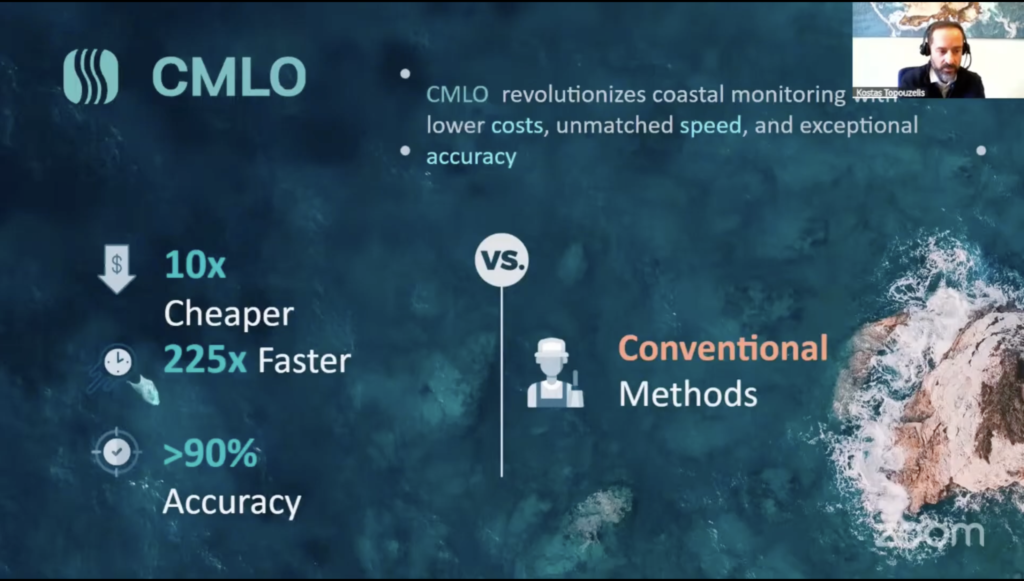
Topouzelis explained that the biggest barrier is not technology but the lack of clear mandates for coastal litter mapping, which makes local authorities reluctant to pay even when they see the value. As a result, early adopters have often been NGOs, international projects and organisations that must report on plastic baselines for grants or Mission commitments.
Compressing Microplastic Analysis From Days to Minutes
Abhilash Venkateshaiah introduced Scout, an AI‑driven microplastic analyser developed by Eden Tech to automate what is traditionally a slow, expert‑heavy laboratory workflow.
Standard microplastic analysis can require several days,sampling, density separation, chemical digestion, filtration, drying, manual spectroscopy and manual reporting, making routine monitoring expensive and hard to scale for water utilities and regulators. Tightening rules on microplastics in drinking water and producer responsibility are increasing demand, but many labs lack capacity.
Scout combines near‑infrared spectroscopy with two machine‑learning models, one to detect microplastics among mixed organic and inorganic particles on a 47 mm filter, and one to classify them into up to 20 polymer families.
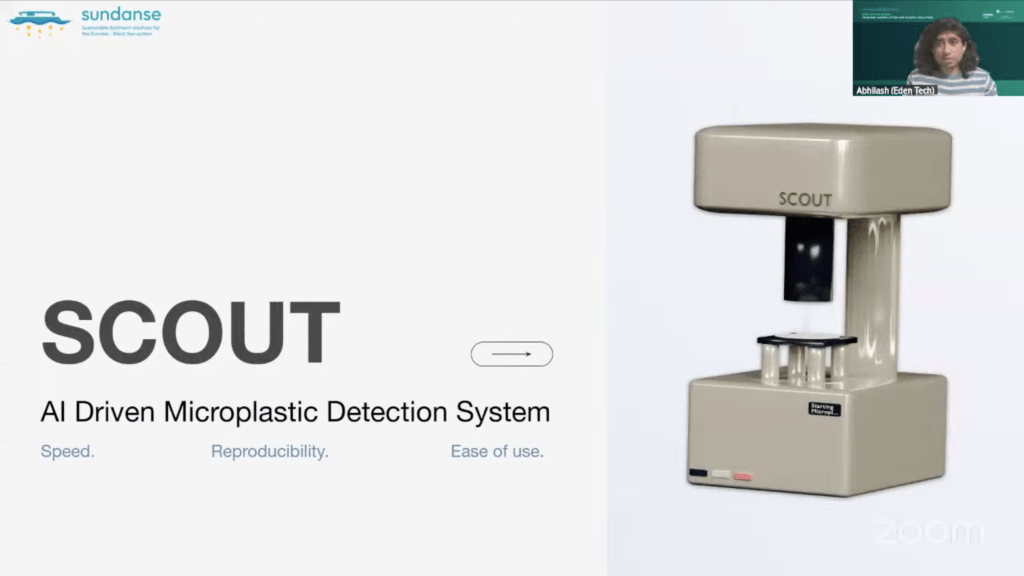
According to Venkateshaiah, the system can:
- Analyse a full filter down to 20 microns in roughly 10 minutes, including particle detection, spectroscopy and automated reporting.
- Process tens of thousands of particles per run at millisecond‑scale acquisition times.
- Provide particle size, shape, colour and polymer‑type statistics in ready‑to‑use reports for authorities, researchers or industry.
This kind of automation could make it realistic for cities, utilities and aquaculture operators in the Mediterranean to integrate microplastic monitoring into regular water‑quality checks, rather than one‑off research campaigns.
From Pilots to Policy, Business Models and Mission Impact
Moderator Uroš Novak positioned both solutions within broader Mission Ocean Lighthouse projects: REMEDIES in the Mediterranean and PHAROS across the Atlantic and Arctic, each tasked with tackling plastic pollution, restoring ecosystems and enabling circular blue economies by 2030.
Novak and Kokkinakis highlighted that for services like CMLO and Scout to scale, incentives must come from:
- Regulation that requires systematic litter and microplastic monitoring (e.g., for beaches, ports, drinking water, aquaculture sites).
- Funding programmes that pay for baseline and follow‑up measurements as part of restoration and circular business pilots.
- Citizen‑ and fisher‑led schemes, such as PHAROS’s Citizen Litter Entrepreneur and Fisher Guardian programmes, which need robust data to prove their impact and attract investment.
Entrepreneurial pathways: Both speakers described using EU‑funded R&D projects and round‑robin validation studies as stepping stones to secure non‑dilutive funding and early lighthouse customers, before moving to broader commercial markets. This mirrors PHAROS’s own strategy of building business cases and investor brokerage events around its demonstrations in Gran Canaria, Ireland and Iceland.
Implementation, Pilots and Real‑World Use Case
Mediterranean and beyond: SciDrones’ CMLO has already been deployed in at least 15 countries, including intensive surveys in Greece and Honduras, covering hundreds of kilometres of coastline and millions of detected litter items, with plastics as the dominant category. These pilots show how quickly hotspots, river mouths, urban beaches, tourist zones, can be mapped to guide targeted clean‑ups and policy measures.
Microplastic validation pipelines: Eden Tech has validated Scout on real marine and freshwater samples from French oceanographic institutes and from the Danube River under the SUNDANSE project, as well as in collaboration with water utilities and industrial partners. By training its AI models on certified open spectral libraries and continuously expanding its dataset, the company aims to reach smaller particle sizes (down to 5 microns) and broader polymer coverage in future updates.
The Q&A Session
The final part of the webinar moved into an open Q&A, where participants dug into the hardest technical problems, validation, regulation and the business reality behind ocean monitoring tools like CMLO and Scout.
Technical Challenges in Detection
Uroš Novak opened by asking both founders about their most challenging technical problems and who they are really building for. Abhilash Venkateshaiah explained that Scout had to learn to find microplastics inside messy, mixed samples containing plastics, organics, inorganics and even wood, without relying on the usual 24–48 hours of chemical digestion. Thanks to AI and near‑infrared spectroscopy, Scout can now pick out microplastics directly on standard filters, sharply cutting preprocessing and analysis time, and making the workflow simple enough for public authorities, industry labs and universities rather than only specialist research facilities.
Konstantinos “Kostas” Topouzelis described a similar journey on the macro‑side: his team began years ago manually examining hundreds or thousands of drone images before gradually building algorithms and then fully AI‑driven detection models over a five‑year period. The remaining bottleneck was data acquisition, which they solved by defining a very simple flying protocol that works with off‑the‑shelf drones; today CMLO is used by researchers, local authorities, NGOs and cleaning or tourism companies to map coastal litter quickly and at scale. Costas also clarified what “marine litter” means in this context: human‑made materials that have spent time at sea and then wash ashore, spanning plastics, rubber, treated or man‑made wood, ceramics and glass.
From Validation to EU Protocols
Asked whether their AI‑based methods should become part of EU legislation, Costas stressed that CMLO already produces coastline‑scale evidence that can be used to test whether existing policies are actually reducing pollution. To validate the system, his team runs controlled experiments with 1 m × 1 m test grids where the exact number and type of items are known, then compares ground truth with what the drones and AI detect, building a robust accuracy benchmark that regulators can trust.
Abhilash outlined a different validation pathway for Scout: during its 1.5‑year development the team has relied on real samples from project partners, round‑robin laboratory studies and certified open data to benchmark performance, with results being shared through open‑access publications while the system remains in a pre‑commercial EU‑project phase. Looking ahead, he flagged a key tension for legislation and open science: once the instrument is commercialised, customers become the data generators and owners, so sharing aggregated datasets for public benefit may become harder unless it is built into future contracts or regulations.
Markets, Mandates and Who pays
A question from the YouTube audience chat challenged Costas to name the investors and markets behind marine litter monitoring. He said his team sees four clear customer groups, local governments, NGOs, large institutions and cleaning/tourism companies, and that, while everyone agrees they need high‑quality litter maps, very few are willing to pay without a legal obligation to do so. The root problem, in his view, is the absence of a strong, operational mandate that requires coastal litter mapping, meaning local authorities struggle to justify dedicated budgets even when the technology is ready.
Today, most paid work comes from large NGOs and institutions that are already committed to beach cleaning and want to document impact, while the company itself is deliberately pursuing a modest, sustainable business path that prioritises community benefit over short‑term profit. In the long run, Costas hopes CMLO data will underpin global‑level reporting for UN SDG 14.1b on marine litter, giving policymakers a consistent way to track progress. Moderator Uroš Novak noted that this “who pays?” dilemma affects both tools presented in the session: they are designed for researchers, projects and cities, but the funding mechanism is ultimately a systemic policy question rather than something a single innovation project can solve.
Sources, Rivers and Applications
In the final Q&A, the discussion turned to whether Scout could help trace microplastics back to their sources and what the team is learning from work on Danube River pollution. Abhilash began to explain how combining high‑throughput microplastic analysis with real‑world monitoring campaigns could, in principle, help identify hotspots and dominant pollution pathways along major rivers.